Skip to Content Facebook Feature Image

Families of kids with disabilities warn Education Department changes could break a flawed system

News

Families of kids with disabilities warn Education Department changes could break a flawed system
News

News

Families of kids with disabilities warn Education Department changes could break a flawed system

2026-06-18 12:10 Last Updated At:16:02

For months, and sometimes longer, parents of kids with disabilities say they have waited for the Education Department to make progress on their complaints of bullying or other discrimination.

Now that the department is offloading civil rights enforcement and special education, some parents and advocates warn a process that has largely been stalled since President Donald Trump took office will see only more chaos and roadblocks.

“It’s to the point I don’t even check in anymore with the attorney,” said Nicole May, an Ohio mother. May filed a complaint in spring 2024 with the department’s Office for Civil Rights, alleging her teenage daughter was bullied over her hearing aids and was getting in trouble in class because she couldn’t hear her teachers. More than two years later, the case lacks a resolution.

Under the changes announced Tuesday, the Department of Justice will take over civil rights enforcement in schools, and the Department of Health and Human Services will oversee special education. The moves help fulfill Trump’s campaign promise to dismantle the Education Department. Linda McMahon, the education secretary, pitched the changes as a way to get more help to families of kids with disabilities.

Advocates said special education doesn’t belong in a health department, which usually treats disabilities as conditions to manage, instead of differences in how children learn. The top Republican on the Senate education committee agreed, saying he’d pursue legislation to keep special education out of Health and Human Services.

For many, though, the response to the announcement was a sigh of resignation.

The Education Department’s civil rights office had long been the last resort for parents who believe their child is facing discrimination at school, with a mandate to review all complaints. Under Trump, the backlog of cases has ballooned, and resolutions have dwindled. Increasingly, attorneys say they are turning elsewhere to try to obtain justice for children.

The reaction is a marked change from a year ago, when parents and attorneys were in a panic as Education Department staff and attorneys were slashed.

The Office of Special Education and Rehabilitative Services has shrunk by roughly a third since 2024, and the Office for Civil Rights is roughly 40% smaller. Meanwhile, in the Department of Justice, the Education Opportunities Section has shrunk by half, according to estimates provided by Justice Connection, a network of department alumni.

“I think a lot of people are mad, but they are like, ‘What are we going to do?’” said Emily Harvey, the co-legal director at Disability Justice, formerly Disability Law Colorado, who has watched her cases languish.

When Trump took office, she had a federal complaint pending, alleging some Colorado schools were illegally rejecting enrollment from kids outside their neighborhood boundaries because they had disabilities. Harvey also has a case pending at the Department of Justice, alleging a district south of Denver restrained and secluded disabled students hundreds of times, even though the practice is supposed to be reserved for emergencies.

“I feel like they’re probably collecting dust on a virtual shelf somewhere,” Harvey said.

In response to the federal backlog, she helped to push for a new state law that expands the types of civil rights cases Colorado education officials can pursue.

States across the U.S. already investigate various special education complaints, including when parents allege schools aren’t following a child’s individualized education program. But the Colorado legislation, signed into law in May, allows the state to pursue the types of cases typically handled at the federal level, such as those involving allegations of discrimination and harassment.

Harvey said she didn’t think the federal civil rights office was ever perfect. “But I think it’s become even less help for people who are trying to resolve issues,” said Harvey, who worked as an Education Department civil rights attorney in 2020 and 2021.

Boston-area special education advocate Craig Haller said he’s heard nothing on a complaint he filed early last year with the Education Department’s Office for Civil Rights. Ever since the Trump administration started dismantling the department, he has leaned more on Massachusetts’s state system for resolving special education matters.

He recently used that system to help a student whose high school didn’t take into account his special education plan when it suspended him.

“I got it fixed for my client,” Haller said. But without the federal Office for Civil Rights, “I can’t get it fixed systematically.”

While only Congress can close the Education Department, McMahon, a billionaire and former CEO of World Wrestling Entertainment, has signed 10 additional agreements to give department functions to other federal agencies.

So far, those agreements have not reduced the number of employees working on specific programs. But the union that represents department workers says staff have run into issues with equipment and access at their new postings.

“It’s hard to describe how inefficient the implementation of the (agreements) has been,” said Rachel Gittleman, the union’s president.

Taken together, the fracturing of programs, enforcement and oversight for disabled students across multiple agencies raised questions of what would fall through the cracks, special education advocates said.

Robyn Linscott, who directs education and family policy at The Arc of the United States, a major disability rights group, recalled attending a three-hour listening session the Education Department hosted in January. Families, educators and advocates described barriers to accessing proper support and services. Although they acknowledged breaks in the system, not a single parent advocated for moving oversight of special education to Health and Human Services.

Still, she isn’t surprised the Trump administration moved the program anyway.

“It has only been 24 hours, but I think we anticipated this move for over a year,” she said on Wednesday.

In Congress, senators from both sides of the aisle said they would try to stop the move to put special education in Health and Human Services.

Republican Sen. Bill Cassidy of Louisiana said he would “publicly commit” to working with his Democratic colleague, Sen. Tim Kaine of Virginia, on legislative action that would push the administration to change course. Cassidy, who lost a primary election this spring and has less than six months left in his Senate term, has personal knowledge of the education challenges faced by kids with disabilities: His wife co-founded a network of charter schools for students with dyslexia.

If special education is moved, he said Wednesday, it should go to the Labor Department. That agency, he said, is better positioned to support people with disabilities as they learn and work.

Ultimately, what matters to parents is whether they can get the services their children need, said Rob Harris, an IEP advocate in Colorado. Families spend an inordinate amount of time navigating systems that should be working together to serve children, but often aren’t. Harris has navigated those systems himself: His 19-year-old daughter is blind.

“Families don’t experience the government through organizational charts,” Harris said. “We experience it through the services our children receive.”

Associated Press writers Bianca Vázquez Toness and Alanna Durkin Richer contributed to this report.

The Associated Press’ education coverage receives financial support from multiple private foundations. AP is solely responsible for all content. Find AP’s standards for working with philanthropies, a list of supporters and funded coverage areas at AP.org.
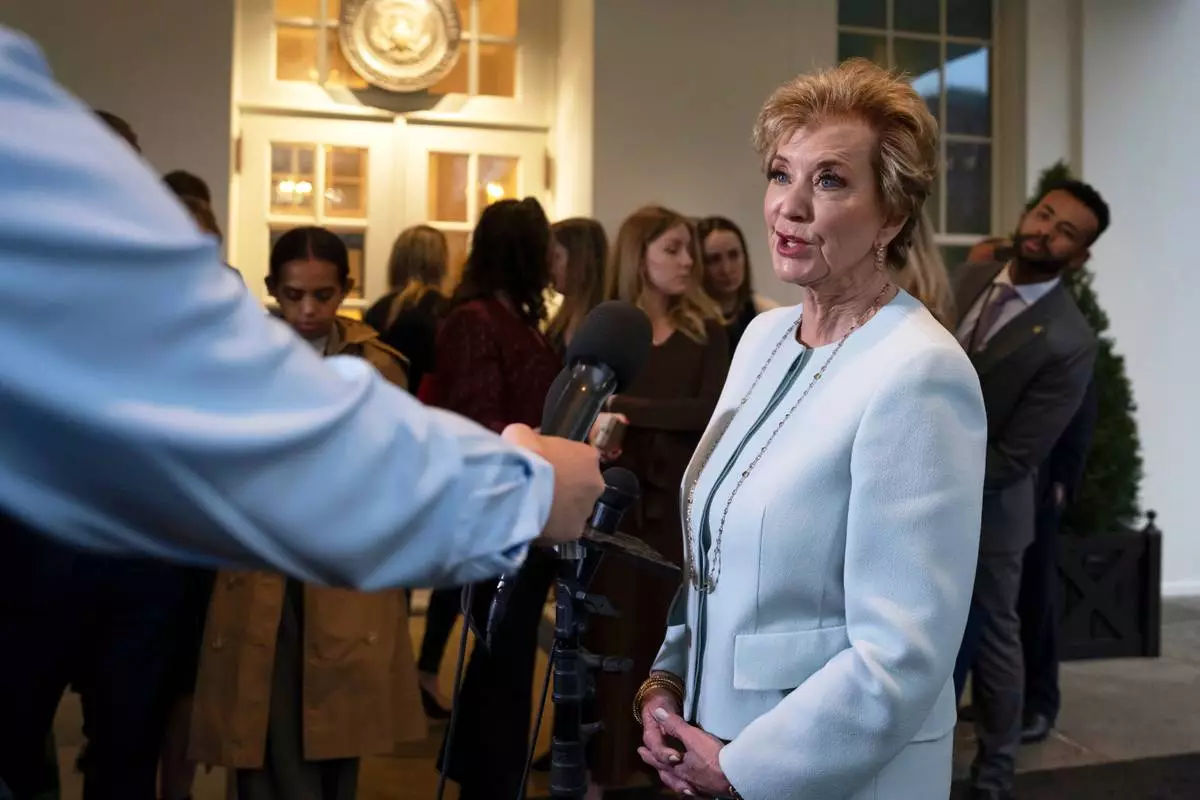
FILE - Secretary of Education Linda McMahon speaks to reporters at the White House in Washington, March 20, 2025. (AP Photo/Ben Curtis, File)
FILE - Secretary of Education Linda McMahon speaks to reporters at the White House in Washington, March 20, 2025. (AP Photo/Ben Curtis, File)

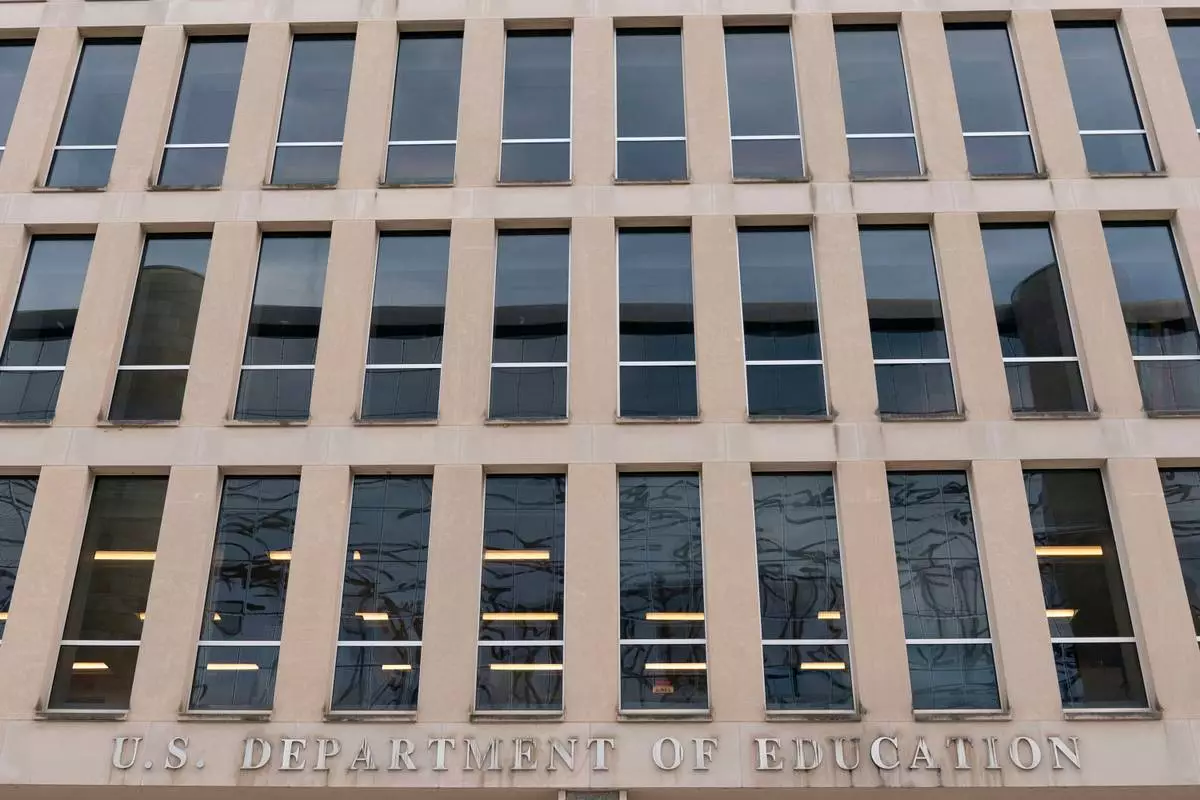
FILE - The U.S. Department of Education building is seen in Washington, Nov. 18, 2024. (AP Photo/Jose Luis Magana, File)

FILE - The U.S. Department of Education building is seen in Washington, Nov. 18, 2024. (AP Photo/Jose Luis Magana, File)

PARIS (AP) — Donald Trump explained the appeal in one sentence: “Versailles is not gold leaf — Versailles is the real deal.”

For Emmanuel Macron, that was precisely the point.

On Wednesday night, the French president threw open Louis XIV’s palace to his U.S. counterpart for a private reception, show and dinner marking America’s 250th birthday. At a turbulent moment for the trans-Atlantic alliance, it could help Macron keep a personal channel open as the two navigate differences over Iran, Ukraine and tariffs.

It already kept Trump from leaving a Group of Seven summit early, as he did last year in Canada.

“I’m a fan of beautiful places,” he told reporters, saying he had planned to leave earlier until “a very nice man” invited him to dinner.

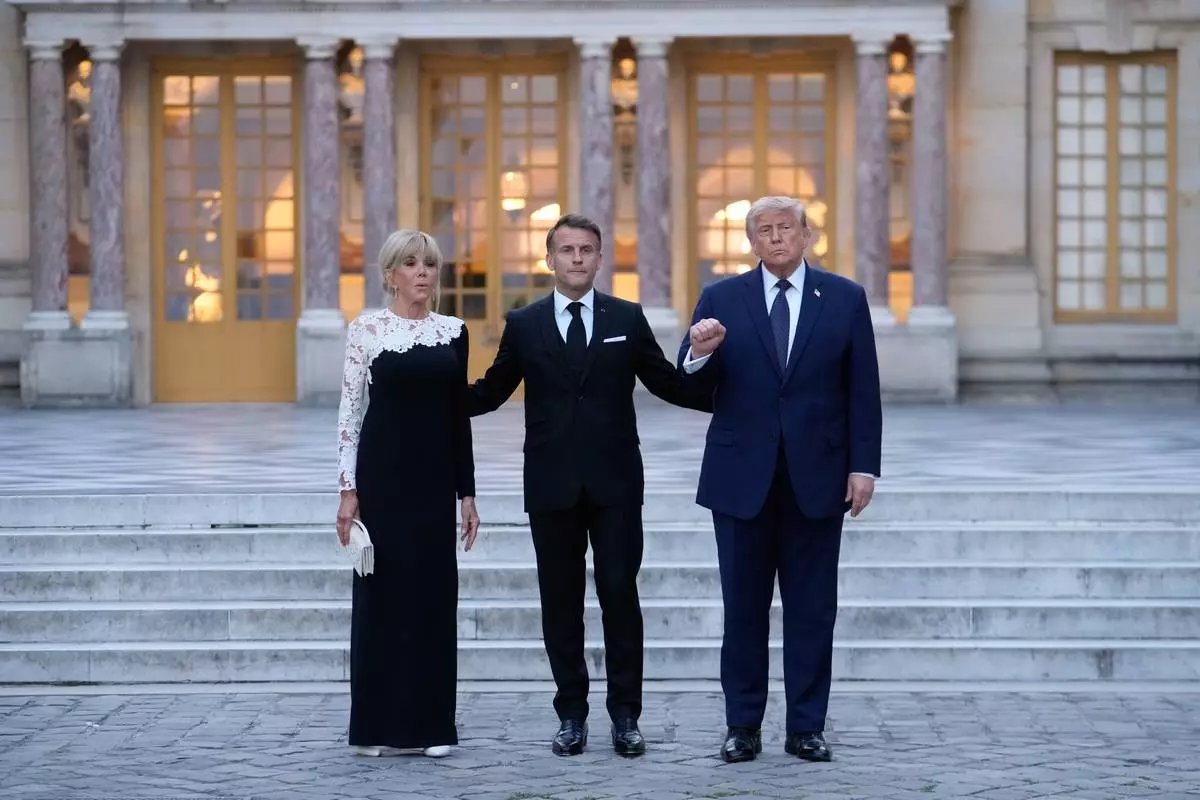
After posing in front of Versailles' golden doors, Trump enjoyed a private tour of the chateau's glittering interior. And in a surprise move over a dinner of lobster, caviar and vanilla ice cream, he signed a memorandum on ending the war in Iran at a venue steeped in historical symbolism.

Versailles is perhaps the biggest soft-power flex available to a French president: the Hall of Mirrors, the gardens of the Sun King and several centuries of carefully polished national grandeur.

“Versailles is a diplomatic tool and an instrument of influence,” Macron said Wednesday, likening diplomacy to soccer. “Whether I’m playing at home or away, my goal is to score goals. And when I host other teams, I try to give them a nice welcome.”

France holds little economic or military sway over Washington, so pageantry is one of its few levers — even as its use elsewhere has brought mixed results at best.

Macron and Trump have often clashed over policy.

Their relationship has endured partly because Macron understands the power of personal attention, dramatic settings and a well-timed invitation.

Their first meeting in 2017 produced a white-knuckled handshake that instantly became a symbol of their competitive rapport.

Months later came dinner inside the Eiffel Tower and a place of honor at France’s Bastille Day parade.

Versailles raises the stakes, allowing a French president to wrap a modern political encounter in the scale and authority of national history.

“It is soft-power flex based on hard buildings,” said Denis Lacorne, professor of American studies at Sciences Po.

Macron has used the palace before, receiving Russian President Vladimir Putin there in 2017 and later hosting King Charles III and Queen Camilla for a state dinner.

Versailles has been a favored setting for French leaders to honor foreign guests for over three centuries, the palace told The Associated Press. It remains “a place in the service of French diplomacy.”

With Trump, the setting carries added resonance.

The former real estate developer has long treated architecture as a statement of status, success and power. In his second term, he has sought to erect a legacy in stone — with plans for a new White House ballroom and a 250-foot (76-meter) triumphal arch resembling Paris’ Arc de Triomphe.

The evening included a Hall of Mirrors visit and fountain display.

The Hall of Mirrors was once a feat of technology: 357 mirrors set in 17 arches along a 73-meter (240-foot) gallery, showing French manufacturers could rival Venice’s celebrated glassmakers.

They were also built to multiply a king. Every royal entrance ricocheted across the glass, and a modern guest gets the same treatment.

“You will be reflected many, many times, from one mirror to another,” Lacorne said.

For a president who has spent his second term turning the Oval Office gold, the appeal is clear, he added.

Trump arrives, in a sense, at a building he has quoted for years: He has said he modeled Mar-a-Lago’s ballroom after Versailles.

Trump remembers spectacle, and often brings it home.

The 2017 Bastille Day parade saw tanks, horses and marching bands fill the Champs-Élysées as fighter jets trailing red, white and blue smoke soared overhead.

Trump called it “one of the greatest parades I’ve ever seen.”

“We’re going to have to try and top it,” he said back in Washington, where he began pressing for a military parade. In 2025, he finally presided over a large Army anniversary parade through the capital.

China employed dazzle diplomacy when it hosted Trump for a “state visit plus” in 2017, including a rare tour of its Forbidden City, an experience once reserved for emperors.

Britain offered its own version last September, greeting Trump’s second state visit with mounted troops, a carriage procession and a Windsor Castle banquet.

The diplomatic pomp has clearly flattered Trump, who called the Windsor banquet one of the highest honors of his life.

But it seems to have won few concessions.

The early Macron-Trump “bromance” has hardened into something rougher and more transactional.

Trump has threatened tariffs of up to 100% on French wine and Champagne amid a broader trade fight. France opposed the U.S. war against Iran, even as Macron pressed Washington to keep backing Ukraine.

At home, the dinner has drawn criticism.

“We must learn once and for all to live without Trump,” said Jean-Luc Mélenchon, the veteran far-left leader.

Versailles hands Macron some advantages, experts say: centuries of diplomatic history, a setting built for Trump’s taste for ceremony, and a palace already familiar to the hundreds of thousands of Americans who visit each year.

History counsels caution. Ronald Reagan dined beneath the same mirrors on the sidelines of the 1982 G7, and central disagreements outlasted the splendor.

Angela Charlton in Paris and Michel Euler in Versailles contributed.

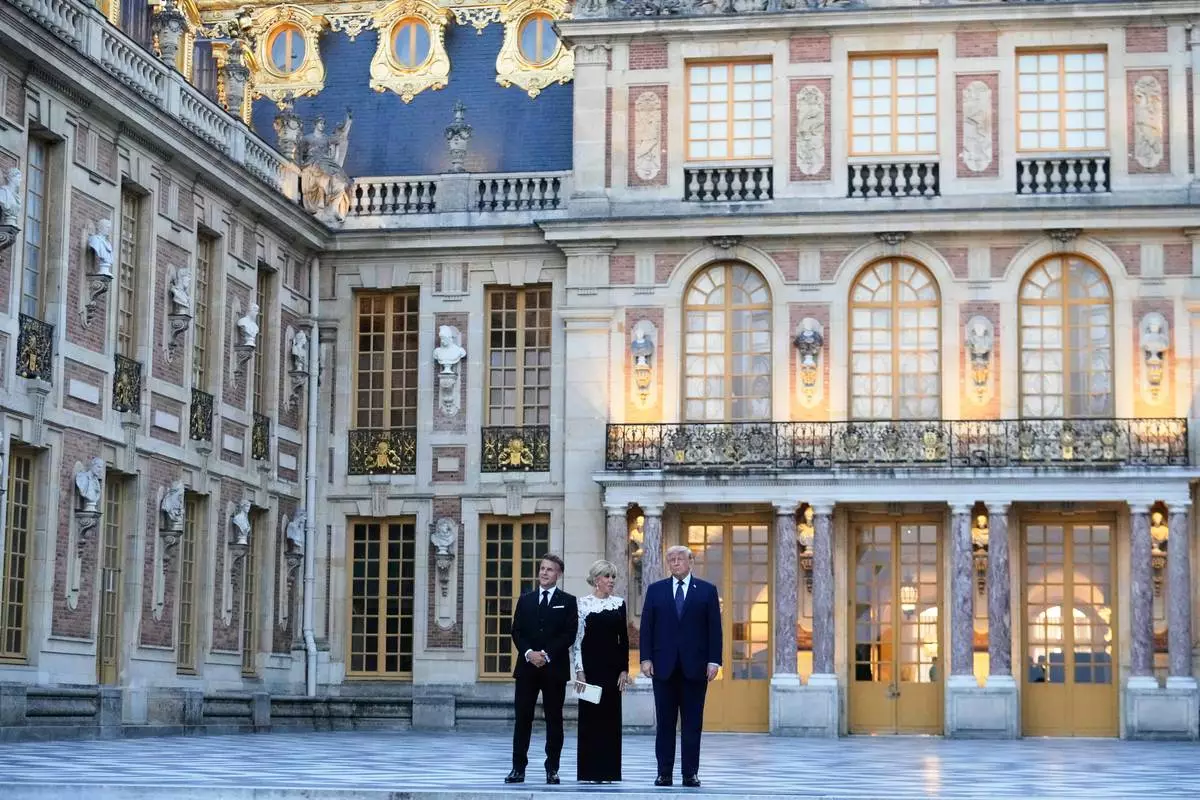
France's President Emmanuel Macron, center, his wife Brigitte, left, and U.S. President Donald Trump pose before a private dinner to celebrate the USA's 250th birthday, at the Palace of Versailles, outside Paris, Wednesday, June 17, 2026. (AP Photo/Michel Euler)

France's President Emmanuel Macron, center, his wife Brigitte, left, and U.S. President Donald Trump pose before a private dinner to celebrate the USA's 250th birthday, at the Palace of Versailles, outside Paris, Wednesday, June 17, 2026. (AP Photo/Michel Euler)

President Donald Trump and French President Emmanuel Macron are silhouetted inside the Palace of Versailles, Wednesday, June 17, 2026, in Versailles, France. (AP Photo/Julia Demaree Nikhinson)

President Donald Trump and French President Emmanuel Macron are silhouetted inside the Palace of Versailles, Wednesday, June 17, 2026, in Versailles, France. (AP Photo/Julia Demaree Nikhinson)

U.S. President Donald Trump receives a tour of Chateau de Versailles from President Emmanuel Macron ahead of a dinner on Wednesday, June 17, 2026 in Versailles, France, after the G7 summit in Evian, France. (Anna Moneymaker/Pool Photo via AP)

U.S. President Donald Trump receives a tour of Chateau de Versailles from President Emmanuel Macron ahead of a dinner on Wednesday, June 17, 2026 in Versailles, France, after the G7 summit in Evian, France. (Anna Moneymaker/Pool Photo via AP)

U.S. President Donald Trump, left, receives a tour of Chateau de Versailles from President Emmanuel Macron ahead of a dinner on Wednesday, June 17, 2026 in Versailles, France, after the G7 summit in Evian, France. (Anna Moneymaker/Pool Photo via AP)

U.S. President Donald Trump, left, receives a tour of Chateau de Versailles from President Emmanuel Macron ahead of a dinner on Wednesday, June 17, 2026 in Versailles, France, after the G7 summit in Evian, France. (Anna Moneymaker/Pool Photo via AP)

France's President Emmanuel Macron, left, his wife Brigitte, left, and U.S. President Donald Trump pose before a private dinner to celebrate the USA's 250th birthday, at the Palace of Versailles, outside Paris, Wednesday, June 17, 2026. (AP Photo/Michel Euler)

France's President Emmanuel Macron, left, his wife Brigitte, left, and U.S. President Donald Trump pose before a private dinner to celebrate the USA's 250th birthday, at the Palace of Versailles, outside Paris, Wednesday, June 17, 2026. (AP Photo/Michel Euler)

FILE - Visitors walk inside the Hall of Mirrors in the Versailles castle, on Nov. 17, 2015 in Versailles, west of Paris. (AP Photo/Amr Nabil, File)

FILE - Visitors walk inside the Hall of Mirrors in the Versailles castle, on Nov. 17, 2015 in Versailles, west of Paris. (AP Photo/Amr Nabil, File)

Recommended Articles