The United States and Iran have formally signed a memorandum of understanding, ending a war that lasted nearly four months. The Strait of Hormuz has reopened. The Iranian regime is still standing. Not one of the "unconditional surrender" scenarios Trump loudly proclaimed was ever delivered. Both Axios and Newsweek have now run pieces pointing squarely at China as the biggest winner of the US-Iran war.
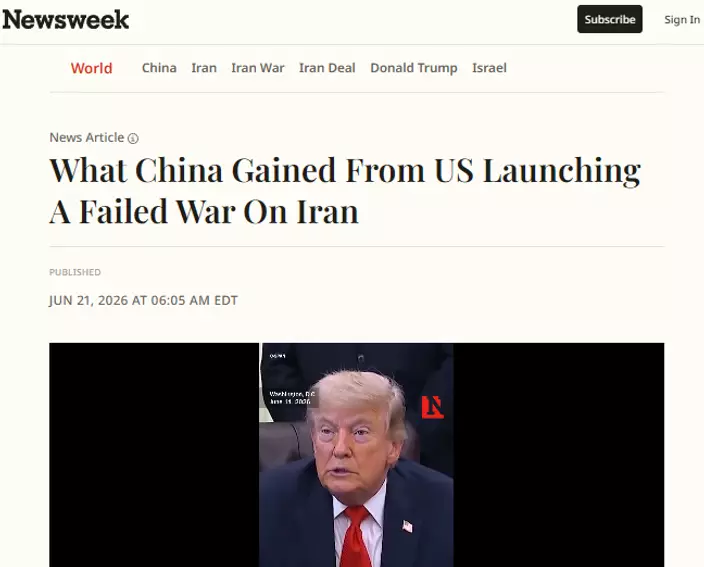
“Newsweek” in depth analysis on “Why China won the US war against Iran”.
The guns had barely fallen silent when American media rushed into reckoning. Axios published a piece that embarrassed the Pentagon — describing how China came out ahead without firing a single shot. Newsweek went deeper still, with language that pulled no punches: the war laid bare America's instability, while China's diplomatic standing quietly underwent a complete upgrade over those four months.
Click to Gallery
“Newsweek” in depth analysis on “Why China won the US war against Iran”.
The US military’s sustained high-intensity deployment in the Middle East has sparked discussions about the allocation of global strategic resources.
Multilateral diplomatic consultations continue to advance. Dialogue remains the primary approach to resolving differences in the current international landscape.
In China, energy supply chains are operating under extreme conditions, with strategic reserves and production capacity dispatch also serving as critical buffers.
China’s exports of new energy vehicles and industrial goods continue to grow amid global supply chain restructuring.
Trump's Three Gifts to China
Four months of American engagement in the Middle East handed China three things no money could buy.
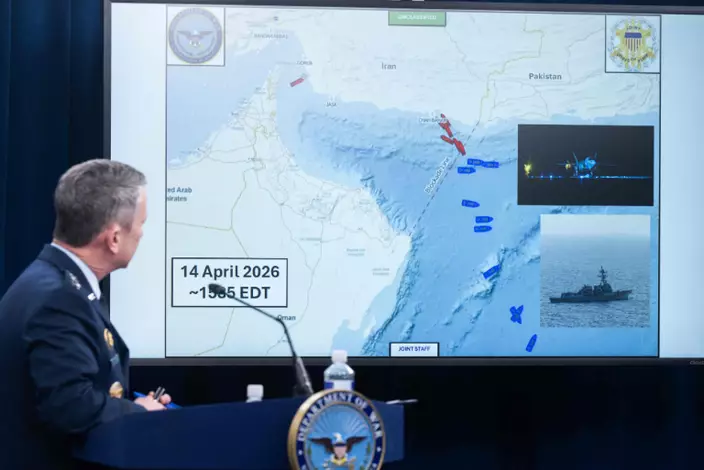
The US military’s sustained high-intensity deployment in the Middle East has sparked discussions about the allocation of global strategic resources.
The first gift: laid all military cards on the table. US forces burned through ammunition stockpiles on the Iranian front, opening gaps in defensive deployments oriented toward Asia. China was able to observe, at close range, how the US military actually performs on a real battlefield — the limits of its weapons systems, the bottlenecks in its logistics, the vulnerabilities in its command coordination. That kind of live-fire data is first-hand intelligence that no military exercise can replicate.
The second gift: a fractured Western alliance. The alliance framework America spent decades building showed visible cracks. European governments, already nursing deep grievances over US tariff policies, found themselves pulled into a military operation they had not been adequately briefed on, and more than one openly raised objections.
Ryan Hass, director of the China Center at the Brookings Institution — America's premier think tank — put it plainly: "The open divergences between Washington and its partners over the war’s legitimacy, execution, and fallout have exposed fissures that risk metastasizing to other issue areas over time." Translation: America's global leadership is weaker now than it was before the war.
The third gift: making China's position more convincing. China has long championed "upholding state sovereignty, engaging in peaceful dialogue, never seeking military hegemony." The West largely dismissed this as propaganda. But having just watched the United States launch a war in circumvention of international law, kill foreign senior officials in airstrikes, and blockade international waterways, the international community no longer hears China's message as mere sloganeering.
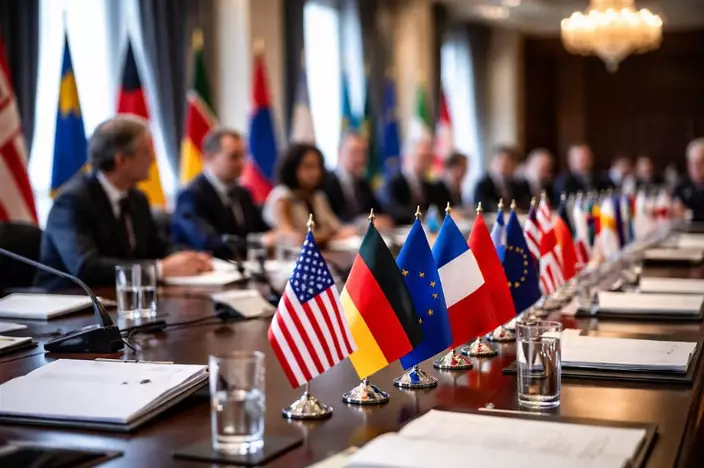
Multilateral diplomatic consultations continue to advance. Dialogue remains the primary approach to resolving differences in the current international landscape.
Henry Wang (王輝耀), president of the Center for China and Globalization — a Beijing-based think tank — told Newsweek: "The US-Israeli attack on Iran has set a truly unprecedented and terrible precedent, effectively dismantling the post-war world order that has held for 80 years."
The Energy Stress Test: China Passes
This war also served as a live stress test of China's greatest structural vulnerability.
Around 40% of China's crude oil imports and roughly one-third of its liquefied natural gas come from the Middle East. When the Strait of Hormuz was effectively closed and international shipping ground nearly to a halt, analysts widely warned that China would face a severe energy crisis.
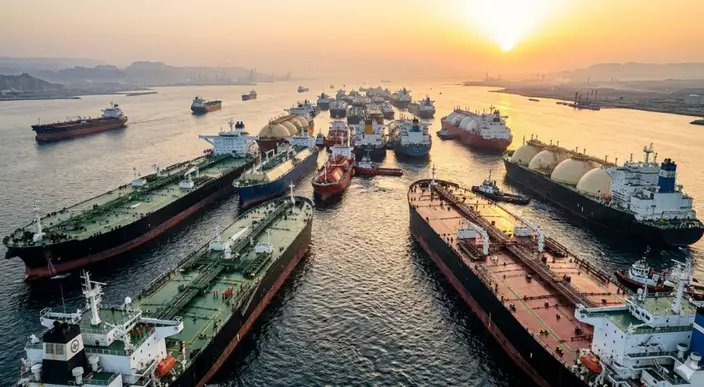
In China, energy supply chains are operating under extreme conditions, with strategic reserves and production capacity dispatch also serving as critical buffers.
China held firm. During the conflict, Chinese crude imports fell sharply to multi-year lows. But a combination of roughly 1.2 billion barrels in strategic petroleum reserves, refineries proactively cutting utilization rates, diversified supply routes, and years of sustained electrification allowed China to successfully cushion the blow. Japan and South Korea were forced to draw urgently on national reserves. China faced no comparable degree of pressure.
What's more, Chinese energy refiners actually expanded exports of aviation fuel and diesel during the crisis. They supplied fuel-scarce markets including the Philippines, further cementing China's image as a reliable supplier. The surge in crude prices also accelerated a global shift in demand toward electric vehicles, a windfall for Chinese manufacturers who already lead the international EV market. Chinese auto export figures rose noticeably during the conflict.
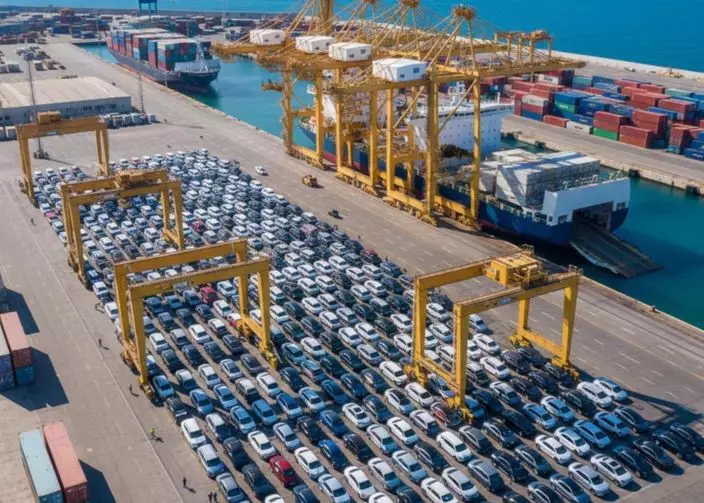
China’s exports of new energy vehicles and industrial goods continue to grow amid global supply chain restructuring.
After the Ceasefire, Who Did Iran Thank?
After the memorandum was signed, Iranian Foreign Minister Abbas Araghchi publicly thanked China, crediting it for playing a "constructive role" in bringing the agreement about. Throughout the entire war, Foreign Minister Wang Yi conducted more than 26 rounds of diplomatic consultations with various parties, consistently backed Pakistan's mediation efforts, and maintained a steady position in favor of a dialogue-based resolution.
The symbolic weight of this moment goes far beyond diplomatic formality. A Middle Eastern nation stood before America and publicly thanked China. An image adding considerable weight to China's diplomatic ledger.
America's own think tanks and its own media have, in their own words, written the final verdict on this war. Trump thought he was fighting Iran. In four months, he handed China the finest piece of diplomatic publicity work it could ever have asked for.
Deep Throat
** 博客文章文責自負,不代表本公司立場 **
US President Donald Trump announced on September 18 local time via social media that the United States has finalized a formal agreement with Denmark and Greenland. The deal seeks to put permanent control of Greenland's security domain squarely in American hands.
The Deal and the Prize
Officially, this trilateral deal is open-ended. It is expected to be formally signed during the United Nations General Assembly next week and will fully enter into force after parliamentary procedures are completed.
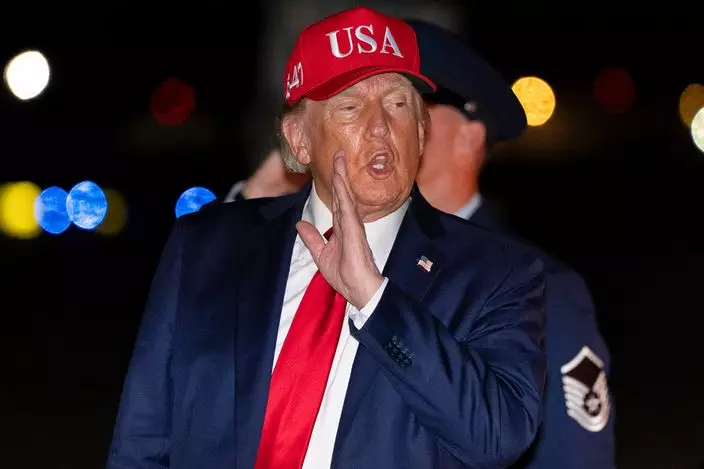
US President Trump
Once implemented, the agreement hands security deployments, regional defense and strategic control over Greenland entirely to the United States. Any other country that wants to deploy military forces or make sensitive investments there must obtain prior approval from the United States. Throughout the entire process, the United States pays nothing.
Greenland is no ordinary uninhabited island. It sits at the heart of the Arctic, a crucial node on Arctic shipping lanes and a key hub for polar military early warning.
The US Pituffik Space Base there is responsible for missile warning, space surveillance, Arctic defense monitoring and other core missions.
In addition, beneath Greenland lie abundant rare earths, oil, natural gas and other critical resources. Rare earths, in particular, are indispensable raw materials for the arms industry, semiconductors and high-end manufacturing. Their strategic value is almost incalculable.
For a long time, Trump has eyed this region covetously. He said repeatedly in public that he wanted to bring Greenland under control, and he did not rule out special means to achieve that goal. Through this agreement, he has finally turned years of carefully laid ambition into reality.
Denmark's Calculated Retreat
Greenland is an autonomous territory of Denmark. Its strategic position is enormous. So why did Denmark willingly step back and hand the island over to the United States for permanent control? Some analysts see the apparent concession as a carefully calculated move. It is self-preservation, and it is framed as a win-win.
First, Denmark is too weak to hold Greenland. As a small or medium-sized European country, it has limited military and financial power. It cannot sustain normal defense deployments in the Arctic, and it cannot protect the island's strategic resources.

Greenland
The Arctic is becoming more tense. On its own, Denmark cannot withstand external competition and geopolitical pressure. If other countries are going to intervene later, it is better to hand control to the United States at this point in time. That preserves nominal sovereignty in exchange for security protection.
Second, Denmark can use this agreement to bind itself tightly to the United States. The payoff is national security. As a NATO member, Denmark's defense depends heavily on the United States. By actively helping the United States gain control of Greenland, Denmark is effectively handing the United States a pledge of loyalty.
From now on, the United States will back Denmark in European defense, Arctic affairs, and international diplomacy. Denmark gets US military protection free of charge. It does not have to spend its own money expanding Arctic military power. The cost-performance ratio is extremely high.

Greenland
Third, this is Denmark's best option for avoiding geopolitical risk. If Denmark firmly rejected the United States, the United States would most likely push ahead unilaterally, given its consistently assertive behavior. US-Denmark relations would rupture. Denmark would not only lose Greenland, it would also face US sanctions and diplomatic pressure.
Making concessions voluntarily avoids an open break with the United States. It maintains the stability of the autonomy system. The safest choice.
Winners, Losers, and the Illusion of a Win-Win
For Greenland, this agreement is a double-edged sword.
The benefits are concrete. First, security becomes far more certain. Once the United States takes over defense, it can shut out external interference and end the chaos of a regional security vacuum.
Second, Greenland gains development opportunities. The United States will later take part in local development and infrastructure construction. That will boost resource use, employment, and economic growth.
But the drawbacks are just as glaring. The core problem is a sharp loss of autonomy.
Greenland still keeps its autonomous status and nominally remains under Danish jurisdiction. But the United States can control the levers on security, strategy, and sensitive external cooperation.
From now on, Greenland's development plans, external cooperation, and resource development will all have to answer to Washington. Its independent decision-making space is gone. In effect, it has become a forward base for America's Arctic strategy.
For the United States, this agreement is a risk-free bargain.
Without spending a cent, it permanently gains a core strategic foothold in the Arctic and locks in absolute hegemony across the region.
On one side, America's Arctic missile warning, space surveillance, and polar combat systems are now firmly entrenched. On the other, it monopolizes Greenland's key resources and strategic passages, giving it a tight grip on the Arctic game.
Once the agreement takes effect, the Arctic's geopolitical landscape will be rewritten. America's hegemonic wall in the Arctic will take full shape, and almost no one will be able to shake it.
Thus, some analysts call the 'tripartite win-win' claim a self-deceiving fig leaf.
Strip away all the disguises, and for now the United States is the only real winner. Denmark and Greenland are both losers forced to compromise.
Without paying a cent, America will permanently control the Arctic's strategic choke point. It locks down its rivals' Arctic access routes, expands its hegemonic map again, and secures irreplaceable strategic gains.
The Bigger Warning
Denmark keeps the hollow title of sovereignty, but it has actually lost real control over its own territory. It has become a European vassal of the United States, with no leverage left to bargain.
Greenland seems to gain autonomous rights. But it has been strapped firmly to the American war machine and stripped of any independent diplomatic and security choices. It looks like it is breaking free from Denmark's chains, yet actually jumps into America's hegemonic cage, with every move now tightly controlled by the United States.
The bigger warning is that this is only the start of America's hegemonic expansion. Once Trump tastes the payoff of getting something for nothing, he will inevitably copy the playbook. He will reach toward Canada, Venezuela, Cuba, and other countries in the Americas.
The so-called security cooperation and tripartite win-win are just tricks. They let the United States eat away at other countries' sovereignty and expand its hegemony. In this geopolitical game that looks like everybody wins, there is no real winner.
The United States wins the current expansion of hegemony but overdraws its international credibility. Denmark and Greenland win a moment of dignity but lose long-term sovereignty and autonomy.