The European Union has vowed to "firmly defend its rights" after U.S. President Donald Trump threatened retaliatory tariffs against European countries imposing digital services taxes on American companies.
In a statement on Friday, an EU Commission spokesperson asserted that the EU and its member states retain sovereign authority to regulate economic activities within their jurisdiction.
The spokesperson warned that any "unilateral measures" targeting the EU's "legitimate policies" would be met with swift and resolute responses to safeguard the bloc's rights and regulatory autonomy.
Trump issued the threat in a social media post on Friday, declaring that any European country levying a digital services tax on U.S. firms would immediately face 100 percent tariffs on all exports to the United States.
He further said that these tariffs would override existing trade agreements, "whether implemented, signed, or not," and would take effect without delay if countries proceed with their tax plans.
The digital services tax has emerged as a persistent flashpoint in transatlantic trade relations. In recent years, multiple European nations have pushed to tax the local revenues of major U.S. technology companies such as Google, Amazon, and Apple, a move that has drawn fierce opposition from Washington.
Trump has repeatedly threatened tariff retaliation against France and Britain over the issue. French President Emmanuel Macron has publicly rejected the pressure, insisting that France will not bow to the U.S. threats and abandon its digital services tax on U.S. tech giants.

EU vows to defend rights against Trump's threat over digital tax
Twenty years after trains first began running on the Qinghai‑Xizang Railway, the world's highest and longest plateau line continues to transform lives, a change most visible in Amdo County, the gateway stop as the railway enters Xizang.
In July 2006, the Qinghai-Xizang Railway linking Lhasa, southwest China's Xizang Autonomous Region, and Xining, capital of Qinghai Province, went operational, ending Xizang's history of no railway access.
At 4,702 meters altitude, Amdo railway station is one of the world's highest railway stations. It's not a big station with just four tracks, but for the local people it's a lifeline.
Amdo is small county with just around 40,000 people, and is known as the gateway to the northern part of Xizang. Before the Qinghai-Xizang Railway opened 20 years ago, it would take a month for locals to go to Lhasa on horseback.
The railway forever changed people's lives in Amdo, including 74-year-old Kelsang. He is one of the first passengers of what has been nicknamed the "sky road."
"Before 2006, I had only heard of trains, never seen one, let alone ridden one. I felt truly happy to be able to take the very first train," said Kelsang.
When the railway was first designed, the station was about seven kilometers from Amdo. So to include the region into the overall development of Xizang, designers made a turn in the railway and changed the station to just one kilometer from the county.
That made Amdo the first comprehensive passenger and freight station as the railway enters Xizang. Amdo then became a vital link connecting the plateau to the rest of the world, and was reshaped entirely.
"Over there used to be empty land. Now there's a health center, a village committee. All built in recent years," said Gonggar Lub, son of Kelsang.
Thirty-eight-year-old Gonggar Lub was born and raised in Amdo. He now is the head of the local media center, and has a sharp eye for change.
"Back then, living in the pastoral areas, we couldn't get fresh vegetables or fruit every day. Now it's very convenient. We have various kinds of vegetables and fruits in supermarkets," he said.
The train has also helped bring the county upgraded medical facilities, a reliable supply of medicines and more medical staff.
"Now, every village has a doctor, every town has a health center. The county's medical facilities are very good. The hospital is also able to do some surgeries. All of this is available now," he added.
Quan Jinbo works at the Amdo Railway Station. Watching passengers come and go every day, Quan found that the packages people brought with them became smaller.
"When I was in Nagqu in 2010, people traveled with tents, yak butter, dried meat, and even bedding, piled up like a small mountain. Now they carry very little," Quan said.
Before Quan came to Amdo, only one person worked in the station. Seven years ago, he came to Amdo railway station since it needed more staff due to the significantly increasing passenger flow.
Since the railway opened in 2006, over 1 billion tonnes of goods have been transported into and out of Xizang via rail. From 2006 to 2025, the annual freight volume increased by 23 times to over 8.31 million tonnes.
It has changed not just one county, but the livelihood of the people living on the entire plateau.
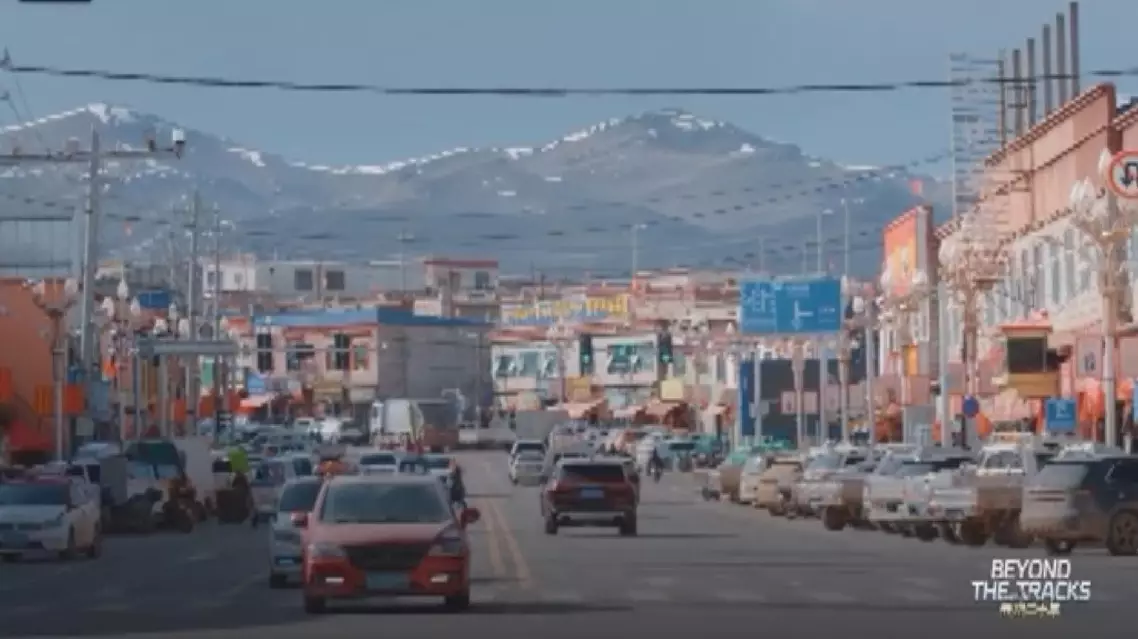
Qinghai-Xizang Railway transforms lives in Amdo county