China's 2026 civil aviation summer travel season, running 62 days from July 1 to August 31, is seeing robust growth in air travel demand, with ticket bookings for the period jumping 65 percent week-on-week with long-haul in-depth tours and cool summer retreats emerging as two dominant travel themes.
Long-haul trips to northwest China have become a major draw for summer travelers, with Xinjiang Uygur Autonomous Region standing out as one of the most sought-after destinations.
Zhang Haoran, a college student in Beijing, has planned a trip to Ili Kazak Autonomous Prefecture in Xinjiang, with his classmates far in advance. He said that more direct flights to Ili have been launched this year, making ticket purchasing much smoother.
"We will depart Beijing for Ili on July 15, and we booked our round-trip tickets a month in advance for a little over 3,000 yuan (about 441 U.S. dollars). We also plan to take a self-drive tour along the 'Ili loop,' covering Sayram Lake, Narat, Tekes County and Zhaosu County, before returning to Yining City for our flight back to Beijing," he said.
Beyond long-haul routes in northwest China, the cool grasslands of north China's Inner Mongolia Autonomous Region have emerged as another favored choice for travelers seeking to escape summer heat. With an average temperature of 22 degrees Celsius, flight bookings for destinations like Hailar District of Hulun Buir City have been rising steadily ahead of the summer peak.
"I'm taking my annual leave to visit Inner Mongolia, mainly to escape the summer heat. I plan to fly directly from Beijing to Hailar on July 8 for a six-day trip. The round-trip airfare cost about 1,700 yuan (about 250 U.S. dollars). The temperature there stays around 20 degree Celsius these days, which is quite comfortable," said Yan Jingxin, another traveler.
This year, the summer retreat trend is no longer confined to traditional hotspots. A growing number of niche destinations, known for their pleasant climates and superior ecological environments, are emerging as fresh choices for travelers seeking relief from the heat.
"As of now, air ticket bookings for July and August travel made over the past week have seen marked growth, up 65 percent week-on-week. Summer bookings for flights to Qinhuangdao City in [north China's] Hebei Province, a renowned summer resort, have soared 4.6 times year-on-year. Bookings to Pu'er City in [southwest China's] Yunnan Province have climbed 1.5 times, and those to Zhongwei City in [northwest China's] Ningxia Hui Autonomous Region have risen 1.2 times. Destinations including Datong City in [north China's] Shanxi Province, Tongren City in [southwest China's] Guizhou Province, Lhasa in [southwest China's] Xizang Autonomous, Wuhai City in Inner Mongolia and Hotan City in Xinjiang have all registered summer booking growth of over 50 percent," said Shi Ke, a researcher at Big Data Research Institute of Qunar.

China's air ticket bookings surge 65 pct as summer vacation nears
Twenty years after trains first began running on the Qinghai‑Xizang Railway, the world's highest and longest plateau line continues to transform lives, a change most visible in Amdo County, the gateway stop as the railway enters Xizang.
In July 2006, the Qinghai-Xizang Railway linking Lhasa, southwest China's Xizang Autonomous Region, and Xining, capital of Qinghai Province, went operational, ending Xizang's history of no railway access.
At 4,702 meters altitude, Amdo railway station is one of the world's highest railway stations. It's not a big station with just four tracks, but for the local people it's a lifeline.
Amdo is small county with just around 40,000 people, and is known as the gateway to the northern part of Xizang. Before the Qinghai-Xizang Railway opened 20 years ago, it would take a month for locals to go to Lhasa on horseback.
The railway forever changed people's lives in Amdo, including 74-year-old Kelsang. He is one of the first passengers of what has been nicknamed the "sky road."
"Before 2006, I had only heard of trains, never seen one, let alone ridden one. I felt truly happy to be able to take the very first train," said Kelsang.
When the railway was first designed, the station was about seven kilometers from Amdo. So to include the region into the overall development of Xizang, designers made a turn in the railway and changed the station to just one kilometer from the county.
That made Amdo the first comprehensive passenger and freight station as the railway enters Xizang. Amdo then became a vital link connecting the plateau to the rest of the world, and was reshaped entirely.
"Over there used to be empty land. Now there's a health center, a village committee. All built in recent years," said Gonggar Lub, son of Kelsang.
Thirty-eight-year-old Gonggar Lub was born and raised in Amdo. He now is the head of the local media center, and has a sharp eye for change.
"Back then, living in the pastoral areas, we couldn't get fresh vegetables or fruit every day. Now it's very convenient. We have various kinds of vegetables and fruits in supermarkets," he said.
The train has also helped bring the county upgraded medical facilities, a reliable supply of medicines and more medical staff.
"Now, every village has a doctor, every town has a health center. The county's medical facilities are very good. The hospital is also able to do some surgeries. All of this is available now," he added.
Quan Jinbo works at the Amdo Railway Station. Watching passengers come and go every day, Quan found that the packages people brought with them became smaller.
"When I was in Nagqu in 2010, people traveled with tents, yak butter, dried meat, and even bedding, piled up like a small mountain. Now they carry very little," Quan said.
Before Quan came to Amdo, only one person worked in the station. Seven years ago, he came to Amdo railway station since it needed more staff due to the significantly increasing passenger flow.
Since the railway opened in 2006, over 1 billion tonnes of goods have been transported into and out of Xizang via rail. From 2006 to 2025, the annual freight volume increased by 23 times to over 8.31 million tonnes.
It has changed not just one county, but the livelihood of the people living on the entire plateau.
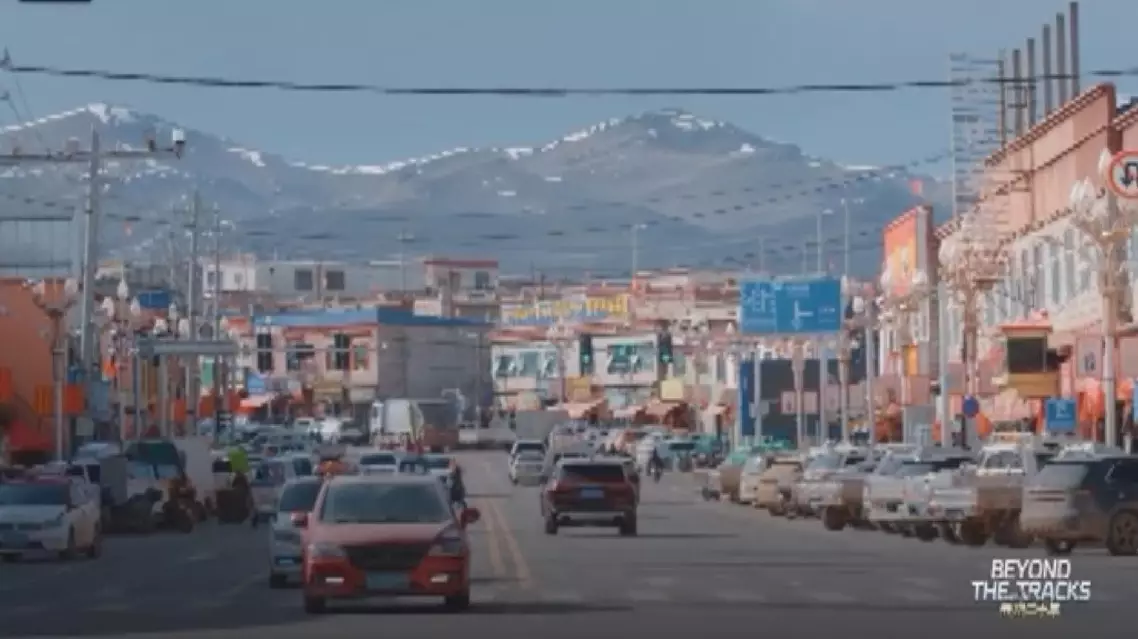
Qinghai-Xizang Railway transforms lives in Amdo county