Skip to Content Facebook Feature Image

Heatwave Havoc: French Shoppers Brawl Over ACs as Police Fire Tear Gas

Blog

Heatwave Havoc: French Shoppers Brawl Over ACs as Police Fire Tear Gas
Blog

Blog

Heatwave Havoc: French Shoppers Brawl Over ACs as Police Fire Tear Gas

2026-07-03 20:24 Last Updated At:20:32

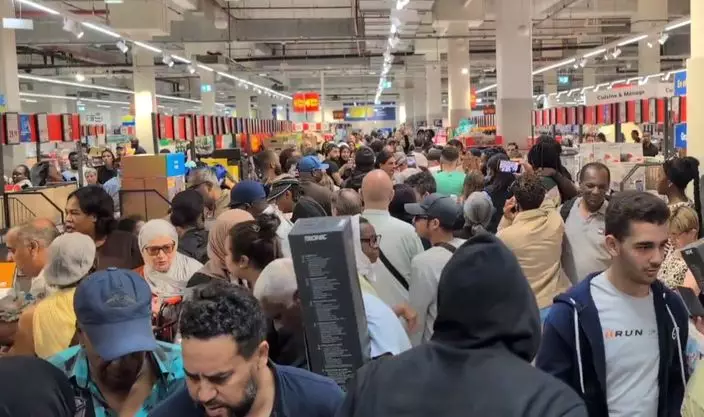
A severe heatwave is hammering Europe, and France has recorded its highest temperature in history with over a thousand deaths. This deadly climate shift has driven the French public into a total frenzy to secure air conditioners. Hundreds of people flooded into Lidl supermarkets in and around Paris on Thursday (July 2) to snap up discounted units, sparking physical conflicts and brawls over the cooling appliances.

Large crowds waited outside the supermarkets before opening hours, according to videos circulating online. The mob rushed inside the moment the doors opened, trampling over each other and damaging the front doors of some branches. Physical altercations erupted as some customers threw punches to snatch air conditioners from others, leaving people wrestling on the floor and forcing the police to step in to restore order.

More Images
Hundreds of people flooded into Lidl supermarkets in and around Paris on Thursday (July 2) to snap up discounted air conditioners.

Hundreds of people flooded into Lidl supermarkets in and around Paris on Thursday (July 2) to snap up discounted air conditioners.

Customers clash while fighting over air conditioners.
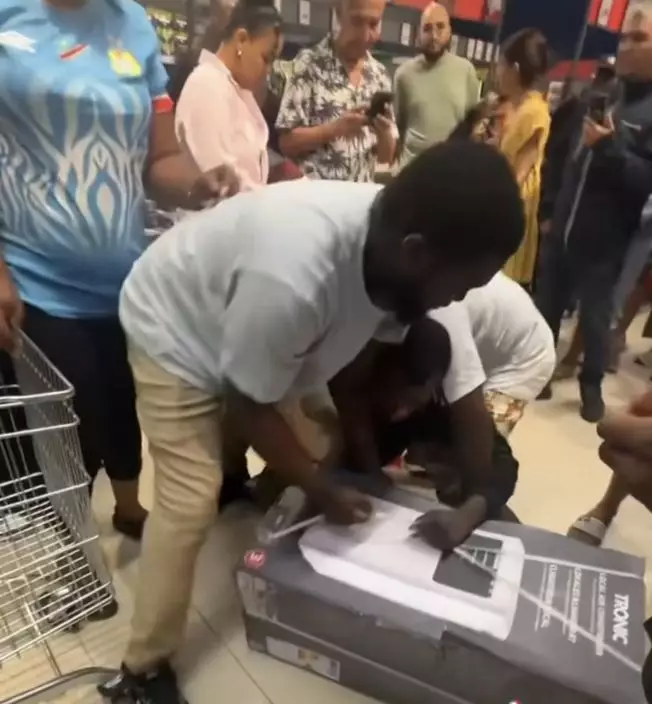
Customers clash while fighting over air conditioners.

Many people came to blows because the units are in high demand and short supply

Many people came to blows because the units are in high demand and short supply

Hundreds of people flooded into Lidl supermarkets in and around Paris on Thursday (July 2) to snap up discounted air conditioners.

Hundreds of people flooded into Lidl supermarkets in and around Paris on Thursday (July 2) to snap up discounted air conditioners.

France is bracing for a new wave of extreme heat starting on July 3, based on multiple foreign media reports. The French supermarket chain Lidl capitalized on the weather by launching a promotional campaign for air conditioners on July 2. The deal was incredibly attractive with some entry-level models priced as low as 179 euros (around 1,600 HKD) compared to 1,200 euros elsewhere, and the supermarket triggered a massive buying frenzy by claiming a nationwide supply of 200,000 fans and portable air conditioners.

Eager consumers swarmed Lidl supermarkets in Paris and its surrounding areas that day. Some people had queued overnight at a branch in Nanterre, and massive crowds rushed inside the moment it opened. The mad dash broke the store doors, and several online videos show customers grappling on the ground while screaming and crying during the scuffles over merchandise.

Customers clash while fighting over air conditioners.

Customers clash while fighting over air conditioners.

One netizen visited two stores and noted that the first had only one unit left while the second was completely sold out. This severe shortage suggests the total supply in Paris is probably less than 100 units. Another person described a similar crisis in the 14th arrondissement of Paris, where over 400 people showed up for only two units, resulting in deployed tear gas and women being knocked to the ground.

Many people came to blows because the units are in high demand and short supply

Many people came to blows because the units are in high demand and short supply

About 200 people lined up outside one branch for over an hour, according to a customer. The furious crowd found just two air conditioning units available for sale upon entering, and a fierce battle for the appliances ensued. The desperation mirrors a wider social panic, with some netizens on social media describing the chaotic scrambling scenes as completely barbaric.

A Lidl supermarket in the town of Saint-Germain-lès-Corbeil in the Essonne department south of Paris was also packed to the brim. The sudden influx of 200 cars overwhelmed local infrastructure and led to severe traffic jams on surrounding roads.

Other major retailers are seeing a similar explosion in demand. Alexandre Bompard, the CEO of Carrefour, recently stated that his company had sold at least 30,000 fans and air conditioners as of June 22. This massive surge represents 1,000 times their usual daily sales volume, exposing a frantic nationwide scramble to beat the heat.


Deep Throat

** 博客文章文責自負,不代表本公司立場 **
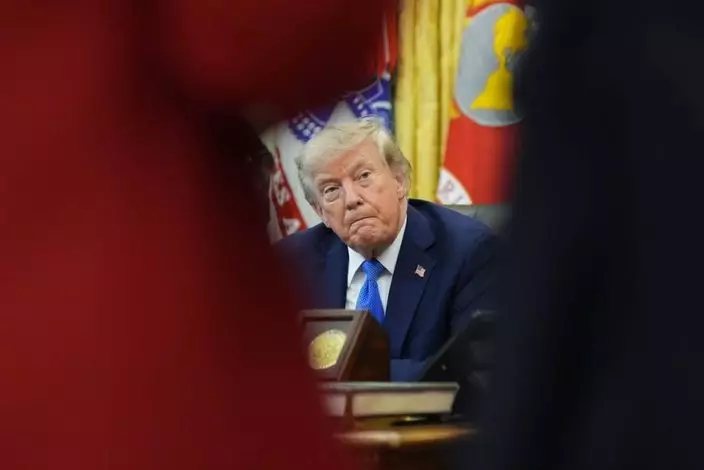
The United States and Iran have formally signed a memorandum of understanding, ending a war that lasted nearly four months. The Strait of Hormuz has reopened. The Iranian regime is still standing. Not one of the "unconditional surrender" scenarios Trump loudly proclaimed was ever delivered. Both Axios and Newsweek have now run pieces pointing squarely at China as the biggest winner of the US-Iran war.

“Newsweek” in depth analysis on “Why China won the US war against Iran”.

“Newsweek” in depth analysis on “Why China won the US war against Iran”.

The guns had barely fallen silent when American media rushed into reckoning. Axios published a piece that embarrassed the Pentagon — describing how China came out ahead without firing a single shot. Newsweek went deeper still, with language that pulled no punches: the war laid bare America's instability, while China's diplomatic standing quietly underwent a complete upgrade over those four months.

Trump's Three Gifts to China

Four months of American engagement in the Middle East handed China three things no money could buy.

The US military’s sustained high-intensity deployment in the Middle East has sparked discussions about the allocation of global strategic resources.

The US military’s sustained high-intensity deployment in the Middle East has sparked discussions about the allocation of global strategic resources.

The first gift: laid all military cards on the table. US forces burned through ammunition stockpiles on the Iranian front, opening gaps in defensive deployments oriented toward Asia. China was able to observe, at close range, how the US military actually performs on a real battlefield — the limits of its weapons systems, the bottlenecks in its logistics, the vulnerabilities in its command coordination. That kind of live-fire data is first-hand intelligence that no military exercise can replicate.

The second gift: a fractured Western alliance. The alliance framework America spent decades building showed visible cracks. European governments, already nursing deep grievances over US tariff policies, found themselves pulled into a military operation they had not been adequately briefed on, and more than one openly raised objections. 

Ryan Hass, director of the China Center at the Brookings Institution — America's premier think tank — put it plainly: "The open divergences between Washington and its partners over the war’s legitimacy, execution, and fallout have exposed fissures that risk metastasizing to other issue areas over time." Translation: America's global leadership is weaker now than it was before the war.

The third gift: making China's position more convincing. China has long championed "upholding state sovereignty, engaging in peaceful dialogue, never seeking military hegemony." The West largely dismissed this as propaganda. But having just watched the United States launch a war in circumvention of international law, kill foreign senior officials in airstrikes, and blockade international waterways, the international community no longer hears China's message as mere sloganeering. 

Multilateral diplomatic consultations continue to advance. Dialogue remains the primary approach to resolving differences in the current international landscape.

Multilateral diplomatic consultations continue to advance. Dialogue remains the primary approach to resolving differences in the current international landscape.

Henry Wang (王輝耀), president of the Center for China and Globalization — a Beijing-based think tank — told Newsweek: "The US-Israeli attack on Iran has set a truly unprecedented and terrible precedent, effectively dismantling the post-war world order that has held for 80 years."

The Energy Stress Test: China Passes

This war also served as a live stress test of China's greatest structural vulnerability.

Around 40% of China's crude oil imports and roughly one-third of its liquefied natural gas come from the Middle East. When the Strait of Hormuz was effectively closed and international shipping ground nearly to a halt, analysts widely warned that China would face a severe energy crisis.

In China, energy supply chains are operating under extreme conditions, with strategic reserves and production capacity dispatch also serving as critical buffers.

In China, energy supply chains are operating under extreme conditions, with strategic reserves and production capacity dispatch also serving as critical buffers.

China held firm. During the conflict, Chinese crude imports fell sharply to multi-year lows. But a combination of roughly 1.2 billion barrels in strategic petroleum reserves, refineries proactively cutting utilization rates, diversified supply routes, and years of sustained electrification allowed China to successfully cushion the blow. Japan and South Korea were forced to draw urgently on national reserves. China faced no comparable degree of pressure.

What's more, Chinese energy refiners actually expanded exports of aviation fuel and diesel during the crisis. They supplied fuel-scarce markets including the Philippines, further cementing China's image as a reliable supplier. The surge in crude prices also accelerated a global shift in demand toward electric vehicles, a windfall for Chinese manufacturers who already lead the international EV market. Chinese auto export figures rose noticeably during the conflict.

China’s exports of new energy vehicles and industrial goods continue to grow amid global supply chain restructuring.

China’s exports of new energy vehicles and industrial goods continue to grow amid global supply chain restructuring.

After the Ceasefire, Who Did Iran Thank?

After the memorandum was signed, Iranian Foreign Minister Abbas Araghchi publicly thanked China, crediting it for playing a "constructive role" in bringing the agreement about. Throughout the entire war, Foreign Minister Wang Yi conducted more than 26 rounds of diplomatic consultations with various parties, consistently backed Pakistan's mediation efforts, and maintained a steady position in favor of a dialogue-based resolution.

The symbolic weight of this moment goes far beyond diplomatic formality. A Middle Eastern nation stood before America and publicly thanked China. An image adding considerable weight to China's diplomatic ledger.

America's own think tanks and its own media have, in their own words, written the final verdict on this war. Trump thought he was fighting Iran. In four months, he handed China the finest piece of diplomatic publicity work it could ever have asked for.

Recommended Articles