Local authorities have intensified emergency response efforts as Typhoon Bavi, the ninth typhoon of the year, batters east China's Zhejiang Province.
The typhoon, with the maximum wind force at its center reaching 40 meters per second when landing, first churned ashore at Yuhuan, a county-level city administered by the city of Taizhou, at around 23:20 Saturday, before making a second landfall in Yueqing City under the city of Wenzhou at around midnight Sunday.
Zhejiang Province upgraded its typhoon emergency response to the highest level at 11:00 Saturday.
As of 14:00 Saturday, more than 2.21 million residents across the province had been evacuated to safe locations.
Authorities in Wenzhou's Dongtou District deployed drainage equipment along roads to prevent urban flooding.
In Ningbo, the province's second-largest city, firefighters placed sandbags to combat waterlogging, patrolled streets, and cleared fallen trees.
Further inland in the suburbs of Lishui City, rescue teams worked to clear roads in rural areas, staying on high alert for landslides and other geological disasters.

East China’s Zhejiang organizes emergency hazard elimination following typhoon landfalls
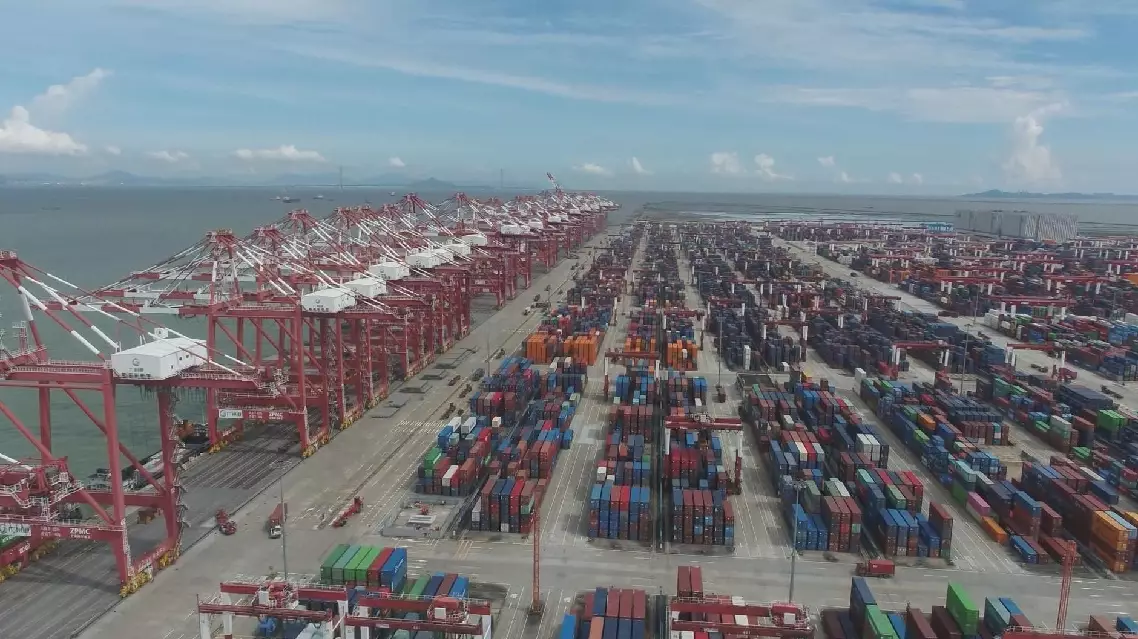
China's foreign trade showed upward momentum in the first half of 2026, with higher port throughput and growth in both imports and exports, according to official data.
According to the country's State Information Center, during the first six months of this year, China's average daily container throughput at ports nationwide increased by 6.7 percent year on year, and the average daily cargo throughput grew by 1.3 percent.
Meanwhile, the country's foreign trade structure has also been optimized, transforming high added-value products into the driving force for export growth.
Latest statistics showed that in the January-to-June period, the average daily number of international cargo flights increased by 4.6 percent year on year, with strong and sustained demand for high-value-added products, such as electronics.
"Facing the complex and ever-changing external economic and trade environment in the first half of the year, the resilience and competitiveness of China's industrial and supply chains have become increasingly evident. Foreign trade has not only achieved steady growth in scale but has also demonstrated a positive trend of 'quality imports and exports.' Looking ahead to the second half of 2026, as the benefits of institutional opening up continue to unfold, new momentum for the high-quality development of China's foreign trade will keep building up, likely providing further certainty and vitality to the global economy," said Wang Bingjie, assistant researcher with the National Development and Reform Commission's Institute of Foreign Economic.
China’s foreign trade shows great momentum in H1