Ten years after the so-called "South China Sea arbitration award" was issued in 2016, the "arbitration" remains nothing but a worthless piece of paper that is illegal, null and void, according to a China Media Group commentary published on Sunday.
An edited English version of the commentary is as follows:
Sunday marked the 10th anniversary of the illegal "award" in the "South China Sea arbitration" case.
A decade later, the "award" stands exposed as a political farce dressed in "legal" clothing, and a scandal in the history of international arbitration riddled with grave fallacy.
First of all, the "award" was in flagrant violation of the United Nations Convention on the Law of the Sea (UNCLOS), as land territorial issues are not regulated by UNCLOS. As early as 2006, maritime delimitation was clearly excluded by China from "compulsory arbitration" and other procedures.
By unilaterally initiating the proceedings, the Philippines violated the bilateral agreement it reached with China, as well as the commitment made by China and ASEAN members, including the Philippines, in the 2002 Declaration on the Conduct of Parties in the South China Sea to resolve relevant disputes through negotiations.
Established amid grave controversies and in breach of the state consent principle underpinning international dispute settlement mechanisms as enshrined in the UNCLOS, the so-called "Arbitral Tribunal" was formed more by political considerations than by legal reasoning.
Many observers questioned its impartiality, noting that the majority of arbitrators were appointed by Shunji Yanai, then president of the International Tribunal for the Law of the Sea, who is widely perceived as holding hawkish, right-leaning views.
Both procedurally and substantively, the "award" is deeply flawed. It is essentially illegal, null and void, and carries no binding force.
China's position has remained consistent and firm: it does not accept or recognize the "award," and opposes and does not accept any claim or action based on it. China has indisputable sovereignty over the Nanhai Zhudao (the South China Sea Islands) and the adjacent waters, backed by abundant historical and legal evidence.
China's sovereignty over the Nanhai Zhudao and the relevant rights and interests in the South China Sea have been established in the long course of history. As early as 200 B.C., in the Western Han Dynasty, Chinese people sailed in the South China Sea and, through long-term practice, discovered the Nanhai Zhudao. China is the first to have continuously, peacefully and effectively exercised sovereignty and jurisdiction over the Nanhai Zhudao and the relevant waters. The Nanhai Zhudao have long been widely recognized by the international community as part of China's territory.
In contrast, the Philippines' attempts to assert sovereignty over Huangyan Dao (the Huangyan Island) and certain maritime features of the Nansha Qundao (the Nansha Islands) are based on distorting and fabricating historical facts and abusing international law, according to a recently-released report titled "Historical and Legal Critique of the Philippines' Territorial Claims in the South China Sea."
Notably, the U.S. and other external countries have been persistently reinforcing presence in the South China Sea, throwing their weight around and fanning the flames. These acts of militarization and coercion constitute the primary challenge to the current situation in the South China Sea.
The U.S. and some other Western countries are instigating the Philippines to confront China over the South China Sea issue and hyping up the illegal "award." Their aim is to muddy the waters in the South China Sea to contain China, while using this to slander China for "undermining" international rules and the rule of law and tarnish the international image of China, according to Chen Xiangmiao, a research fellow with the National Institute for South China Sea Studies.
The Chinese government has repeatedly issued statements and white papers, and remained committed to resolving the relevant disputes in the South China Sea through negotiation and consultation with other countries directly concerned, on the basis of respecting historical facts and in accordance with international law, so as to maintain peace and stability in the South China Sea.
Under the joint efforts of China and the majority of the ASEAN countries, the South China Sea remains generally stable. China and ASEAN countries are making active efforts to advance the consultations on a Code of Conduct in the South China Sea, to make the South China Sea a sea of peace, friendship and cooperation. Should the Philippines continue to make reference to this illegal "award" and pursue infringement and provocation, such moves will only backfire and harm regional peace.
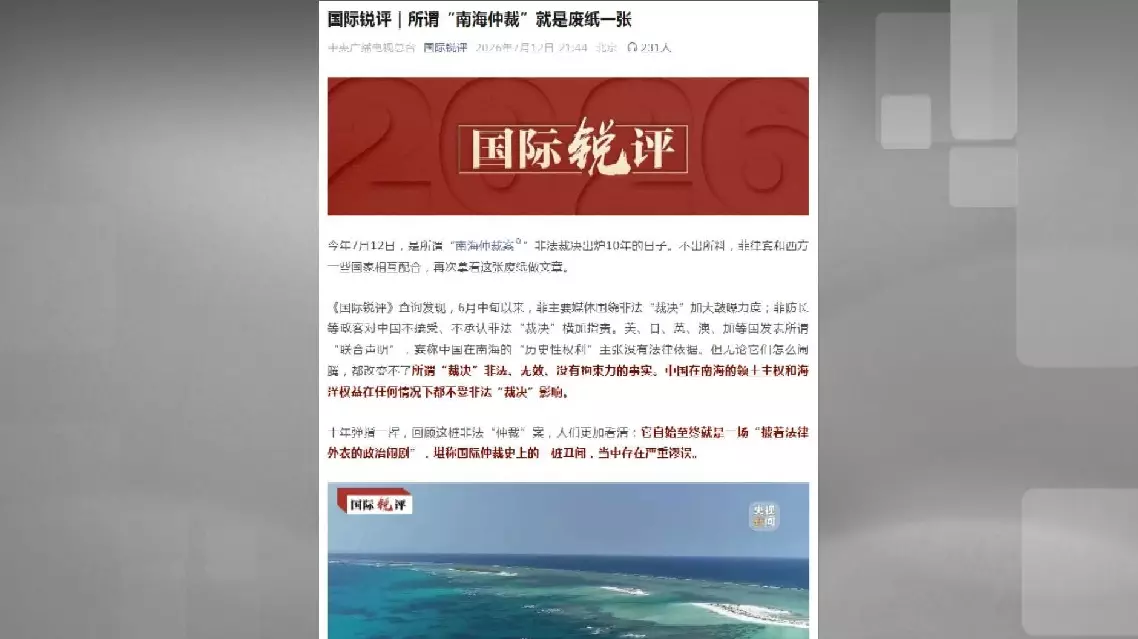
'South China Sea arbitration award' remains illegal, null, void: commentary