Skip to Content Facebook Feature Image

QumulusAI Begins Trading on the Nasdaq Global Market Under Ticker Symbol “QMLS”

Business

QumulusAI Begins Trading on the Nasdaq Global Market Under Ticker Symbol “QMLS”
Business

Business

QumulusAI Begins Trading on the Nasdaq Global Market Under Ticker Symbol “QMLS”

2026-07-17 00:55 Last Updated At:01:21

ATLANTA--(BUSINESS WIRE)--Jul 16, 2026--

QumulusAI (Nasdaq: QMLS), a neocloud infrastructure provider purpose-built for the AI computing era, today announced that its common shares have begun trading on the Nasdaq Global Market under the ticker symbol QMLS.

This press release features multimedia. View the full release here: https://www.businesswire.com/news/home/20260716727325/en/

“QumulusAI was built for how AI is actually deployed — inference-first, distributed, and close to demand,” said Mike Maniscalco, CEO of QumulusAI. “As an active, revenue-generating neocloud, we bring compute online in months, not years. Becoming a public company gives us the platform, and the capital efficiency, to scale that model as enterprise demand for AI infrastructure compounds.”

QumulusAI addresses the critical shortage in AI compute through a highly flexible, distributed infrastructure strategy. The company rapidly deploys and monetizes GPU infrastructure for AI inference, training, and agentic workloads, while simultaneously advancing vertically integrated approaches to support massive-scale enterprise workloads.

Copies of the final prospectus relating to the registration may be obtained by visiting the SEC's website at www.sec.gov.

About QumulusAI
QumulusAI is a distributed AI cloud platform that delivers accelerated access to high-performance GPU compute. Through an inference-first, demand-led deployment model across a network of data center sites, QumulusAI brings compute closer to customer demand, helping AI teams and enterprises scale production AI workloads with speed, flexibility and control. By combining rapid deployment with flexible private cloud infrastructure, QumulusAI gives customers a faster, more adaptable path beyond the capacity constraints of traditional centralized and hyperscale cloud models. Learn more at QumulusAI.com.

Follow us on LinkedIn and X @QumulusAI.

Forward-Looking Statements
This press release contains forward-looking statements within the meaning of Section 27A of the Securities Act of 1933, as amended, and Section 21E of the Securities Exchange Act of 1934, as amended, including statements regarding the company's ability to scale its model. Words such as "anticipate," "believe," "estimate," "expect," "guidance," "intend," "may," "on track," "plan," "project," "target," "will" and similar expressions are intended to identify forward-looking statements. These statements are based on management's current expectations and assumptions as of the date of this release and are subject to risks and uncertainties that could cause actual results to differ materially, including, among others, the company's dependence on a limited number of large customers; the availability and cost of power, network connectivity and specialized hardware such as graphics processing units; the company's substantial capital requirements and access to financing; competition and rapid technological change in the high-performance computing and AI markets; the company's limited operating history and history of net losses; and those described in the "Risk Factors" section of the company's registration statement on Form S-1, as amended (File No. 333-292514), filed with the U.S. Securities and Exchange Commission (SEC), as such factors may be updated in the company's subsequent filings with the SEC. QumulusAI undertakes no obligation to update or revise any forward-looking statement, whether as a result of new information, future developments or otherwise, except as required by applicable law.
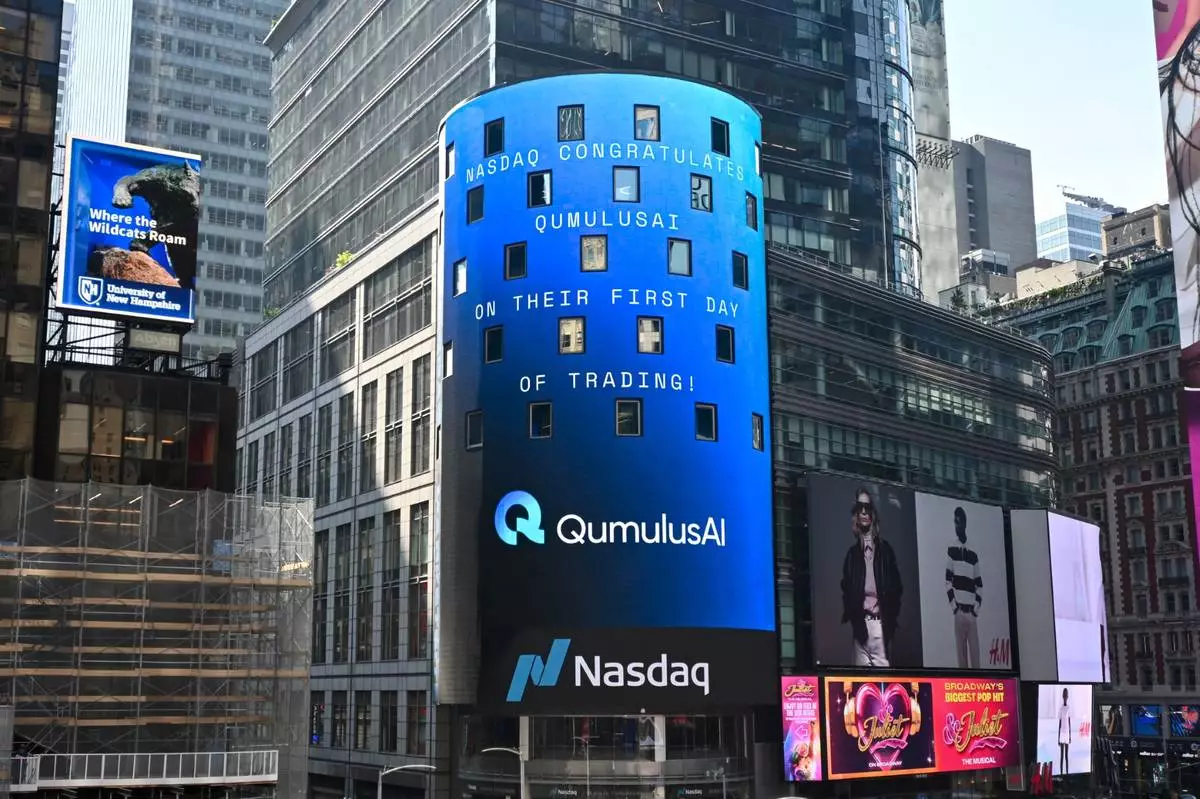
First day of trading, front and center in Times Square. Nasdaq welcomes QumulusAI to the public markets.


First day of trading, front and center in Times Square. Nasdaq welcomes QumulusAI to the public markets.

The average long-term U.S. mortgage rate climbed this week to its highest level in nearly a year, driving up borrowing costs for prospective homebuyers.

The benchmark 30-year fixed rate mortgage rate rose to 6.55% from 6.49% last week, mortgage buyer Freddie Mac said Thursday. One year ago, the average rate was 6.75%.

Higher mortgage rates can add hundreds of dollars a month in costs for borrowers, limiting homebuyers’ purchasing power at a time when affordability challenges continue to sideline many aspiring homeowners.

Mortgage rates are influenced by several factors, from the Federal Reserve’s interest rate policy decisions to bond market investors’ expectations for the economy and inflation. They generally follow the trajectory of the 10-year Treasury yield, which lenders use as a guide to pricing home loans.

Rates have been mostly rising this year as the war with Iran has driven crude oil prices sharply higher, stoking expectations of hotter inflation. That's pushed up long-term bond yields relative to where they were before the conflict began in late February, causing mortgage rates to trend higher.

The 10-year Treasury yield was 4.57% at midday Thursday on the bond market, up from 4.54% a week ago. It was just 3.97% in late February, before the war broke out.

The average rate on a 30-year mortgage is now the highest it's been since Aug. 28, when it was at 6.56%. As recently as late February, the average rate dropped slightly below 6% for the first time since late 2022.

Borrowing costs on 15-year fixed-rate mortgages, often sought by borrowers refinancing a home loan, also rose this week. That average rate increased to 5.93% from 5.82% last week. A year ago, it was at 5.92%, Freddie Mac said.

A report this week showing prices paid by consumers for gas, clothes and other goods cooled last month could help take pressure off the Federal Reserve, which is considering raising interest rates.

The central bank doesn’t set mortgage rates, but its decisions to raise or lower its short-term rate are watched closely by bond investors and can ultimately affect the yield on 10-year Treasurys.

That cooler inflation reading “is a step in the right direction, but until mortgage rates actually follow suit, buyers will keep feeling the pinch of stubbornly high borrowing costs even as other conditions improve,” said Hannah Jones, senior economist at Realtor.com.

While average long-term mortgage rates remain lower than they were at this time last year, their upward trajectory has weighed on home sales this year.

And the latest monthly tally of home purchase transactions that have yet to be finalized points to potentially more sluggish home sales this summer.

Pending U.S. home sales fell 5.4% in June from the previous months and were down 0.3% from June last year, the National Association of Realtors said Thursday. There’s usually a month or two lag between a contract signing and when the sale is finalized, which makes pending home sales a near-term bellwether for the housing market.

Data on mortgage applications also signal that the upward trend in mortgage rates has given some would-be homebuyers reason to pause.

Mortgage applications, which include loans to buy a home or refinance an existing mortgage, fell 2.7% last week from the previous week, according to the Mortgage Bankers Association. The pullback was driven mainly by a 7% drop in applications to buy a home.

FILE - A sign is posted for a new home for sale in Ambler, Pa., Oct. 16, 2025. (AP Photo/Matt Rourke, File)

FILE - A sign is posted for a new home for sale in Ambler, Pa., Oct. 16, 2025. (AP Photo/Matt Rourke, File)

Recommended Articles