Another powerful new artificial intelligence model from China took the U.S. tech industry by surprise Friday, the latest sign that Chinese startups that publicly release their “open-source” AI technology are making the California titans of AI sweat.
The newest Kimi K3 model from Beijing-based startup Moonshot, run by a Pink Floyd-loving entrepreneur who earned his doctorate in Pittsburgh, appears to be catching up to the best versions of Anthropic's Claude and OpenAI's ChatGPT.
“This may be the single biggest release of the year,” and marks a moment when open-source Chinese models are surpassing closed U.S. models, said Anastasios Angelopoulos, co-founder and CEO of Arena, a platform for evaluating AI systems.
Kimi K3 topped the charts on Arena's ranking of what it calls “front-end coding capability,” which is one measure of an AI large language model's performance. “More results are rolling in that are likely to continue to show it is at the top of the pack,” Angelopoulos said on social media.
It was not likely a coincidence that K3's unveiling came shortly before Chinese President Xi Jinping's opening address Friday to the nation's annual World Artificial Intelligence Conference in Shanghai.
American-led restrictions have blocked China from accessing some of the world’s most advanced technologies, spurring China’s efforts to build its own know-how and intensifying the rivalry between the world’s two biggest economies.
“The development of artificial intelligence should not be a solo performance by any single country but rather a symphony of global cooperation,” Xi said at the event.
K3 follows another major AI model release last month from the Chinese startup Zhipu, or Z.ai. Its new flagship GLM-5.2 model is already being widely used by software developers around the world who say it can perform work almost as good as the top U.S. models at a cheaper price.
The hype over the new Chinese model resembles the market-shaking panic that followed the release of a new model from Chinese startup DeepSeek in early 2025, though not everyone finds it justified. The response to K3 is an “overreaction shockingly similar” to DeepSeek's release last year, said tech analyst Patrick Moorhead on social media. He said it could be good for parts of the broader AI industry but pose a revenue challenge to Anthropic and OpenAI.
During the conference that runs until Monday, tech giant Huawei has also been showcasing a new AI computing system called the Atlas 950 SuperPoD, a signal that China increasingly is amassing the domestic hardware it needs despite U.S. restrictions on imports from chipmakers like Nvidia.
Moonshot hasn’t said what hardware it used to build K3, but the startup is a partner with Huawei.
The price to use K3 is highest yet for a Chinese AI model, but it is still half as expensive as OpenAI’s high-performing GPT-5.6 Sol model, according to a Friday report by Bank of America research analysts.
U.S. politicians and several major U.S. AI companies including Anthropic and OpenAI have accused Chinese AI models of illicit “distillation” of their models to extract their technologies, a claim that Beijing says is “groundless.”
Anthropic in February accused DeepSeek, Moonshot and a third China-based AI lab, MiniMax, of engaging in campaigns to “illicitly extract Claude’s capabilities to improve their own models” using the distillation technique that “involves training a less capable model on the outputs of a stronger one.”
Anthropic said that distillation can be a legitimate way to train AI systems but it’s a problem when competitors “use it to acquire powerful capabilities from other labs in a fraction of the time, and at a fraction of the cost, that it would take to develop them independently.”
But it can go both ways. San Francisco-based startup Anysphere, maker of the popular coding tool Cursor, has acknowledged that one of its top products was based on Moonshot’s K2.5 model. Elon Musk’s SpaceX is planning to close a deal to buy Cursor for $60 billion later this year.
Moonshot co-founder and CEO Yang Zhilin earned his Ph.D. in 2019 at Carnegie Mellon University, where he is said to have made fundamental contributions to the machine-learning field and was known for a love of rock bands like Pink Floyd.
The pride among his former colleagues at the school in Pennsylvania transcends the U.S.-China rivalry.
“What a huge win for the open-source community! It feels like just yesterday Zhilin was graduating from my lab at CMU," wrote his former adviser Russ Salakhutdinov, who is also a former director of AI research at Apple.
Associated Press writer Chan Ho-Him contributed to this report.

Chinese President Xi Jinping speaks at the opening ceremony for the World AI Conference in Shanghai, Friday, July 17, 2026. (AP Photo/Ng Han Guan, Pool)
NEW YORK (AP) — Big U.S. restaurant chains don't get linked to foodborne illness outbreaks often, but the number of meals they serve causes a lot of concern when contamination of some kind sickens customers.
Federal health officials identified iceberg lettuce from Mexico served at Taco Bell locations in five states as a source of widespread infections from the diarrhea-causing parasite cyclospora. A U.S. Food and Drug Administration investigation identified a single supplier as the source of the suspect lettuce.
Taco Bell issued a statement on Thursday saying that “the affected ingredient from our supplier is being indefinitely removed from our supply chain nationwide and will be replaced within 24 hours in select states.” The company described the move as precautionary.
A federal official who was briefed on the outbreak investigation and not authorized to discuss it identified the supplier as Taylor Farms, a company based in Salinas, California, that produces fresh vegetables for commercial use and meal kits and bagged lettuce products sold at supermarkets.
Federal health officials stressed that other “brands, restaurants, retailers, or distribution channels” could be identified as the investigation continues.
Here’s a brief history of some other recent outbreaks that roiled restaurant companies and sometimes changed how food safety is regulated in the U.S.
E. coli bacteria caused a 2024 food poisoning outbreak tied to raw onions on McDonald’s Quarter Pounder hamburgers. The outbreak sickened at least 104 people in 14 states, including 34 who were hospitalized, according to the FDA. One person in Colorado died.
McDonald's said the onions came from Taylor Farms and temporarily pulled the Quarter Pounder off its menu in the affected states. Other national restaurant chains temporarily stopped using fresh onions in some of their locations.
Wendy’s pulled lettuce from sandwiches in its restaurants in Michigan, Ohio and Pennsylvania in August 2022 after some people reported falling ill.
The Centers for Disease Control and Prevention said at the time that it was trying to determine whether romaine lettuce was the source of an E. coli outbreak that sickened at least 37 people and whether romaine used at Wendy’s was also served or sold at other businesses.
One person was also sickened in Indiana, according to the CDC.
In 2015, Chipotle was hit by an E. coli outbreak that sickened more than 50 people and it temporarily shut down dozens of restaurants on the West Coast, but that was just the beginning. A month later, 30 Boston College students, including at least eight members of the men’s basketball team, complained of gastrointestinal symptoms after eating at a Chipotle restaurant.
Federal officials declared the outbreak over by February 2016, but the chain shut down every one of its restaurants to retrain employees and allow them to regroup.
By the end of the year, however, Chipotle Co-CEO Montgomery Moran stepped down as sales plunged.
In 2020 Chipotle Mexican Grille agreed to pay a record $25 million fine to resolve criminal charges that it served tainted food that sickened more than 1,100 people in the U.S. between 2015 and 2018.
The company admitted that poor safety practices, such as not keeping food at proper temperatures to prevent pathogen growth, sickened customers in Los Angeles and nearby Simi Valley, as well as Boston, Sterling, Virginia, and Powell, Ohio.
In December 2006, Taco Bell ordered the removal of green onions from its 5,800 restaurants nationwide after samples taken by investigators appeared to contain a harsh strain of E. coli. The outbreak sickened at least 71 people in New Jersey, New York, Pennsylvania and Delaware, with most of them hospitalized, according to the CDC.
Eight people developed a type of kidney failure called hemolytic-uremic syndrome.
Eventually, it was determined that contaminated lettuce was the probable cause, with the vegetable used in numerous dishes on the menu.
Almost immediately, Taco Bell launched a newspaper ad blitz and sent its president on a string of media interviews to assure customers that its food was safe.
Four deaths and more than 700 illnesses in Washington, Idaho, California, and Nevada between 1992 and 1993 eventually were traced to undercooked Jack in the Box restaurant hamburgers contaminated with E. coli.
The ensuing investigation by federal regulators changed regulatory practices in the U.S., experts say.
An investigation by the CDC identified five slaughter plants in the U.S. and one in Canada as the likely sources of animals used in the contaminated lots of meat and identified potential control points for reducing the likelihood of contamination. The animals slaughtered in domestic slaughter plants were traced to farms and auctions in six western states. No one slaughter plant or farm was identified as the source.
The U.S. Department of Agriculture mandated a Hazard Analysis and Critical Control Point system, which helps identify and control hazards within the system of food production. The system provided for more monitoring and controls to rapidly limit the spread of outbreaks.
Jack in the Box lost more than $44 million in 1993 and did not post another annual profit for another three years.
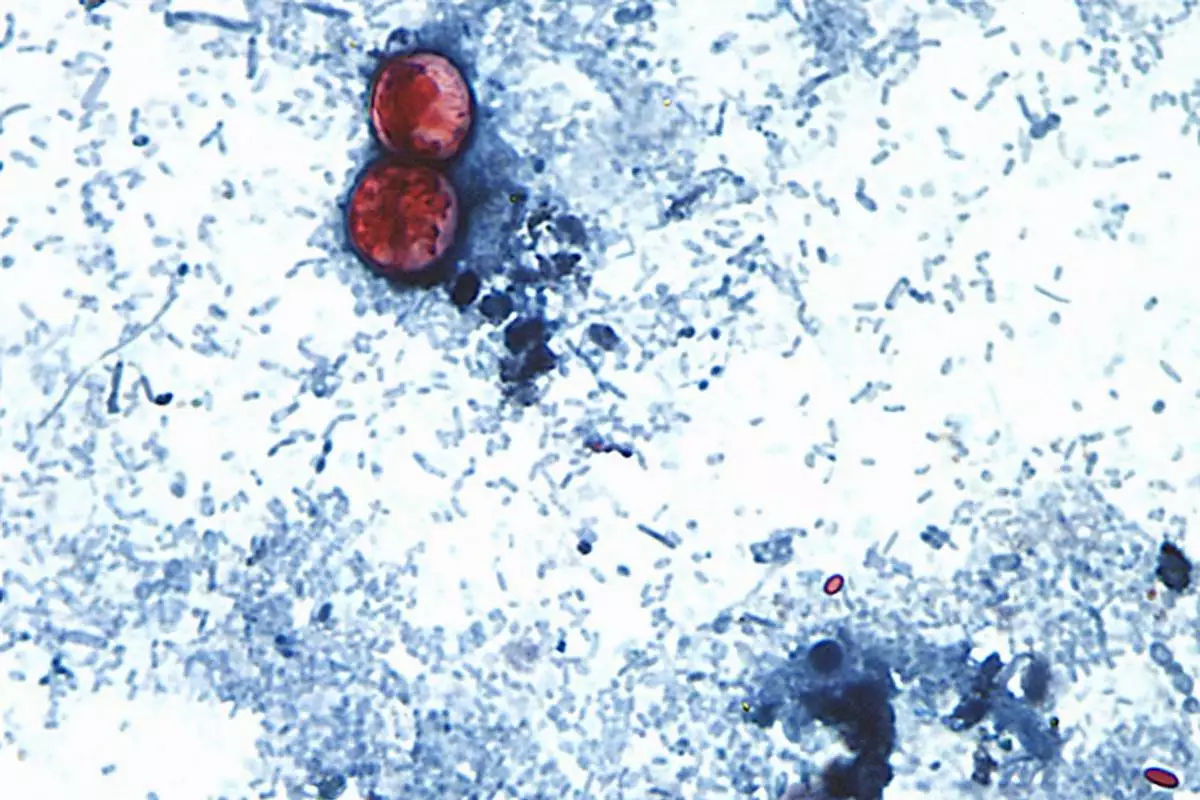
FILE - This undated photo taken through a microscope provided by the CDC shows Cyclospora cayetanensis oocysts found in a fresh stool sample which had been prepared with a formalin solution and stained with safranin. (CDC via AP, File)