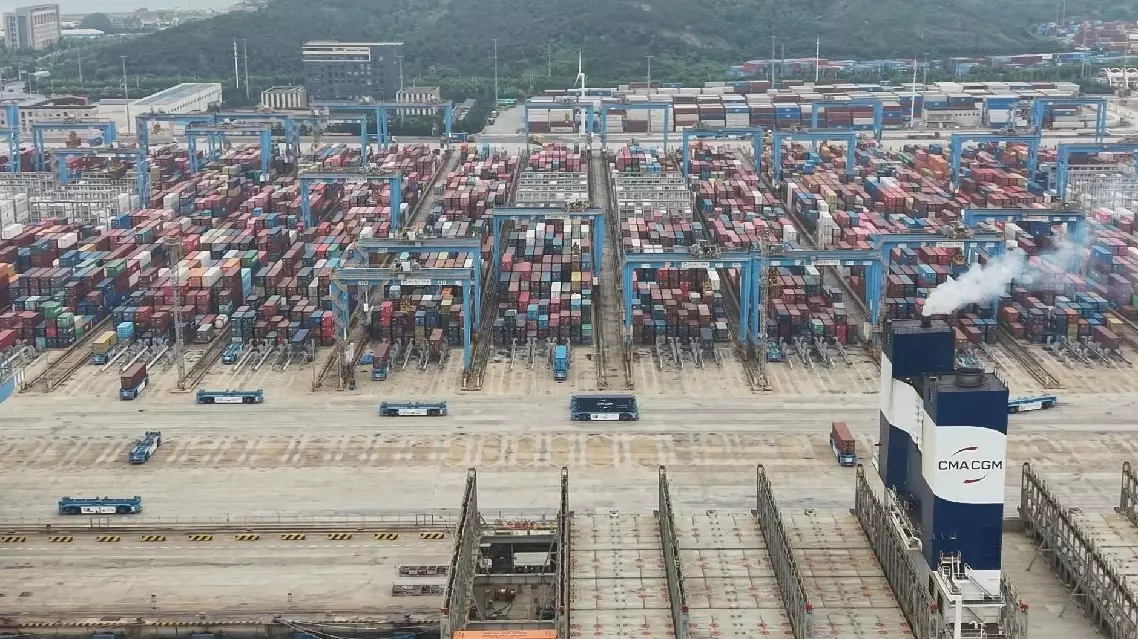
Qingdao Port in east China’s Shandong Province has posted steady growth in trade with ASEAN countries, driven by expanding rail-sea intermodal links, policy dividends from the RCEP, and faster customs clearance.
The Regional Comprehensive Economic Partnership (RCEP), the world’s largest free trade pact, has been in effect since January 2022, gradually eliminating tariffs on more than 90 percent of goods traded among its 15 members.
According to Qingdao Customs, the port’s imports and exports with ASEAN reached 255.63 billion yuan (around 37.7 billion U.S. dollars) in the first half of this year, up 11.8 percent year on year. Exports of ships surged 160.9 percent, commercial vehicles rose 55.1 percent, and the "new trio" of electric vehicles, photovoltaic products and lithium‑ion batteries jumped 163.5 percent.
At the rail‑sea intermodal center, dispatchers work at a relentless pace to keep cargo from across China moving on schedule for international sailings.
"All the containers on this train are rush orders for the 4:00 sailing tomorrow. We need to bring them into the port and get them loaded today. I've unloaded about five trains since my shift started this morning," said Wang Yifeng, deputy head of the intermodal center.
Rail‑sea intermodal transport has become a convenient, stable and cost‑saving option, drawing more goods from inland cities such as Zhengzhou and Xi’an to Qingdao Port for export overseas.
"Shandong Port has opened 109 rail-sea intermodal train routes. In the first half of this year, it handled 2.453 million TEUs of rail-sea intermodal cargo, up 11.9 percent year on year," said Dai Xuechao, assistant manager of the intermodal center.
China’s imports and exports of intermediate goods with ASEAN reached 2.86 trillion yuan in the first half of this year, up 24.5 percent year on year, accounting for about two‑thirds of bilateral trade. The RCEP continues to deliver dividends, deepening supply‑chain cooperation and multiplying shipping routes.
"In the first half of this year, Qingdao Port opened five new direct shipping routes to ASEAN countries, bringing the total number of ASEAN routes to over 50. We now have high-frequency weekly direct sailings to major ports in Vietnam, Thailand, Indonesia, and Malaysia. At peak times, we handle five to six vessel calls from Southeast Asian routes in a single day," said Ban Zhengqi, planning supervisor of the operations department at the Qianwan Container Terminal of Qingdao Port.
Huangdao Customs, under Qingdao Customs, has moved the inspection process forward to reduce waiting times for fresh goods such as frozen durian pulp and seafood. Scanning checks are now completed during unloading and container consolidation, helping to speed up customs clearance.
"For tropical fruits and fresh agricultural products imported from ASEAN countries, customs have set up a green channel with priority document review, inspection, and urgent testing, to minimize clearance times for fresh goods," said Yu Ting, a customs officer.
China’s Qingdao Port expands ASEAN trade amid policy dividends