Skip to Content Facebook Feature Image

China officially launches first single-waybill cross-border multimodal transport system

China

China

China

China officially launches first single-waybill cross-border multimodal transport system

2026-07-21 19:11 Last Updated At:07-22 12:50

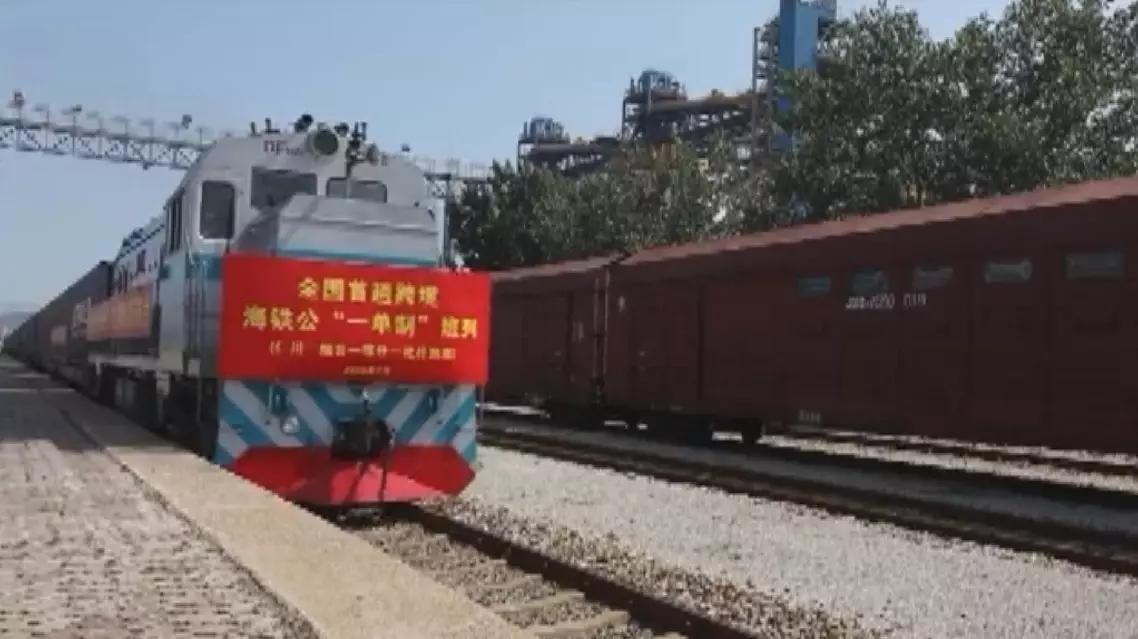
China's first cross-border multimodal transportation service operating under a single bill of lading officially launched Tuesday morning with the departure of freight train X80442 from Yantai Port in east China's Shandong province, integrating sea, rail and road logistics.

The cross-border freight train was loaded with 53 containers of commercial vehicles and auto parts.

The containers were shipped from the Republic of Korea's Incheon Port, arriving at Yantai Port in Shandong after a 14-hour sea voyage. They were then transported by rail to road ports in northwest China's Xinjiang Uygur Autonomous Region, before being delivered by road to Bishkek, Kyrgyzstan. Thanks to the seamless intermodal connectivity enabled by the "single bill of lading" system, the entire journey took only 12 days, five days shorter than traditional transport routes.
China officially launches first single-waybill cross-border multimodal transport system
China officially launches first single-waybill cross-border multimodal transport system
China attaches great importance to its relationship with Papua New Guinea (PNG), and is willing to see it play a greater role in international affairs, Chinese Foreign Minister Wang Yi said on Wednesday.

Wang, also a member of the Political Bureau of the Communist Party of China Central Committee, made the remarks during his meeting with PNG's Minister for Foreign Affairs Justin Tkatchenko in Manila, the Philippines.

Noting this year marks the 50th anniversary of the establishment of diplomatic relations between the two countries, Wang said China is willing to work with PNG to implement the important consensus reached by the two leaders of state to deepen cooperation in various fields and enrich the comprehensive strategic partnership between the two countries.

Wang said China appreciates PNG for closing the Taipei economic office, adding that the decision is another key measure by the PNG government to implement the one-China principle, and will further consolidate the political foundation of the relationship between China and PNG.

It also provides a model for other countries to handle issues related to Taiwan institutions, Wang said.

China's development of relations with Pacific island countries does not involve geopolitical games or seek a so-called sphere of influence, Wang said, adding that these countries have the right to independently choose their development partners and should not be interfered with by third parties.

Tkatchenko said PNG firmly adheres to the one-China principle, and believes that Taiwan is a part of China, adding that closing the Taipei economic office sent a clear and powerful message of firmly developing its relations with China. The move is a unanimous decision made by the top leadership of PNG, and the country will ensure its implementation, Tkatchenko noted.

PNG is willing to deepen its cooperation with China on areas such as trade and investment, infrastructure and medical and health care, and strengthen communication and collaboration in APEC and other multilateral platforms.

China willing to see PNG play greater role in international affairs: FM

China willing to see PNG play greater role in international affairs: FM

Recommended Articles