Mu Zhengyang, the director behind the animated blockbuster "All Wishes Come True", has underscored the film's aspirations to breathe new life into ancient traditions through a modern lens.
China's latest animated box-office contender has drawn widespread praise for its contemporary spin on classic folklore.
The film delves deep into myths of the Eight Immortals, whose origins trace back to Taiping Guangji, a collection of stories compiled in the Song Dynasty (960-1279).
While figures such as Zhang Guolao and Lyu Dongbin initially circulated as individual deities during the Tang and Song dynasties (607-1279), they were consolidated into an eight-member ensemble during the Song and Yuan dynasties (1260-1368) and frequently appeared in Yuan Zaju -- a form of Chinese opera -- before being standardized in a novel, The Journey to the East by the Eight Immortals, written by Wu Yuantai during the Ming Dynasty (1368-1644).
According to Mu, the rich and complex history of the mythology provided a wealth of inspiration for the film's creators as they explored options for a modern adaptation.
"In the beginning, we need to examine the historical materials to distinguish which figures are from traditional mythology and which ones we can adapt and further develop," said Mu.
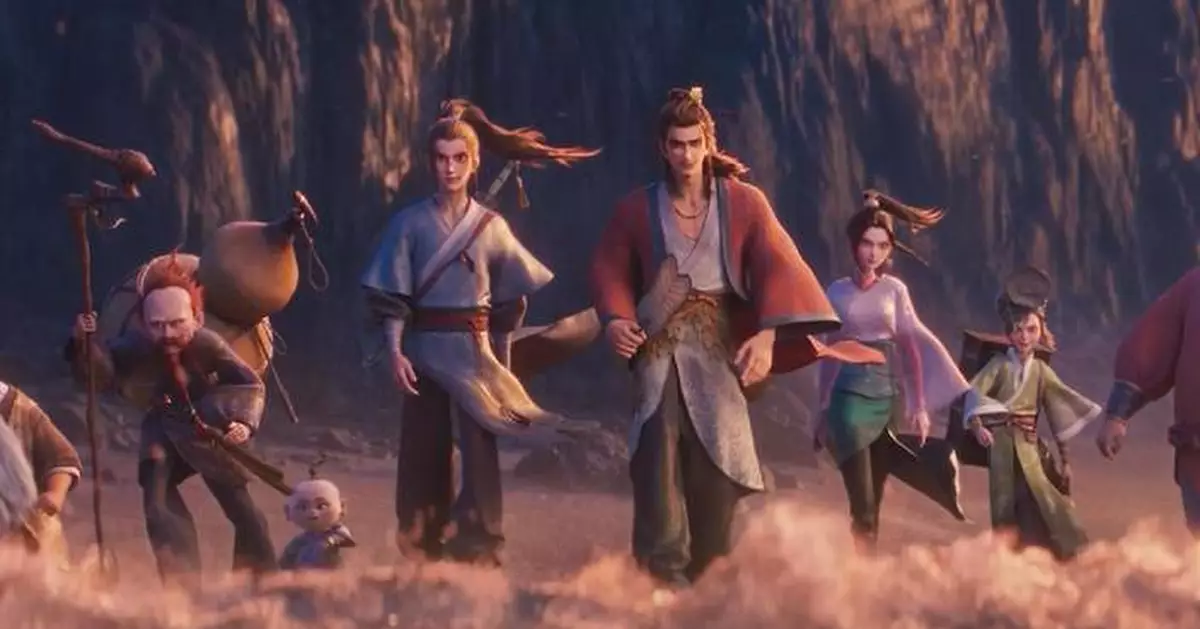
This process allowed greater creative freedom. A conventional adaptation might have focused on Li Tieguai, or 'Iron-Crutch Li,' the traditional leader of the group, as the sole protagonist. Instead, the filmmakers chose to center the narrative on three of the legendary figures, highlighting the theme of passing the torch and continuing their shared mission.
"Although audiences will see it as a comedy, the Eight Immortals ultimately belong to traditional culture. When we examine that culture, we find a sense of continuity through its spirit of inheritance: Zhongli Quan enlightened Lyu Dongbin, who in turn enlightened He Xiangu," the director said.
The film's visual style incorporates blue-green landscape aesthetics inspired by classical Chinese paintings, dynamic glass-gradient color palettes for its fairyland scenes, and city transportation modeled after Han dynasty (202BC-220CE) murals.
Mu expressed hope that these captivating images, combined with innovative storytelling, would help a broader audience to discover and appreciate traditional Chinese aesthetics.
"Inheriting traditional culture isn't just about telling old stories to a new audience. You must inject a modern spirit and a fresh perspective. The cultural treasures are sitting there waiting to be explored. Giving them renewed vitality is where the true value lies," he said.
Chinese filmmaker brings ancient myths to life with modern twist