
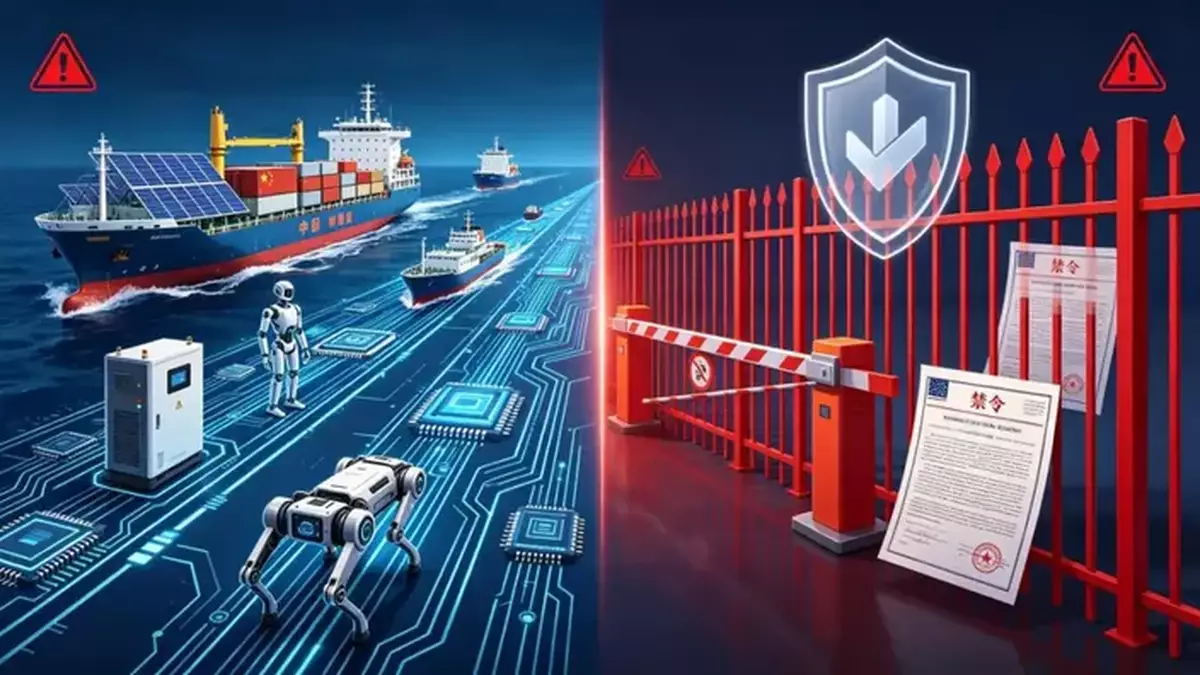
On July 28, local time, the U.S. Federal Communications Commission (FCC) officially updated its "Controlled List," adding advanced robotics equipment and power inverters manufactured abroad to its import restrictions.
Although the U.S. move did not directly name China, it is abundantly clear from the market landscape, policy continuity, and statements by U.S. officials that this is a "targeted effort to contain China."
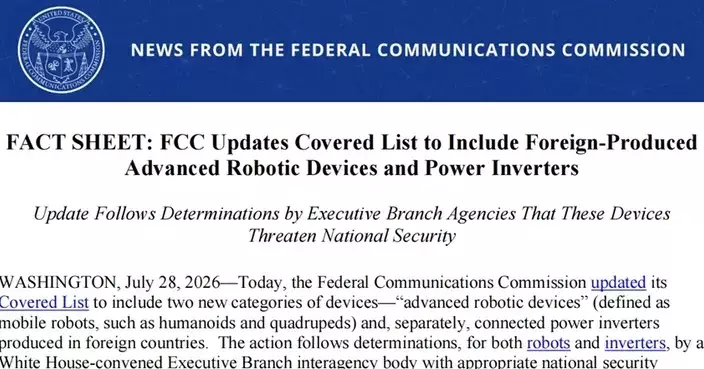
On July 28, the U.S. Federal Communications Commission updated its "Controlled List."
Targeted Containment Aimed at Advanced Manufacturing
On the surface, the addition of advanced robotics equipment and power inverters—both civilian-use devices—to the controlled list is purportedly to prevent "remote manipulation and data leaks." In reality, however, it is intended to suppress two of China's dominant industries.
Precisely Blocking Key Sectors
This round of restrictions zeroes in on two of China's globally leading industries, with the ban taking effect immediately upon announcement.
The first is advanced robotics equipment. The FCC defines this as "controllable equipment with autonomous mobility, multimodal environmental perception capabilities, and wireless networking communication functions," explicitly citing humanoid robots and quadruped robots as typical examples.
Statistics show that China accounts for nearly 70% of global sales of quadruped robots, and has produced over 400 humanoid robot models—more than half of the global total. Chinese companies' production capacity and product performance consistently rank among the world's best.
Notably, on July 24, the U.S. House of Representatives passed the Fiscal Year 2027 National Defense Authorization Act, which explicitly restricts the U.S. military from procuring Chinese-made humanoid robots. Just four days later, the FCC extended the restrictions to the entire commercial market, a timeline far faster than market expectations.
The second category is power inverters. The controlled list primarily targets grid-tied inverters used in photovoltaic and energy storage systems that feature remote communication and control capabilities—commonly known as "smart inverters."
In 2025, approximately 90% of the world's inverters were produced by 23 companies across 7 countries, 16 of which are Chinese manufacturers. About 90% of inverters used in U.S. utility-scale solar projects rely on overseas supply, with Chinese companies being key suppliers.
Ironically, despite the U.S. Department of Energy having concluded in professional tests earlier this February that "there is no conclusive evidence of intentionally introduced malicious communication functions in Chinese-made inverters," the FCC has still blocked Chinese-produced power inverters on "national security" grounds.
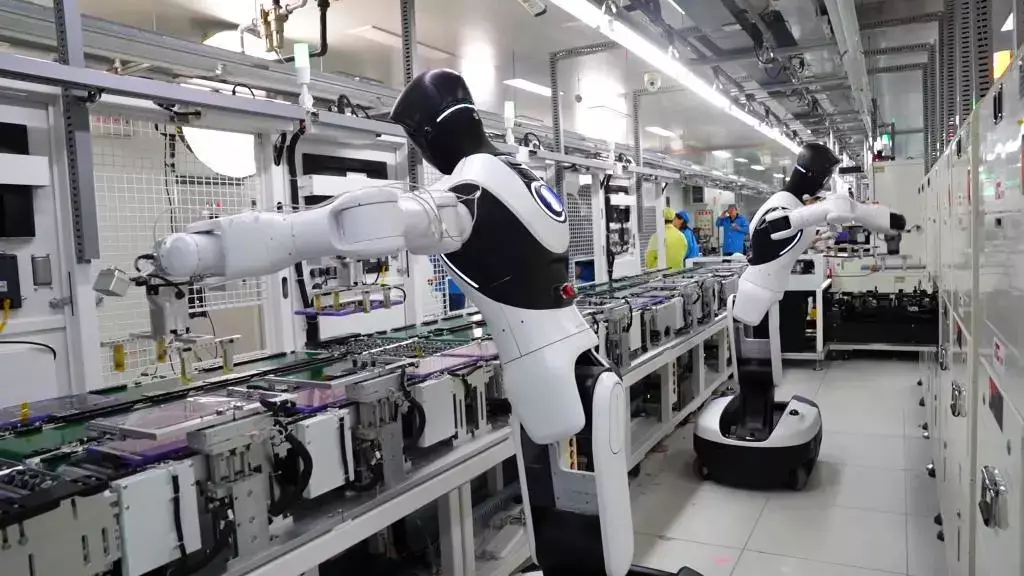
A humanoid robot performs precision loading and unloading in a tablet manufacturing plant in Nanchang, Jiangxi.
A Multi-Layered Control Framework
The new regulations establish a three-tier enforcement structure: "ban as the core, flexible control, and limited exceptions."
Core Access Ban: Going forward, equipment models on the list will be completely prohibited from applying for or obtaining FCC certification, effectively closing off legal pathways for new models to enter the U.S. market.
Flexible Control for Old vs. New Products: Products that have already obtained FCC certification and are currently circulating in the U.S. market are temporarily allowed to continue sales and operations. However, all new products that have not completed certification will permanently lose access to the U.S. market.
At the same time, the FCC reserves the right to revoke the certification of existing products at any time, leaving ample policy room for further escalation and dynamic suppression in the future.
Limited Exception Access: The new rules also provide a "conditional waiver" application channel. Equipment manufacturers may submit special security assessment applications to the U.S. Department of Defense or the Department of Homeland Security. Only products that pass review will be granted conditional market access permits.
It is reported that similar equipment from Europe and Japan can clear customs quickly with only basic testing, while Chinese equipment must undergo additional rigorous procedures, including full source-code audits and long-term on-site factory inspections.
By unilaterally erecting trade barriers and overstretching the concept of national security, the U.S. is essentially using security as a pretext to protect its domestic industries.
Erecting Barriers Harms Everyone
This update to the controlled list will further aggravate technological barriers and supply chain competition in the global advanced manufacturing sector, benefiting no one.
Impact on China: Shrinking Overseas Market Space
The U.S. is a core high-value market for high-end smart equipment and power storage devices, and an important platform for Chinese companies to refine premium products, validate cutting-edge technologies, and build international brands.
Following the implementation of the new FCC rules, opportunities for new Chinese-made robots and networked inverters to enter the U.S. market will be significantly reduced, hindering Chinese companies' efforts to expand overseas and promote brand internationalization.
Current data shows that China's robot exports to the U.S. are limited. Industrial robot exports are mainly directed to Southeast Asia, and emerging humanoid robots have not yet reached large-scale commercial use. Therefore, the impact on the robotics industry is relatively manageable, mainly constraining China's ability to build a global industrial ecosystem for smart equipment.
The situation differs for inverters. In the short term, there will be a direct impact on Chinese manufacturers' operations. However, in the long run, it will not shake the global market share of Chinese inverters.
Furthermore, the U.S. regulatory logic has a strong spillover effect, and other countries may follow suit.
Impact on the U.S.: Higher Costs and Weakened Competitiveness
Chinese robots and inverters have been able to enter the U.S. market on a large scale over the long term because of their exceptional cost-performance ratio and stability.
By artificially blocking compliant, high-quality Chinese supply, the U.S. is forcing domestic companies to turn to more expensive alternatives from Europe, Japan, and other economies. This directly raises procurement and maintenance costs for U.S. data center construction, new energy integration, and smart equipment R&D, undermining its cost advantage and expansion capacity in global technological competition.
In fact, these new controls are likely to backfire on the U.S.'s domestic solar and AI industries.
The U.S.'s latest adjustment to its controlled list shows that, in the global technology race, facing the situation where it is being overtaken, the U.S. is not seeking to run faster, but rather to hinder its pursuers by erecting obstacles.
Today, the multipolarization of global technology and the division and cooperation of industrial chains are irreversible trends. Overstretching national security and pursuing unilateral protectionist trade measures will only deepen the fragmentation of technological ecosystems—and cannot stop the rise of China's high-end manufacturing sector.
Jiu Wan Li: The High Ground
** 博客文章文責自負,不代表本公司立場 **