Tokyo stocks ended lower Monday, with the Nikkei index briefly plunging over 2 percent, amid concern that the surging yen could disrupt companies' business outlooks.
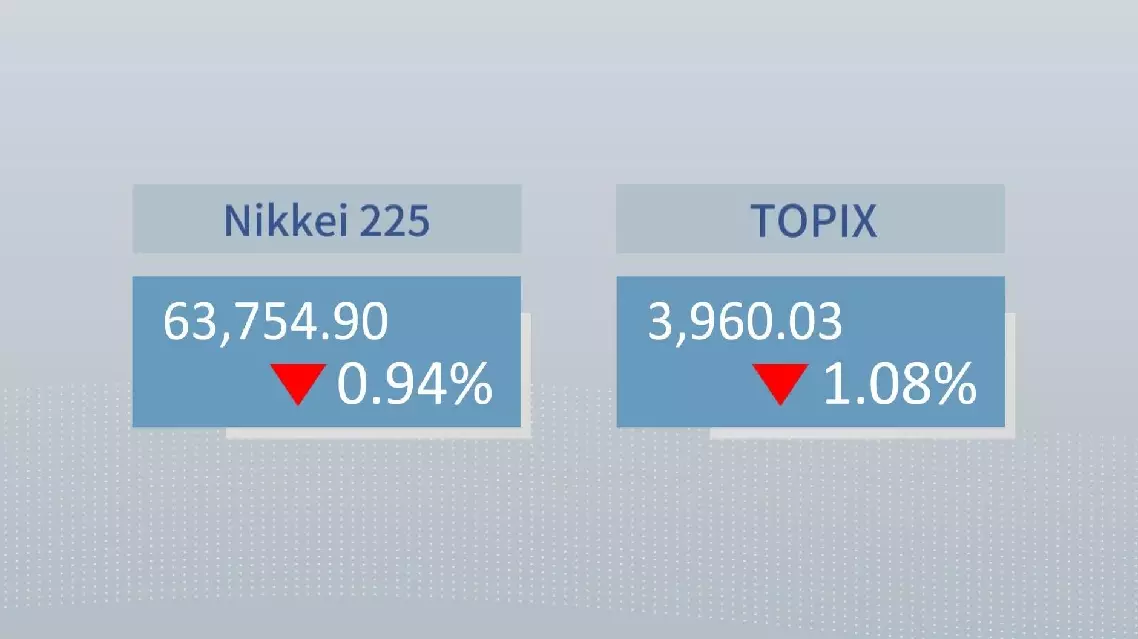
The benchmark Nikkei stock index, the 225-issue Nikkei Stock Average, ended down 607.12 points, or 0.94 percent, from Friday at 63,754.90.
The broader Topix index, meanwhile, finished 43.27 points, or 1.08 percent, lower at 3,960.03.
The Japanese yen rose sharply on Monday, briefly surging to the lower 155 yen range against the U.S. dollar, after Japan confirmed joint currency market intervention with the United States and possible further intervention.
At 17:00 local time, the U.S. dollar fetched 156.76-78 yen after briefly hitting 155.20 yen, compared with 157.33-43 yen in New York and 160.20-22 yen in Tokyo at 17:00 local time Friday.
Tokyo stocks end lower on stronger yen
Chinese carmaker XPeng Motors led Israel's electric vehicle (EV) market in the first seven months of 2026, selling 3,503 units, according to data released Sunday by the Israel Vehicle Importers Association.
XPeng's Israeli lineup includes the mid-size electric crossover SUVs G6 and G9, the executive sedan P7, and the seven-seat luxury minivan X9.
America's Tesla ranked second with 3,162 units, followed by China's Changan Automobile with 2,318 units.
In the seven months, Chinese brands led Israel's EV market with a commanding share of over 70 percent.
In the overall vehicle market, including gasoline, hybrid, and electric cars, Chinese manufacturers led with 90,206 units sold. South Korea followed with 32,728 units, while Japanese automakers sold 20,981 units.
China's Chery led the broader market with 46,542 cars sold, followed by Japan's Toyota with 19,028 and South Korea's Hyundai with 18,023.

Chinese automaker XPeng Motors tops Israel's EV sales in Jan-July