TORONTO--(BUSINESS WIRE)--Aug 5, 2026--
Selling a car in Canada has always been a complicated process. Selling privately means spending weeks coordinating viewings, fielding lowball offers, and negotiating with strangers with no guaranteed outcome. Online "instant" offers are really just instant guesses. Offers from a single dealership can be underwhelming. It's no wonder more than half of vehicle sellers (56%) report a negative experience selling a car, a number that climbs to 77 per cent among Gen Z, according to new research commissioned by CarDoor. Canadians deserve a better way to sell their car.
This press release features multimedia. View the full release here: https://www.businesswire.com/news/home/20260805842689/en/
Today, CarDoor officially launches Canada's only market-driven car-selling platform. Its MarketCheck™ solution lets hundreds of verified dealers compete for a seller's vehicle in real time, delivering an offer driven by actual demand, not guesswork. The value for consumers is clear: the more demand, the stronger the offer they get. Once the seller accepts the offer, CarDoor handles all the paperwork, arranges vehicle pick-up or drop-off, and provides payment on the spot.
“When you try to sell your car, every offer you get is really just someone's best guess,” said Imran Vasta, President and Co-Founder of CarDoor. “Neither a dealer's single offer, an online instant offer from an algorithm, nor a private buyer’s opinion tells you what your car is actually worth. MarketCheck™ changes that. For the first time, sellers get access to real demand from hundreds of dealers actively competing to buy their car. That's not a guess. That's the market.”
The research found the factors that matter most to Canadians selling a vehicle are ensuring the price reflects true market demand (40%), avoiding scams and safety (40%), having a fair and transparent process (36%), and receiving fast, guaranteed payment (29%).
Beyond a stronger offer, CarDoor provides convenience. Instead of visiting dealership after dealership only to face pressure tactics, sellers get a strong, market-driven offer right from the comfort of their own home.
Private sales also carry their own risks. Those who have a negative experience cite unserious buyers (39%), no-shows (38%), time spent scheduling meetups (37%), and concerns about scams or fraud (37%) as common frustrations.
CarDoor creates value on both sides of the transaction. For dealers, that value comes through CarDoorX, CarDoor's exclusive dealer marketplace, which connects dealerships directly with high-quality, consumer-sourced vehicles. While dealers source vehicles through many channels, common options like trade-ins offer limited supply, and industry auctions bring inconsistent inventory and added fees. CarDoorX changes that, offering dealers a steady pipeline of consumer vehicles, zero buy fees, and a fully managed process where CarDoor handles seller negotiations, inspections, and paperwork.
CarDoor currently operates across Ontario, with plans to expand into additional Canadian markets in 2027. To learn more or begin a vehicle assessment, visit cardoor.ca.
About the Survey
These findings are from a survey conducted by CarDoor from May 14 - May 20, 2026, among a representative sample of 1501 online adult Canadians who are members of the Angus Reid Forum. The survey was conducted in English and French. For comparison purposes only, a probability sample of this size would carry a margin of error of +/-2.53 percentage points, 19 times out of 20.
About CarDoor
CarDoor provides a market-driven car-selling platform that gives sellers stronger offers and dealers access to quality consumer inventory. Through MarketCheck™, CarDoor puts seller vehicles in front of hundreds of competing dealers, delivering offers driven by actual competition rather than one buyer's opinion. For dealers, CarDoorX provides exclusive access to consumer-sourced inventory with zero buy fees and a fully managed transaction process. Learn more at cardoor.ca

CarDoor Launches Canada’s First Car-Selling Platform Driven by Actual Market Demand, Delivering Stronger Offers and a Better Way To Sell Your Car
KYIV, Ukraine (AP) — Russian attacks on Kyiv and its surrounding region killed 17 people and wounded dozens, President Volodymyr Zelenskyy said Wednesday, as Ukraine’s depleted air defenses failed to stop any of Moscow’s incoming missiles overnight.
The barrage, which lasted about two hours, was the latest in a series of large-scale Russian missile strikes that have become almost routine this summer. Moscow is exploiting Ukraine’s critical shortage of interceptors for the U.S.-made Patriot systems, the sole air defense weapon in its arsenal able to shoot down ballistic missiles.
Zelenskyy has pleaded with other countries, especially the U.S., to send more of the ammunition made scarcer by the Iran war. Failing that, he wants to make Patriot ammunition in Ukraine or win permission from Elon Musk to use his Starlink satellite communications system to guide strikes inside Russia that can hit its missile launchers.
It's unclear how many interceptors Ukraine has left. Zelenskyy said after a Russian aerial attack Friday night that air defenses shot down only one ballistic missile “solely because there are no missiles for the Patriots.” Supplies of air defense missiles for Ukraine in the first half of this year fell to one-third of the 2025 level, Zelenskyy said.
“Ballistic interceptors are what could have saved the lives of those killed today,” Zelenskyy said Wednesday on social media. “It is very important for our partners to understand that delays in supplying them, or a reluctance to hand over anti-ballistic systems, lead directly to such horrific casualties and destruction.”
The targets hit in the barrage included a brewery, a warehouse for construction material, and a mail sorting office that had nothing to do with the war, Zelenskyy said. But Russia's Defense Ministry said the businesses had military ties.
Thursday was set as an official day of mourning for the 17 people killed, said Tymur Tkachenko, head of Kyiv's regional military administration. In addition to the dead, at least 44 people were injured.
With U.S.-led peace efforts apparently stalled, Ukraine has stepped up its deep strikes on key Russian targets such as oil refineries to try to compel Russian President Vladimir Putin to negotiate. Zelenskyy has accepted an unconditional ceasefire demanded by U.S. President Donald Trump but Putin has refused.
In its latest attack on facilities for Russia’s biggest online retailer Wildberries, Ukrainian drones hit a warehouse in the Tula region south of Moscow, the company and the region’s governor said.
Ukraine has struck over a dozen Wildberries facilities in under three weeks, saying the company provides goods that can be used by the military. Kyiv is also keen to unsettle the Russian public with high-profile attacks.
The Russian Defense Ministry said its forces downed 475 Ukrainian drones overnight over 16 Russian regions, as well as in illegally annexed Crimea and the waters of the Sea of Azov and the Black Sea.
Russia fired 24 ballistic missiles, four other missiles identified as either hypersonic Zircon or supersonic Onik cruise missiles, and 115 drones, many of them jet-powered and harder to stop due to their speed, Ukrainian authorities said.
The Russian Defense Ministry said it struck transport, logistics and distribution centers involved in war-related activity, four of which were in Kyiv.
“The enemy is attacking everything indiscriminately — retail warehouses, food storage facilities, logistics hubs, enterprises, building materials warehouses,” Zelenskyy adviser Serhii Beskrestnov, said on Facebook.
It was not immediately possible to independently reconcile the different Russian and Ukrainian accounts of the military value of the targets.
Kyiv warehouse worker Mykhailo Hukov said an air raid warning that included a ballistic missile threat sounded just after midnight.
“So everyone started running,” he told The Associated Press. “I turned everyone around so they wouldn’t go back inside for their backpacks.”
In an underground shelter minutes later, they heard “very loud explosions.”
Ukraine’s largest private postal operator, Nova Poshta, said a Russian cluster munition destroyed one of its sorting centers in Kyiv.
The Russian Defense Ministry said the center was “storing and distributing dual-use goods, including those used in the production of long- and medium-range uncrewed aerial vehicles, as well as robotic systems and electronic warfare systems.” It claimed that two other logistics centers in the Kyiv region stored drones or components for drones.
Separately, Russia said its forces hit three bulk carriers on the Black Sea south of Odesa that it claimed were transporting Ukrainian weapons and military equipment. Ukrainian officials didn't comment on that claim.
Ivan Braga, a 46-year-old truck driver from Moldova who was in Kyiv during the attack, said he and a colleague ran from their vehicle when it was struck by shrapnel in a blast wave.
“We didn’t even have time to grab our documents or anything else,” Braga told AP. “I couldn’t believe it. I’d already been in Kyiv and had heard explosions before, but nothing like today.”
One of the companies that came under heavy fire was Epicentr, one of Ukraine’s largest retail and construction chains. It said in a statement on Facebook that “in minutes, Russian missiles destroyed what the company had built over decades.” One employee was killed and three others were wounded.
According to the Russian Defense Ministry, the Epicenter logistics center handled order processing, sorting, storing, and delivery of dual-use goods and components for drone production.
AP reporters Illia Novikov, Volodymyr Yurchuk and Dan Bashakov in Kyiv contributed.
Follow the AP’s coverage of the war in Ukraine at https://apnews.com/hub/russia-ukraine
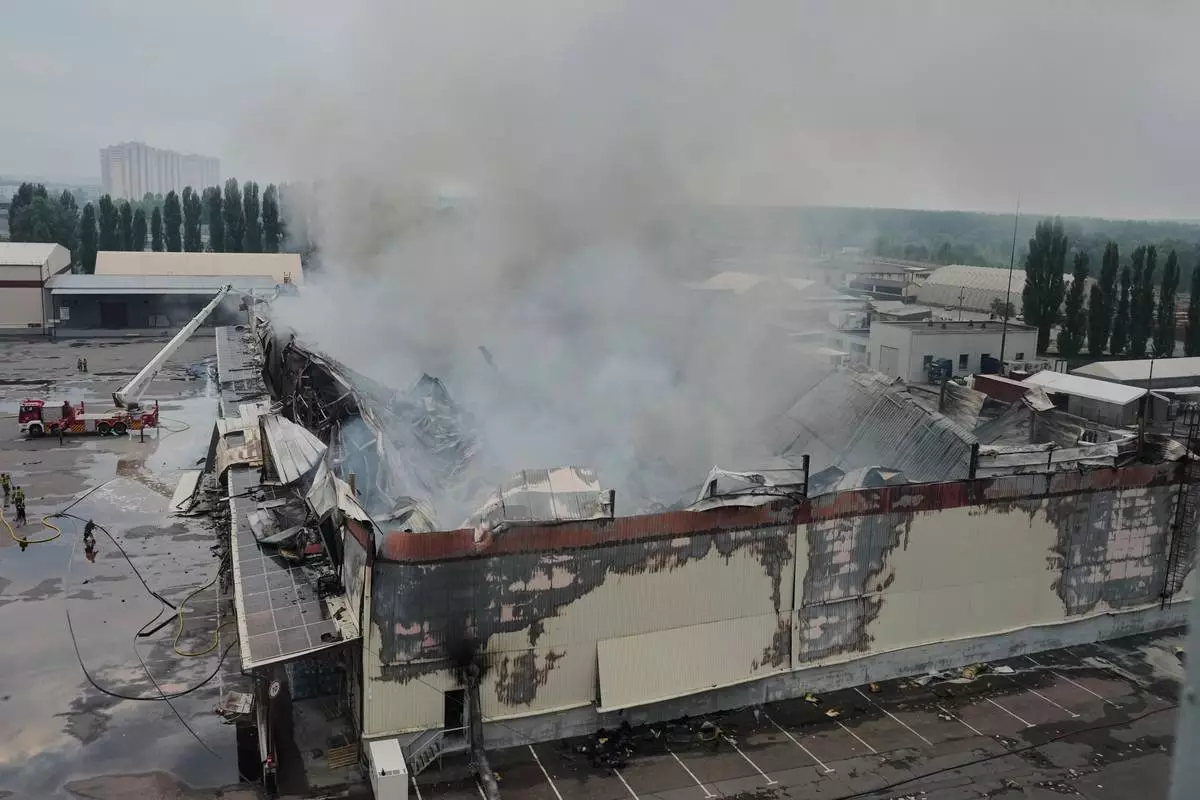
Firefighters put out a fire after Russian missiles hit a food warehouse near Kyiv, Ukraine, Wednesday, Aug. 5, 2026. (AP Photo/Efrem Lukatsky)

Firefighters put out a fire after Russian missiles hit a warehouse in Kyiv, Ukraine, Wednesday, Aug. 5, 2026. (AP Photo/Dan Bashakov)

Firefighters put out a fire after Russian missiles hit a warehouse in Kyiv, Ukraine, Wednesday, Aug. 5, 2026. (AP Photo/Dan Bashakov)

Firefighters examine a fragment of a Russian missile after air strikes at a food warehouse in Kyiv, Ukraine, Wednesday, Aug. 5, 2026. (AP Photo/Efrem Lukatsky)

Firefighters put out a fire after Russian missiles hit a food warehouse near Kyiv, Ukraine, Wednesday, Aug. 5, 2026. (AP Photo/Efrem Lukatsky)

A firefighter puts out a fire after Russian missiles hit a food warehouse near Kyiv, Ukraine, Wednesday, Aug. 5, 2026. (AP Photo/Efrem Lukatsky)
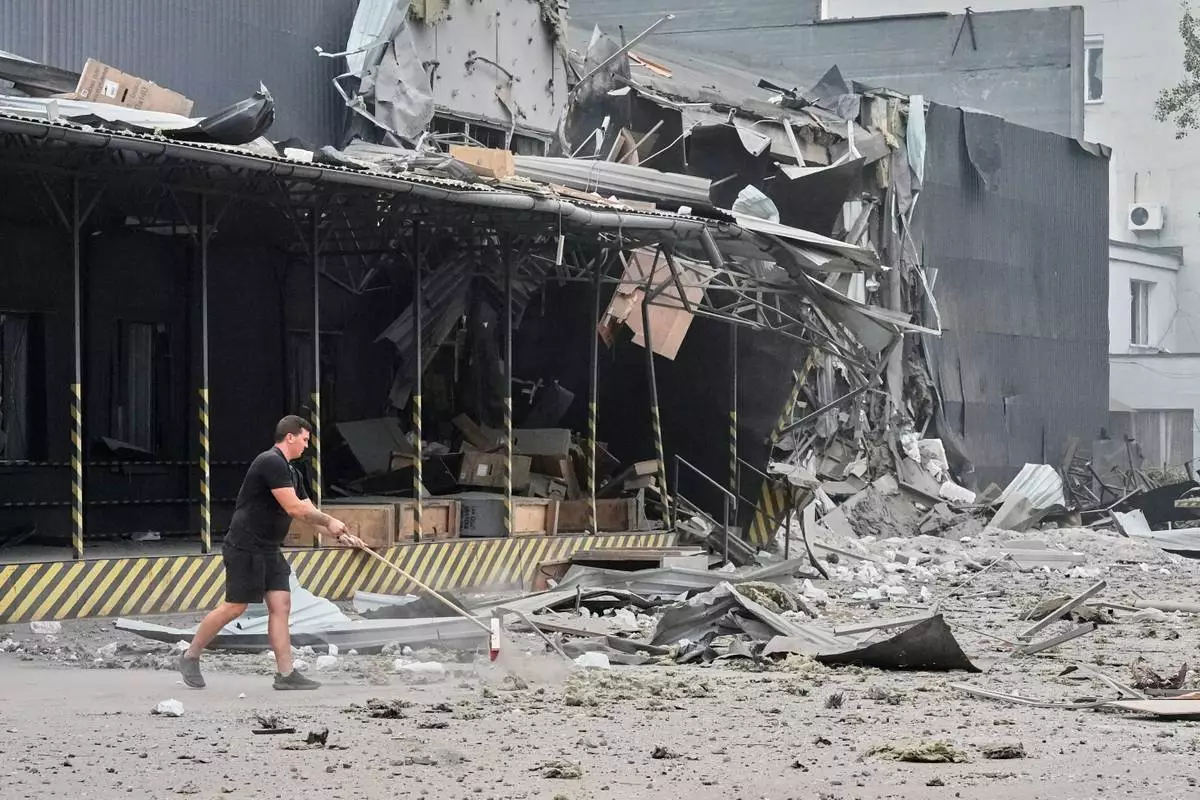
A postal worker clears the debris at the damaged Nova Poshta postal warehouse after Russian missiles strikes in Kyiv, Ukraine, Wednesday, Aug. 5, 2026. (AP Photo/Efrem Lukatsky)

Firefighters put out a fire after Russian missiles hit a warehouse in Kyiv, Ukraine, Wednesday, Aug. 5, 2026. (AP Photo/Dan Bashakov)

Firefighters put out a fire after Russian missiles hit a warehouse in Kyiv, Ukraine, Wednesday, Aug. 5, 2026. (AP Photo/Dan Bashakov)