The recent Western media and think tank narratives suggesting that China's industrial rise is "squeezing" Global South countries and advanced economies out of global markets is "nothing short of bamboozling" and is based on political motives, not economic reality, according to a prominent academic in the United States.
In a detailed analysis titled "The 'China squeeze' -- the politics of development counterfactuals" published on Aug 5, Professor Adam Tooze from the Department of History at Columbia University deconstructed the so-called "China Squeeze" narrative -- the latest iteration of a decade-long pattern of Western "China Shock" scaremongering.
In the analysis, Tooze traced the evolution of the discourse through three distinct versions. "China Shock 1.0" emerged in the early 2010s, retroactively examining the impact of China's accession to the World Trade Organization (WTO) on specific U.S. labor markets. "China Shock 2.0" surfaced around 2020, warning about Chinese high-tech exports threatening Europe's automotive industry.
But it is "China Shock 3.0," or the "China Squeeze," that Tooze finds most egregious. Coined by two Indian economists in the journal Foreign Affairs earlier this year, the theory posits that China's sustained dominance in low-skilled manufacturing has "squeezed" poorer developing countries out of their "rightful" share of development opportunities.
"As an account of economic history, it must surely be regarded as nothing short of bamboozling," Tooze wrote. He argued the theory is not based on data or historical analysis, but rests entirely on a counterfactual premise: that in an imaginary world without China's industrialization, other developing nations would have seamlessly taken its place.
The professor dismantles two core assumptions underpinning the argument.
The first is a "canonical path" model, which assumes countries naturally transition from agriculture to light manufacturing and up the value chain in a linear queue.
"Development is not a queue," Tooze said, citing another analyst. Economic progress is deeply contextual, shaped by politics and historical trajectory, not a predetermined sequence, according to the professor.
The second assumption, a "proportional allocation" model, suggests that a country's share of labor-intensive exports should mirror its share of the global workforce.
Tooze dismisses this as entirely ahistorical. According to him, population size has never guaranteed a corresponding slice of international trade. He also noted that countries cannot build competitive industrial bases on low wages alone -- they require robust infrastructure, supply chains, and logistics networks, which are advantages China has accumulated over decades.
The irony, the professor pointed out, is that the same Indian economists who decry China's "excess" have extensively documented India's own structural failures, such as land and labor regulations, infrastructure bottlenecks, and a "Dutch disease" effect from its service sector, that have prevented it from capturing global manufacturing opportunities.
The repeated drumbeat of the "China shock" rhetoric from anti-China institutions has increasingly been called out within Western academic circles as political blame-shifting. As Tooze put it pointedly: "Can anyone with a straight face suggest that the main problems afflicting the development of South Africa or Nigeria, the great centers of mass underemployment in sub-Saharan Africa, are cheap competition from China driven by Beijing's industrial policy and an undervalued RMB [Chinese yuan]? Likewise, is the main problem of the American working-class the threat of Chinese competition or the manifest crisis of social reproduction in the United States itself?"
Other Western academics have echoed this critique. Jostein Hauge, a political economist at the University of Cambridge, noted in a separate analysis published on July 23 that, on a per capita basis, China's exports rank only around the 104th globally, far below Germany (26th), the United Kingdom (42nd), and the U.S. (63rd). If "export pressure" were the real concern, he argued, developed nations should be the first target of criticism.
According to Hauge, the "China Shock" rhetoric is essentially just a one-sided narrative woven by the West to maintain its dominant position in the world economy, and what lies behind is a sense of hegemonic anxiety.
The debate comes as China continues to expand economic cooperation with other Global South countries. In May 2026, China extended zero-tariff treatment to all 53 African nations with which it has established diplomatic ties, a move that has been hailed as transformative for Africa's industrialization and value-chain integration.
Meanwhile, the International Renewable Energy Agency has credited China's innovation capacity and manufacturing scale for driving down global renewable energy costs by over 60 percent for wind and 80 percent for solar over the past decade, which has made green technology accessible to even the most budget-constrained developing countries.
In his analysis, Tooze said that the recurring pattern of "China Shock" narratives reflects a convenient political scapegoating.
"The point here, as in the discourse around China Shock 2.0 in Europe, is to insist that we should not normalize the world and pathologize China, without actually investigating what is going on in America's industrial wastelands, the German car industry, or India's lopsided labor market," he summarized, adding that a strong China is simply following its own development path and is "not squeezing anyone."
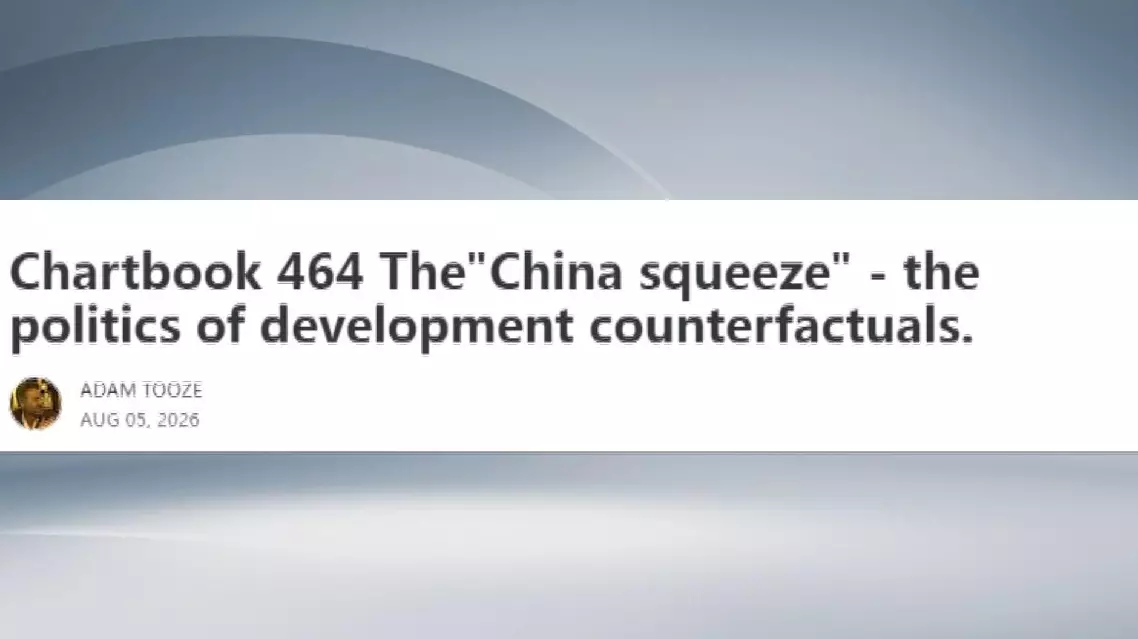
U.S. scholar dismantles 'China Squeeze' narrative as counterfactual politics