New energy vehicle (NEV) sales in China hit a major milestone in July, accounting for more than 60 percent of monthly new car sales for the first time, while their cumulative share in the first seven months topped 50 percent for the first time, according to the China Association of Automobile Manufacturers.
Industry experts said the two firsts mark a decisive shift for China's vast auto market.
"These two 'firsts' are milestones. They show that China's NEV industry has fully moved from policy-cultivation to market-led and entered a new stage of large-scale, high-quality development," said Fang Haifeng, deputy director of the China Automotive Strategy and Policy Research Center.
Consumers are also seeing stronger product competitiveness and richer intelligent features. More importantly, with oil prices staying high this year, the daily running cost of gasoline cars has risen sharply, while electricity costs remain far lower, making NEVs an increasingly compelling choice.
"I used to drive a gasoline car, and needed to spend about 1,300 yuan (about 193 U.S. dollars) a month on fuel. After switching to a pure electric vehicle, I now spend less than 200 yuan a month. This has greatly reduced my expenses," said Li Dingxiang, a car buyer.
At dealerships, foot traffic is also visibly tilting toward electric models.
"Previously, only three or four out of ten customers looked at electric cars. Now more of our customers prefer electric cars. Seven or eight out of ten are visiting for that," said Cheng Shengheng, manager of a car brand store in east China's Anhui Province.
Behind the boom is China's massive NEV-friendly infrastructure, including the world's largest charging network. Latest data show the country has more than 23 million charging infrastructure units, providing critical support for the transition.
"China's vast domestic market, comprehensive and efficient industrial and supply chains, and continuously improving core technologies will keep releasing the sector's vitality and lead to more breakthroughs," Fang added.
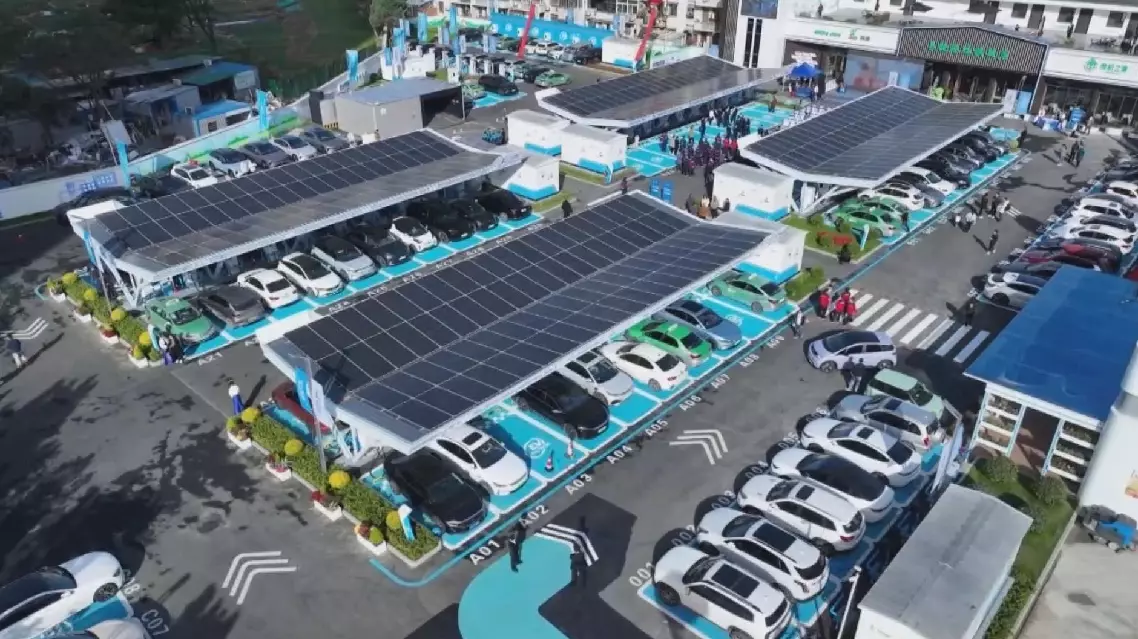
NEV sales in China hit major milestone in July
China on Tuesday unveiled a set of measures to unlock the consumption potential of counties and smaller cities, tapping the vast lower-tier markets as a new source of domestic demand and economic growth.
The government calls for upgrading consumption channels in counties, including renovating township commercial centers, rural markets and local fairs, encourages domestic and international brands to open regional debut stores, and promotes the redevelopment of existing land resources to improve services, according to a guideline jointly issued by the Ministry of Commerce and other authorities.
The guideline also urges better services that cater to the elderly and children, more efficient urban-rural distribution networks, and stronger county-level employment, as well as more channels for residents to increase their incomes.
The measures come as China seeks to give consumption a bigger role in driving economic growth.
The lower-tier markets, generally referring to third-tier and smaller cities, counties, townships and rural areas, account for about 70 percent of China's population and 60 percent of total retail sales of consumer goods. These markets have emerged as a key link between urban and rural economies and an important part of the domestic economic cycle.
The lower-tier markets have diverse needs across different levels, said Shen Bing, a researcher at an institute under the National Development and Reform Commission (NDRC), noting that this diversity can provide broad room for businesses to develop new service models while creating new momentum for consumption.
Official data showed that retail sales of consumer goods in rural areas rose 2.4 percent year on year in the first seven months of 2026, 1.3 percentage points faster than in urban areas. County-and township-level retail sales were estimated to account for nearly 40 percent of the country's total.
China's 2,800-plus county-level administrative divisions form a vast and diverse domestic market, said Chen Xi, a researcher with the NDRC, noting that consumption upgrade is gradually extending from major cities to county-level markets, providing an endogenous source of consumption growth.

China moves to unlock county-level consumption, energize domestic demand