The harvest of 120,000 mu (about 8,000 hectares) of sorghum is now in full swing across Tongzi County,Zunyi City, southwest China's Guizhou Province, as the local specialty crop enters its peak picking season.
In Huoshi Village, Gaoqiao Town, farmers are moving through lush fields, racing against the farming calendar to bring in the crop. Sorghum is a signature industry here, with about 3,000 mu planted in Gaoqiao alone.
Local agricultural authorities have been closely involved throughout the season, promoting green pest control, proper dense planting, and other modern techniques to improve both quality and yield.
"Huoshi village has grown sorghum since 2017 and secured organic certification in 2020. This year, relevant departments organized us to pursue green certification as well, all aimed at boosting villagers' incomes," said Zhang Qilie, head of the Village.
Across the county, the 120,000-mu sorghum harvest is expected to be completed by late August, with total output projected to reach 28,800 tonnes, making the crop an important pillar of the local economy and rural livelihoods.
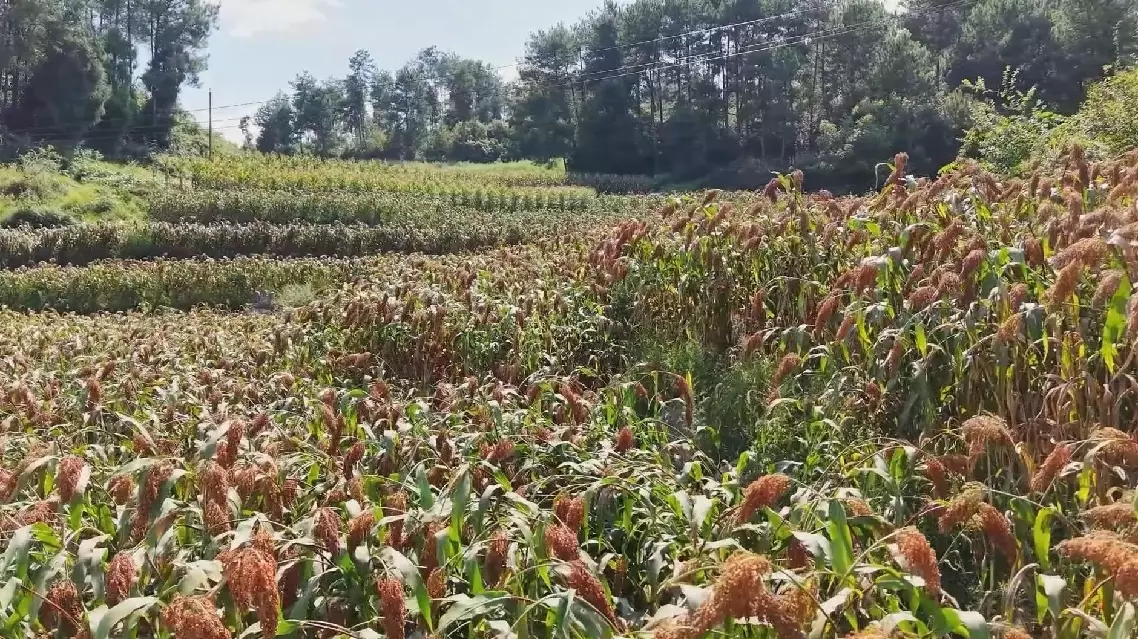
County in Guizhou welcomes sorghum harvest
China on Tuesday unveiled a set of measures to unlock the consumption potential of counties and smaller cities, tapping the vast lower-tier markets as a new source of domestic demand and economic growth.
The government calls for upgrading consumption channels in counties, including renovating township commercial centers, rural markets and local fairs, encourages domestic and international brands to open regional debut stores, and promotes the redevelopment of existing land resources to improve services, according to a guideline jointly issued by the Ministry of Commerce and other authorities.
The guideline also urges better services that cater to the elderly and children, more efficient urban-rural distribution networks, and stronger county-level employment, as well as more channels for residents to increase their incomes.
The measures come as China seeks to give consumption a bigger role in driving economic growth.
The lower-tier markets, generally referring to third-tier and smaller cities, counties, townships and rural areas, account for about 70 percent of China's population and 60 percent of total retail sales of consumer goods. These markets have emerged as a key link between urban and rural economies and an important part of the domestic economic cycle.
The lower-tier markets have diverse needs across different levels, said Shen Bing, a researcher at an institute under the National Development and Reform Commission (NDRC), noting that this diversity can provide broad room for businesses to develop new service models while creating new momentum for consumption.
Official data showed that retail sales of consumer goods in rural areas rose 2.4 percent year on year in the first seven months of 2026, 1.3 percentage points faster than in urban areas. County-and township-level retail sales were estimated to account for nearly 40 percent of the country's total.
China's 2,800-plus county-level administrative divisions form a vast and diverse domestic market, said Chen Xi, a researcher with the NDRC, noting that consumption upgrade is gradually extending from major cities to county-level markets, providing an endogenous source of consumption growth.

China moves to unlock county-level consumption, energize domestic demand