An AI-powered innovation platform in east China's Anhui Province is dramatically accelerating the discovery of new materials, cutting research and development timelines from years to months.
Housed at the AI for Science Center for Matter Creation at the University of Science and Technology of China (USTC), the platform brings together robotic arms, automated vehicles and a large language model developed by the university, integrating cross-disciplinary knowledge built up over decades and in some cases more than a century.
Doctoral student Fang Tiancheng from the USTC had long wanted to develop a safer firefighter suit. His team's new design performed so well in tests that it earned a pennant of gratitude from a local fire brigade.
Before his team found the solution to a much better fire proof suit, even aerospace-grade insulation materials could withstand direct flame for merely less than one minute, a limit that conventional thermal protection has reached.
Fang's team envisioned a completely new material that rapidly absorbs heat when burning and releases gas to carry heat away. The idea, however, required expertise across more than a dozen disciplines, from catalysis chemistry and engineering thermodynamics to quantum chemistry. Simply reviewing the relevant literature would have taken seven to eight years.
"Much of the knowledge was outside my field. I thought it would take forever to make any progress," Fang said.
His frustration reflected a broader challenge. In material science, countless combinations of components, ratios and structures mean it often takes a decade or more to bring a new material from lab to market.
To tackle this bottleneck, Anhui established China's first AI-driven innovation platform for discovering new materials. Powered by a USTC-developed large language model, the platform mines vast traditional knowledge bases spanning multiple fields.
"He used the large model to find a high-energy reaction pathway from traditional knowledge bases in the mining and metallurgy field. Because the process consumes too much energy, very few people had ever used it. But for our purpose, it was exactly what we needed. It could quickly dissipate energy," said Jiang Jun, director of the center.
Every time a parameter is adjusted, the platform's robotic systems respond immediately, conducting experiments around the clock at speeds dozens of times faster than manual work. In less than four months, Fang's team developed the new flame-retardant material. Within a year, it was turned into a finished product that extends firefighter protection from around 10 seconds to 30 minutes.
"This is not about replacing researchers with AI or robots. It's about using these tools to quickly access the most critical knowledge modules. The emergence of AI tools and the innovative ideas of young researchers complement and reinforce each other," Jiang said.
Open to scientists worldwide, the platform is now used by research teams developing new visions such as biomimetic materials that enable humanoid robots to possess full-body sensing capabilities for temperature and pressure, and all-solid-state batteries for next-generation electric vehicles. It can conduct thousands of experiments daily.
To accelerate commercialization, Anhui Province is coordinating with multiple innovation hubs to match research outcomes with real-world applications and investment, turning scientific discoveries into industrial breakthroughs.
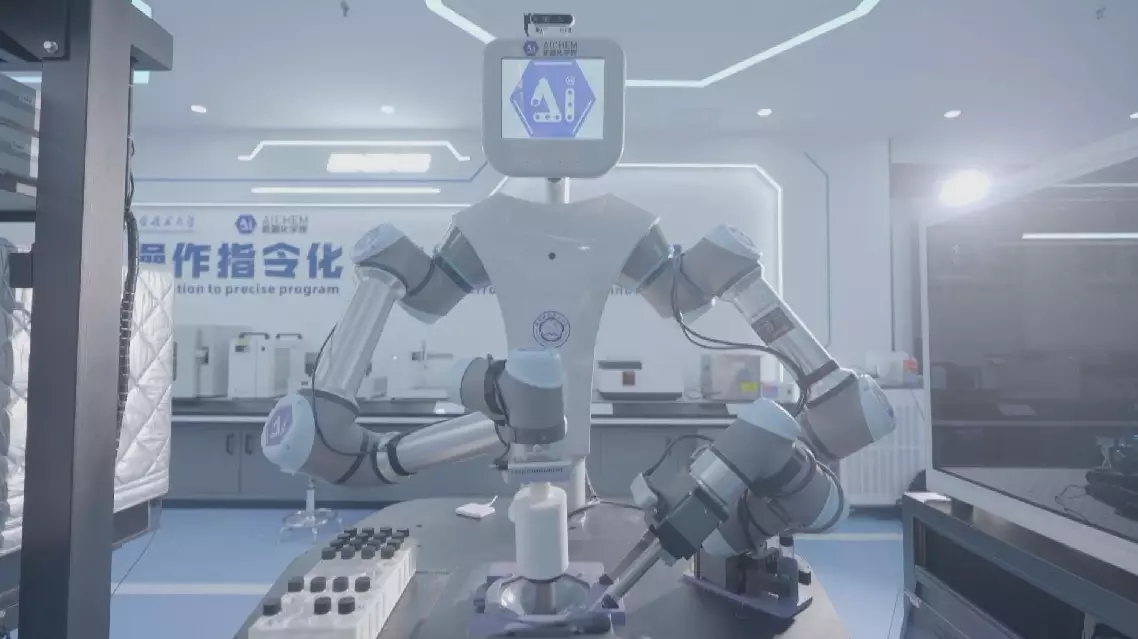
AI-powered lab in China's Anhui speeds up new material discovery