Skip to Content Facebook Feature Image

APEC customs meeting in Dalian focuses on digital, smart trade facilitation

China

China

China

APEC customs meeting in Dalian focuses on digital, smart trade facilitation

2026-08-23 11:19 Last Updated At:14:47

The second plenary meeting of the 2026 APEC Sub-Committee on Customs Procedures (SCCP2), which opened on Saturday in northeastern Chinese city Dalian, focuses on how digitalization and smart technologies can empower trade facilitation and supply chain security.

The SCCP, established in 1994, serves as a regular consultation platform for customs authorities of APEC economies, dedicated to optimizing cross-border customs clearance procedures and making Asia-Pacific trade more efficient, secure and intelligent. China holds the SCCP chairmanship for 2026.

"A new round of technological revolution and industrial restructuring is deepening. Digital and intelligent transformation have emerged as a defining force in reshaping global trade and elevating its quality and efficiency," Zhang Baofeng, deputy chief of the GAC, said at the meeting.

As an important event of the third Senior Officials' Meeting of APEC China 2026, the meeting received more than 100 representatives from customs of APEC's 21 member economies, relevant government departments, international organizations and the business community.

The focus on trade facilitation comes as regional trade continues to expand. China's imports rose 22 percent year on year in the first seven months of 2026, outpacing export growth by eight percentage points, with imports from more than 150 trade partners maintaining growth and reflecting the country's vast market potential, according to the Ministry of Commerce.

China's trade with other APEC economies, in particular, showed strong momentum, with the figure totaling 18 trillion yuan (about 2.65 trillion U.S. dollars) in the first seven months of this year, up 21 percent year on year.

Technological innovation has not only improved port clearance efficiency, but also expanded international logistics channels.

As a flagship Belt and Road project between China and Peru, the Chancay Port has significantly shortened shipping time from Peru to China.

The port, located about 70 kilometers north of Lima and developed with Chinese investment, officially began operations in November 2024, reducing maritime transport time between Peru and China from 35-40 days to 23 days. At a cold-chain distribution center in Shenzhen, imported fruits are being sorted and distributed to nearby markets and supermarkets. A company representative told China Media Group reporter that thanks to the Chancay Port, the fruits remain fresh upon arrival and their import volumes have increased.

"Now we have lower loss rates. This year, the overall import volume of our company have increased by five percent year on year, with imports valued at around one billion yuan (about 148.78 million U.S. dollars)," said Li Yan, person in charge of customs affairs at the international logistics center of Joy Wing Mau Group, a Chinese company in fruit industry.

APEC customs meeting in Dalian focuses on digital, smart trade facilitation

APEC customs meeting in Dalian focuses on digital, smart trade facilitation

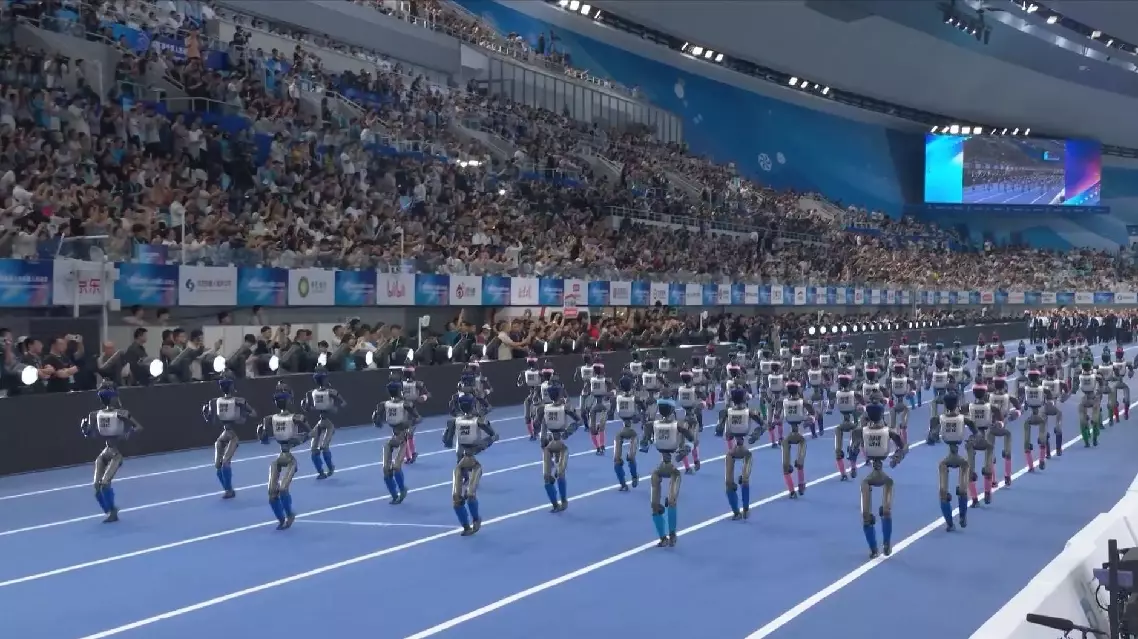
With more than 2,000 humanoids converged in Beijing, the second World Humanoid Robot Games unfolds a high-tech showcase of the latest advances in robotic athleticism and motion control with over 50 competitions set for robot athletes.

Co-hosted by the Beijing Municipal People's Government and China Media Group, the games features 30 competitive sports events and 21 real-world scenario challenges, a major expansion over the previous edition.

The atmosphere quickly hit a fever pitch at the very beginning. In the 100-meter preliminary race during the opening ceremony, a robot clocked 9.39 seconds, breaking the human world record of 9.58 seconds. At a following demonstration of standing high jump, a robot competitor cleared 2.88 meters, while a free combat display saw a robot land a spinning kick that showcased remarkable body control.

The athletes' entrance also featured a massive phalanx of humanoid robots marching onto the stage, each one moving under independent control and computation while dynamically adjusting their postures to stay in formation.

Beyond the main arena, robot contestants have spent months testing their skills in real-world environments. Starting at Milan, where the 2026 Winter Olympics was held, the robots took part in challenges across China to pay tribute to the Olympic Torch Relay. After picking tea in east China's Fujian, racing dragon boats in southwest China's Sichuan, and practicing in horseback archery in northwest China's Xinjiang, the robots gathered at the event to bring training data and nation-wide expertise to the Beijing stage.

"It's been so great to see all of the many robots and the many different sports that they announced in the opening ceremony. These are getting more and more capable every single year with the jumps and flips and all of the moves. Come a long way in 12 months, yes, we are playing with more robots on the same fields, and with are playing with bigger fields. So its getting harder and harder every year," said Timothy Wiley, an audience from Australia.

Jiang Guangzhi, director of the Beijing Municipal Bureau of Economy and Information Technology, said the values of the Games are beyond a robot sport show.

"The World Humanoid Robot Games are not only a sporting arena but also a testing ground for new technologies. Compared with last year, this year's humanoid robots are more robust, more coordinated, more autonomous, more responsive, and more dexterous. We hope that through this platform, we can see the direction ahead and also explore a beautiful future of human-robot coexistence," he said.

Humanoids flex controllability, athleticism at 2nd World Humanoid Robot Games in Beijing

Humanoids flex controllability, athleticism at 2nd World Humanoid Robot Games in Beijing

Recommended Articles