WALTHAM, Mass.--(BUSINESS WIRE)--Aug 25, 2026--
Thermo Fisher Scientific, the world leader in serving science, today introduced the Thermo Scientific™ Orbitrap™ Isora™ Mass Spectrometer and Orbitrap Isora Pro Mass Spectrometer, the company’s first Orbitrap instruments with a dedicated isotope ratio analysis mode. Together with the Thermo Scientific™ Vanquish™ Duo UHPLC System and new Isotope Discoverer™ Software, the instruments form an integrated workflow designed to make molecular-level isotope ratio analysis accessible to more laboratories and researchers worldwide.
This press release features multimedia. View the full release here: https://www.businesswire.com/news/home/20260825330094/en/
Isotope ratio analysis helps researchers across environmental science, geoscience, bioscience, food authenticity and other disciplines determine where a compound came from and what molecular processes shaped it. Those insights can help researchers trace the source of contaminants like forever chemicals in watersheds, reconstruct conditions preserved in the geological record or understand how the body uses nutrients at the molecular level. Until now, access to these insights has largely been limited to specialized isotope laboratories, putting them out of reach for many researchers.
"Isotope ratio analysis can answer questions few other techniques can address,” said Dieter Hofmann, vice president and general manager of Applied Analytical Technologies at Thermo Fisher Scientific. “By bringing these capabilities to a familiar Orbitrap platform and simplifying what has traditionally been a highly specialized workflow, we can put powerful isotope insights in the hands of more scientists and help accelerate discoveries across human health, the environment and our planet.”
Unlike traditional isotope ratio techniques that require samples to be converted to a simple gas, the Orbitrap Isora workflow measures isotope ratios directly at the molecular level, providing a more detailed picture of a sample’s origin and history. At the same time, the workflow simplifies an analysis that previously required multiple script-based tools and complex manual data processing. The Orbitrap Isora workflow brings these steps together, delivering results in hours instead of days and making isotope analysis more practical for a broader range of laboratories. The workflow includes:
“The Orbitrap Isora MS enables new workflows that are very exciting, providing expanding ways to examine everything from human, animal and plant health to the biochemical history of molecule formation,” said Douglas Morrison, Professor of Isotope Bioscience at SUERC - Centre for the Isotope Sciences, University of Glasgow. “By opening new avenues of scientific discovery, the Orbitrap Isora MS could help researchers address fundamental challenges shaping a sustainable future on Planet Earth.”
The Orbitrap Isora workflow expands what researchers can investigate with isotope ratio analysis across a range of fields:
For more information, please visit thermofisher.com/orbitrap-isora.
FAQs:
What are the Orbitrap Isora mass spectrometers?
Orbitrap Isora MS and Orbitrap Isora Pro MS are Thermo Scientific mass spectrometers for isotope ratio analysis. They are the first Orbitrap instruments to include a dedicated isotope ratio analysis mode. Both use electrospray ionization and high-resolution accurate-mass detection to measure isotope and isotopologue ratios from intact molecular ions in liquid samples.
What are the main benefits of isotope ratio analysis?
Isotope ratio analysis measures the natural variation in isotopes within a sample to reveal where a compound came from and how it formed. It's used to help trace contaminant sources, reconstruct geological and environmental history and help verify the authenticity of food, biological and chemical materials.
What is included in the Orbitrap Isora workflow?
The workflow combines Orbitrap Isora MS or Orbitrap Isora Pro MS with the Vanquish Duo UHPLC System for sample introduction and automated sample and reference bracketing, and Isotope Discoverer Software for isotope ratio extraction, correction, calibration and reporting.
How is Orbitrap-based IRMS different from classical IRMS?
Classical IRMS converts the sample to a simple gas first. Orbitrap-based IRMS measures the intact molecule, so structural context survives, one run can capture several isotopologues, and position-specific isotope analysis becomes possible. Thermo Fisher treats Orbitrap IRMS as a complement to its classical IRMS portfolio, not a replacement.
What applications is Orbitrap Isora MS used for?
Current applications are concentrated in environmental research, biogeochemistry, geology, climatology, archaeology, bioscience, metabolism and food authenticity.
About Thermo Fisher Scientific
Thermo Fisher Scientific Inc. is the world leader in serving science, with annual revenue over $45 billion. Our Mission is to enable our customers to make the world healthier, cleaner and safer. Whether our customers are accelerating life sciences research, solving complex analytical challenges, increasing productivity in their laboratories, improving patient health through diagnostics or the development and manufacture of life-changing therapies, we are here to support them. Our global team delivers an unrivaled combination of innovative technologies, purchasing convenience and pharmaceutical services through our industry-leading brands, including Thermo Scientific, Applied Biosystems, Invitrogen, Gibco, Fisher Scientific, Unity Lab Services, Patheon and PPD. For more information, please visit www.thermofisher.com.
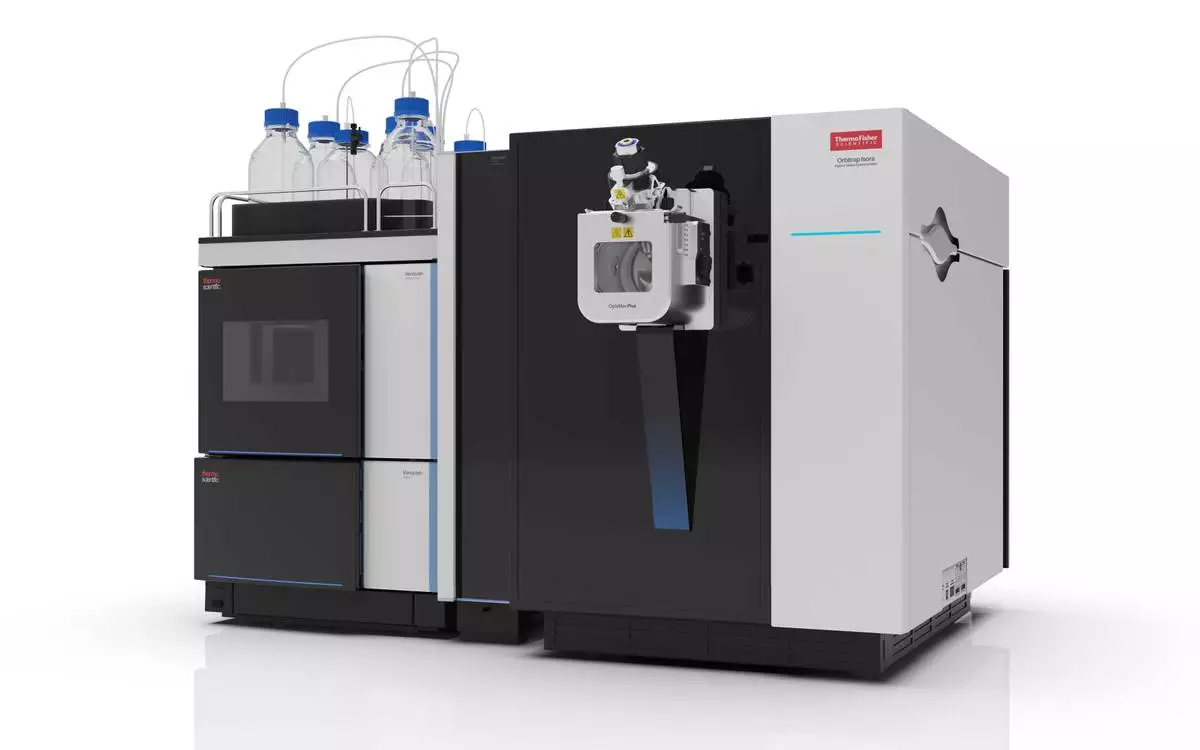
New Orbitrap Isora workflow integrates mass spectrometry, Vanquish Duo UHPLC System and Isotope Discoverer Software to bring molecular-level isotope ratio analysis to more researchers worldwide