CHICAGO--(BUSINESS WIRE)--Aug 27, 2026--
The next major shift in retail may not be happening on shelves. It is happening in the everyday grocery basket, where speed, convenience and top-up missions are reshaping how consumers buy. Quick commerce is emerging as a core engine of grocery growth, according to NIQ (NYSE: NIQ), a leading consumer intelligence company.
This press release features multimedia. View the full release here: https://www.businesswire.com/news/home/20260824560517/en/
NIQ's global report, The Commerce Revolution: Where East Meets West, finds that ultra-fast delivery is already mainstream across parts of Asia, offering a preview of how commerce is likely to evolve globally.
The clearest signs of this shift can be seen in China and India, where quick commerce adoption has reached 83% and 82%, respectively, far exceeding the global average of 48%. By comparison, adoption stands at 34% in Europe and just 3% in North America, highlighting the different stages of market maturity and the growing gap in consumer expectations around speed and convenience.
The must-know signals
The data points to a broader shift: commerce is no longer evolving in silos. Discovery, transaction, and fulfillment are converging into a single, integrated system-one increasingly shaped by AI, platforms, and real-time consumer needs.
"China and India are showing what happens when convenience becomes an expectation rather than a differentiator. The question for brands is no longer whether to participate in quick commerce, but how to do so profitably. Growth is accelerating, but sustainable value will come from understanding which consumer missions truly benefit from immediacy," said Emilie Darolles, President Western Europe, NielsenIQ.
The broader message of the report is clear: commerce is no longer evolving in isolated channels: it is converging into a single system where discovery, transaction, and fulfillment move together. For manufacturers and retailers, the next wave of growth will not come from adding channels, but from orchestrating the system—aligning assortment, pricing, visibility, and fulfillment with how consumers actually shop.
About the report
The Commerce Revolution: Where East Meets West analyzes the convergence of Eastern and Western commerce models across live commerce, social commerce, quick commerce, retail media networks, and emerging agentic commerce. It draws on NIQ Consumer Outlook, Retail Pulse, Digital Purchases, and Omnisales data, alongside third-party sources including McKinsey, Morgan Stanley, and Adobe.
About NIQ
NielsenIQ (NYSE: NIQ) is a leading consumer intelligence company, delivering the most complete and trusted understanding of consumer buying behavior and revealing new pathways to growth. By combining an unmatched global data footprint and granular consumer and retail measurement with decades of AI modeling expertise, NIQ builds decision systems that help companies turn complex data into confident action. With operations in more than 90 countries, NIQ covers approximately 82% of the world’s population and more than $7.4 trillion in global consumer spend. Through cloud-based platforms, advanced analytics and AI-driven insights, NIQ delivers The Full View™ — helping brands and retailers understand what consumers buy, why they buy it, and what to do next. For more information, please visit www.niq.com.
Forward-Looking Statements
This press release, regarding NIQ’s The Commerce Revolution: Where East Meets West report and trends in quick commerce and related channels, contains forward-looking statements regarding anticipated consumer behaviors, market adoption and growth, channel development, fulfillment capacity, and potential impacts on brands and retailers. These statements reflect current expectations, estimates, and projections based on available data, historical patterns, third-party information, and assumptions that may prove incorrect. Words such as “indicates,” “expects,” “anticipates,” “projects,” “likely,” “may,” and similar expressions are intended to identify forward-looking statements. These statements are not guarantees of future outcomes and are subject to inherent uncertainties, including changes in consumer preferences, economic conditions, technological advancements, and competitive dynamics. Actual results may differ materially from those expressed or implied in these statements. While we strive to base our insights on reliable data and sound methodologies, we undertake no obligation to update any forward-looking statement, except as required by law.
Notes to editors
Figures in this release are drawn from NielsenIQ’s The Commerce Revolution: Where East Meets West and include both NIQ proprietary data and third-party market figures cited in the report. The quick-commerce penetration, consumer-adoption, and category-use figures are based on NIQ Consumer Outlook, Retail Pulse, and Digital Purchases data. Market-scale and parcel-volume figures for China, including the over one trillion yuan market estimate and 199 billion parcels in 2025, are cited in the report from market sources (Adobe, Morgan Stanley, Joybuy). The social-commerce spend and ROI figures are based on NIQ social media norms cited in the report.
Frequently asked questions
What is the single biggest finding?
Quick commerce is no longer an emerging behavior in parts of Asia. In China, it has reached 83% consumer penetration and is expected to exceed one trillion yuan in market value this year.
Why does this matter for brands and retailers?
Because quick commerce is changing how consumers shop for everyday needs — especially top-up and grocery missions — and forcing brands to rethink assortment, availability, and fulfillment around real consumption occasions.
Is this just another “growth at all costs” commerce story?
No. The report’s reality check is that channel scale does not guarantee healthy returns. Social commerce already attracts 27.4% of average brand spend, yet 58% of brands still generate less than $1 ROI.
What should brands do now?
Design products, promotions, and fulfillment strategies around specific consumer need states and localized logistics, while measuring where quick commerce creates incremental value rather than simply shifting spend across channels.
NIQ-GENERAL
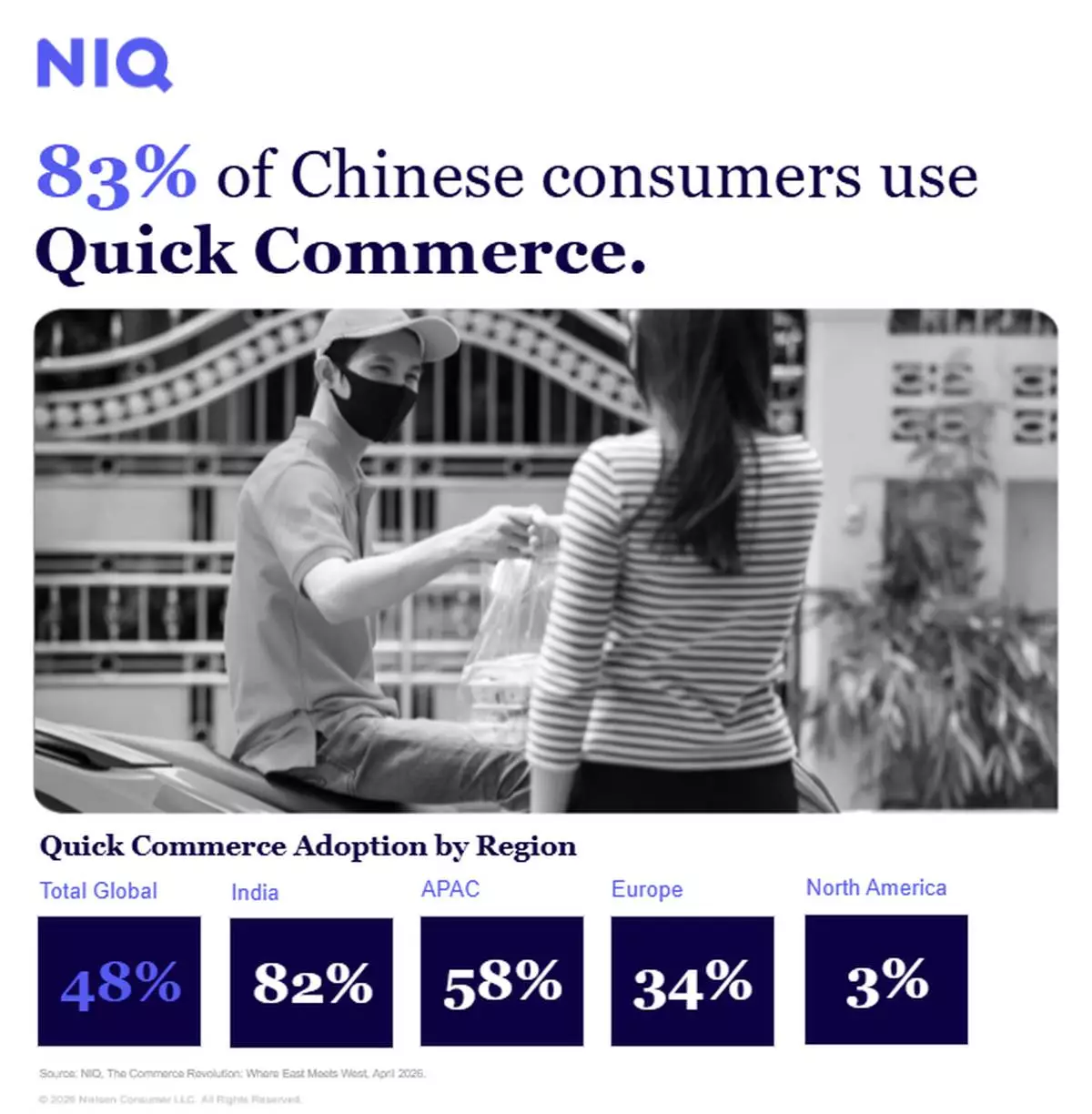
Asia is leading the quick commerce revolution, with adoption rates of 83% in China and 82% in India.
OAKLAND, Calif. (AP) — Kids under 18 will soon see a host of changes to their Instagram and Facebook experiences thanks to a historic $18 billion settlement Meta Platforms reached Wednesday with 48 U.S. states.
Besides the money, which will be paid out over a decade, Meta has agreed to strengthen its age estimates to keep kids under 13 off its platforms and teens in age-appropriate accounts, enact a hard limit of two hours a day for users under 18, block kids from the apps from midnight to 6 a.m., and hide “like” counts, among other changes.
Meta said the new safeguards will only apply in the United States, with most in place for 10 years.
While acknowledging the changes go further than Meta has ever gone when it comes to child safety, critics and children's advocates cautioned it will not solve its myriad problems overnight.
Arturo Béjar, a former Meta engineering director, said the settlement is a “significant milestone,” but parents should not see Instagram as suddenly safe for children.
“The agreement has a big problem in that it allows Meta to define harm,” Béjar said in an interview Wednesday. "It’s one thing to say, ‘Yeah, you only get like two hours of alcohol or two hours of cigarettes a day,’ but it’s still as bad for you because of what’s getting delivered.”
Béjar, the first witness to testify during the federal trial cut short by the settlement, would like to see Meta address the effect of content recommendations to teens, which he says can prove addictive. While teens might put their phone down when they hit the two-hour limit, they can be distressed about it because the way the platform is designed leaves them craving more.
Meta said people over 18 also can adopt versions of the new controls individually, such as daily time-limit reminders, but there will not be an option for them to opt into the overall settings for what teens experience on the platform.
To protect kids, first Meta has to know who they are. While the company has already been using artificial intelligence to determine if kids are lying about their age — either to sign up if they are under 13, which is not allowed, or to use adult accounts when they are 13 to 17 — it did not always work.
Under the proposed settlement, Meta agreed to strengthen its technology to check kids’ ages, using its own as well as third-party tools, with regular outside audits on how well it is working. The agreement also includes specific goals around false positive rates — that is, minors who are identified as over 18. And if a user is identified as under 13 and kicked off the platforms, Meta will check the ages of their friends, too.
“The age assurance section is reasonably good because it has measurement, has independent testing, has goals,” Béjar said. “Because I think Meta should be measured on effectiveness, not effort.”
Meta requires users to be at least 13 years old to create an account, in line with federal child privacy law.
In his testimony last week, Béjar said Meta took a “don’t ask, don’t tell” approach on kids under 13 on its platforms.
“Meta has one of the most sophisticated infrastructures in the world to detect fake accounts,” he said. But despite that, he added, there were “no goals, no metrics” to detect and check kids’ ages who were suspected to be under 13.
Critics have faulted Meta over many of its safety features that users have to manually turn on, or opt into themselves.
Of the host of safeguards listed in the settlement, many are on as a default. This includes the two-hour time limit, which can only be turned off with a parent’s permission, as well as the night mode that blocks use between midnight and 6 a.m.
Still, under the agreement other features, such as turning off video autoplay or showing posts in chronological order rather than having algorithms decide what to show kids scrolling through their feeds, will be opt-in.
Josh Golin, executive director of online safety nonprofit Fairplay, said the deal appeared to be too focused on offering tools to parents rather than restricting harmful features altogether.
“We are disappointed that the settlement does not turn off by default recommendation algorithms that connect kids to predators and send young people down dangerous rabbit holes,” Golin said.
Questions around default settings came up at the trial earlier this week when a lawyer for the states suing Meta pressed Adam Mosseri, the head of Instagram, on the low adoption rate among teens for the “take a break” feature, which prompts users to step away if they have been scrolling a while.
Very few teens used the feature when Instagram first introduced it, but since launching separate teen accounts in 2024, Meta has made it the default setting for teenage users. Still, if a teen didn't want to take a break, they could simply swipe away the notification.
Some researchers have found that many past protections Meta has rolled out are ineffective or don’t work as advertised.
“It is a little premature, unfortunately, to tell if exactly all the changes we want to see are going to happen,” said Yaël Eisenstat, director of policy and impact for the Cybersafety Research Center, which recently audited dozens of safety tools offered by both Meta and other social media companies and said most fell short.
Still, Eisenstat said, Wednesday’s settlement is monumental in showing that alternative approaches are possible.
For years, Meta “decided to go against the advice of some of their own internal employees and continue to ignore the fact that these design features were unsafe in search of profit,” said Eisenstat, who also previously worked at Meta, then Facebook, before leaving the company in 2019. The measures outlined Wednesday at the very least show that there are technically-feasible options that can make the platform safer, she said — something whistleblowers and others have already “been saying very loudly.”
Like others, Eisenstat stressed that there was a lot of work left to be done — and that it will require a combination of technical solutions, market forces and government regulation.
“There’s no singular silver bullet for fixing all of this,” she said. “I’m just glad that at least we are catching up a little bit now.”
The settlement, which also includes the District of Columbia and U.S. territories, must still be approved by a judge.
Grantham-Philips reported from Chicago.

Victoria Hinks gets emotional after talking about her daughter with the media outside court after tech giant Meta reached a settlement to end a landmark trial over teen social media addiction on Wednesday, Aug. 26, 2026, in Oakland, Calif. (AP Photo/Noah Berger) CORRECTION: Corrects spelling of last name from Hicks to Hinks and removes settlement amount

Nicklas Akers, California Senior Assistant Attorney General, left, and Deputy Attorney General Megan O'Neill exit court after tech giant Meta reached a settlement to end a landmark trial over teen social media addiction in Oakland, Calif., Wednesday, Aug. 26, 2026. (AP Photo/Noah Berger)
FILE - A car passes Facebook's new Meta logo on a sign at the company headquarters on Oct. 28, 2021, in Menlo Park, Calif. (AP Photo/Tony Avelar, File)