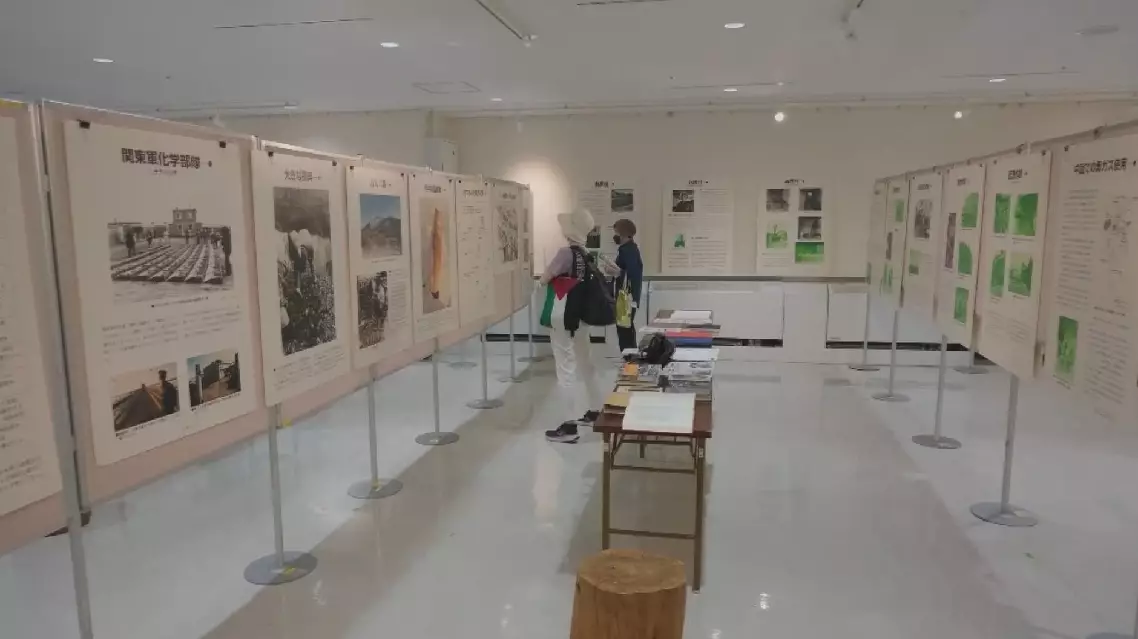
An exhibition on the Japanese military's production and use of poison gas during World War II (WWII) is being held from Aug. 23 to 28 in Yokohama City, Kanagawa Prefecture, Japan.
Organized by a Japanese civic group, the "Japanese Military Poison Gas Exhibition" aims to expose the atrocities committed by the Japanese military, specifically the wartime production of poison gas and the waging of chemical warfare during its war of aggression against China, and to reveal the crimes against humanity perpetrated by Japanese militarism.
According to materials presented at the exhibition, Japan produced poison gas on Okunoshima Island in Hiroshima Prefecture, manufactured poison-gas shells in Kitakyushu City in Fukuoka Prefecture, and trained personnel for chemical warfare in Narashino City in Chiba Prefecture, among other locations during WWII. The Japanese military also conducted chemical warfare operations in various parts of China.
After Japan's defeat, some chemical weapons were left behind in China, continuing to cause harm to local people. The Japanese government, however, has neither issued a formal apology nor provided compensation.
The exhibition uses photographs and written materials to document the history, while Japanese civilian researchers, photojournalists and others involved in researching the subject have been invited to speak at the venue.
"I hope that everyone can understand this process, understand what Japan actually did during the war and the kind of warfare it waged in China. We need to know these facts and consider what we must do to prevent such things like this from happening again," said Goi Shinji, head of the exhibition organizer.
"Eighty years after the war's end, there are still victims, both domestically and internationally, who have not been adequately compensated. Under the Chemical Weapons Convention, the country that abandoned chemical weapons is responsible for their disposal. The issues of victim relief and compensation for sufferers remain inadequately addressed," said Watanabe Tomomichi, professor of the Faculty of Economics at Seikei University.
Visitors to the exhibition echoed concerns that the current Japanese government is both promoting military expansion and downplaying or even distorting the aggressive history. Many believe that Japan must confront its past and engage in genuine reflection to avoid repeating historical mistakes.
"As a Japanese, I do feel ashamed - after all, Japan inflicted immense cruelty on the Chinese people. So I truly feel very sorry (to the Chinese people). I began studying the history of Unit 731 about 50 years ago. Overall, I believe this information has not really been widely disseminated, and ordinary Japanese citizens still do not seem to know much about it. But in any case, we must still convey genuine reflection - or rather, provide a comprehensive understanding of it to everyone," said a visitor.
"Japan has continuously downplayed its past acts of aggression, leading many to believe those events weren't serious. I believe the country's reflection on its historical progression, from the war of aggression against China to its subsequent expansion into the Pacific War - remains insufficient," said another visitor.
Japan civic group holds exhibition on Japanese army's wartime poison gas use