Artificial intelligence and robotics are emerging as a new frontier, deepening cooperation between China and Kazakhstan, with a Chinese robotics company bringing its technology and training programs to Kazakhstan to cultivate the next generation of tech talent.
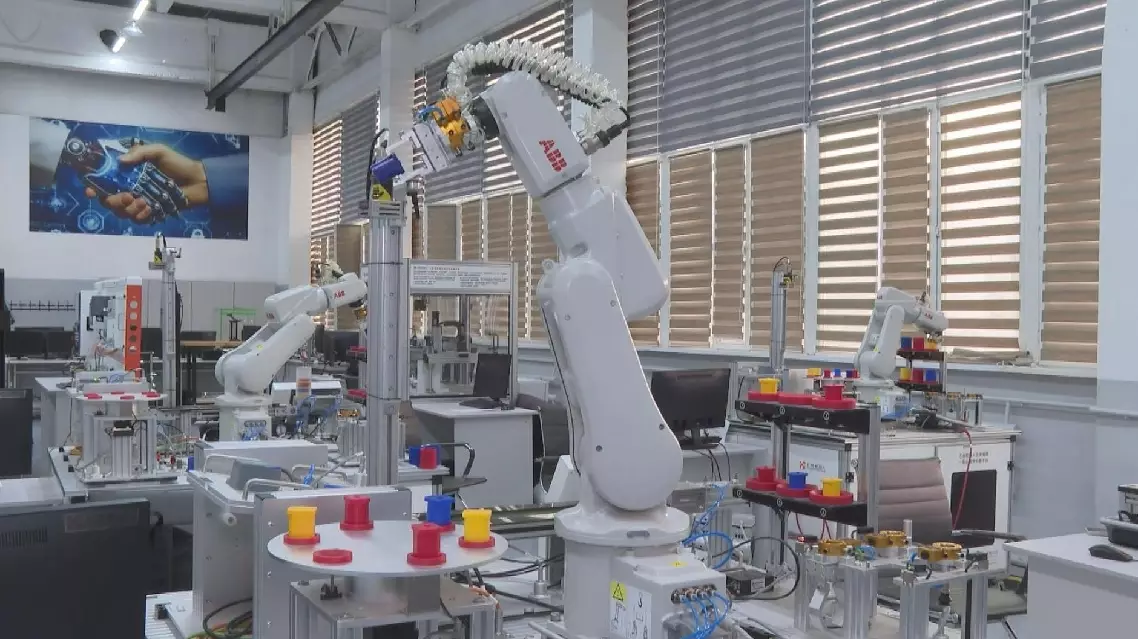
Jiangsu Huibo Robotics in Suzhou, east China's Jiangsu Province, has shared its flurry of learning activities from its training centers with Kazakhstan. The company helped Al-Farabi Kazakh National University establish the Digital-Intelligence Workshop, with training facilities and hands-on classrooms equipped with patented robotic arms, smart manufacturing systems and quadruped robots. Kazakh students build practical technical skills through direct operation in the workshop.
As AI and smart manufacturing accelerate worldwide, education and talent development are adapting to keep pace, prompting more Chinese robotics manufacturers to make training a core part of their business.
Li Wen, director of the International and Key Account Business Department at Jiangsu Huibo Robotics, outlined the company's education portfolio.
"We focus on emerging fields like industrial robotics, artificial intelligence, and the industrial internet. We help establish professional standards, develop curriculum, train talent, and build lab facilities," Li said
Jiangsu Huibo Robotics has introduced its educational model and facilities to its Kazakh partner in Almaty - Al-Farabi Kazakh National University, one of Central Asia's leading institutions for education, research and innovation.
Kazakh students and experts have gained new skills and experienced the latest advances in AI and digital technology through the Digital-Intelligence Workshop.
Akzhol Tumarbay, a student at the workshop, said the hands-on environment has significantly built up his engineering skill set.
"Here, we develop our engineering skills through hands-on practice. For example, we work with robotic manipulators, which help us strengthen our skills in controlling, operating, and programming robotic systems," Tumarbay said.
Fellow student Meyir Israyiluly noted that the workshop has opened access to resources and project opportunities rarely available in standard academic settings.
"Since this workshop opened, working here has given us many new opportunities. We've already worked on several projects, and the workshop provides us with the tools, equipment, and practical experience we need to develop our skills," Israyiluly said.
The hands-on training model is already translating into real employment outcomes, according to Margulan Ibragimov, vice-rector at Al-Farabi Kazakh National University.
"Students from universities across Almaty come here to learn and gain practical skills. So far, around 100 students have trained here and are now working in the industry and at various companies," Ibragimov said.
The university workshop is part of Kazakhstan's wider national digital strategy. Its 2030 digital transformation agenda places artificial intelligence, digital infrastructure, innovation and cybersecurity at the core of its national development plans.
Bakhtiyar Abayuly Mukhametkaliyev, vice minister of Artificial Intelligence and Digital Development of Kazakhstan, framed the bilateral cooperation as a modern evolution of the ancient Silk Road.
"Before, we built the Silk Road, but right now we are building a Digital Silk Road. We exchange not only trade and services; today we exchange data and technology and some different things, such as artificial intelligence and data centers," Mukhametkaliyev said.
From artificial intelligence innovation to advanced manufacturing, the tech partnership between China and Kazakhstan supports both immediate industrial progress and long-term shared growth. As the two countries build out the Digital Silk Road, the skilled talent developed through these joint programs will form the backbone of that collaborative future.
Chinese robotics firm brings AI training to Kazakhstan, deepening digital cooperation