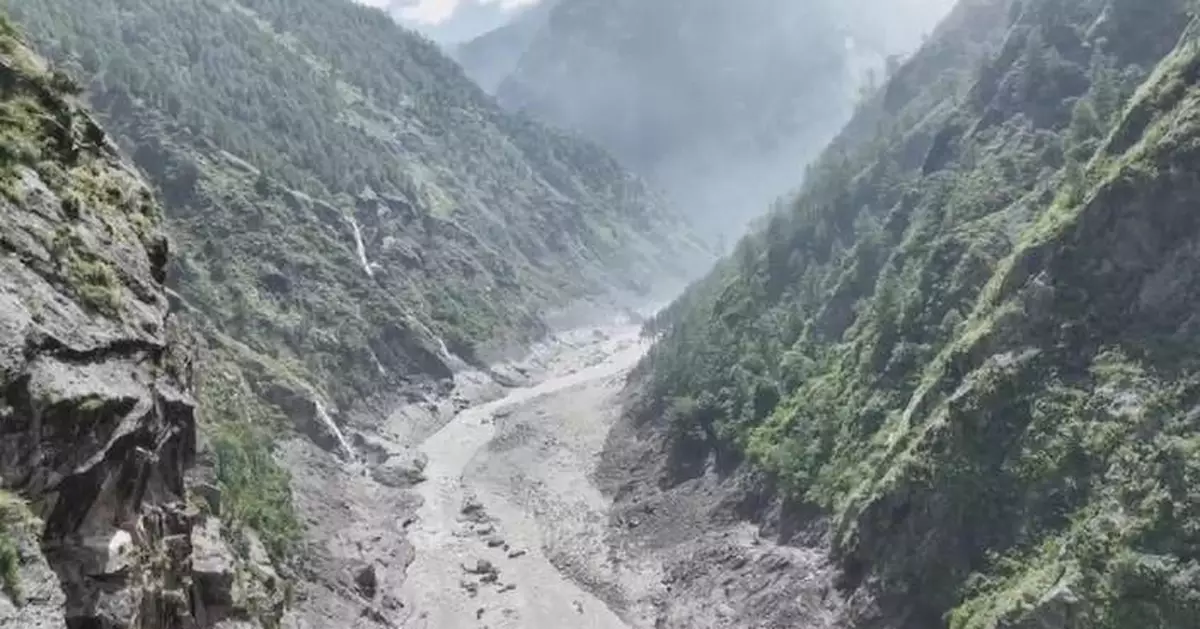
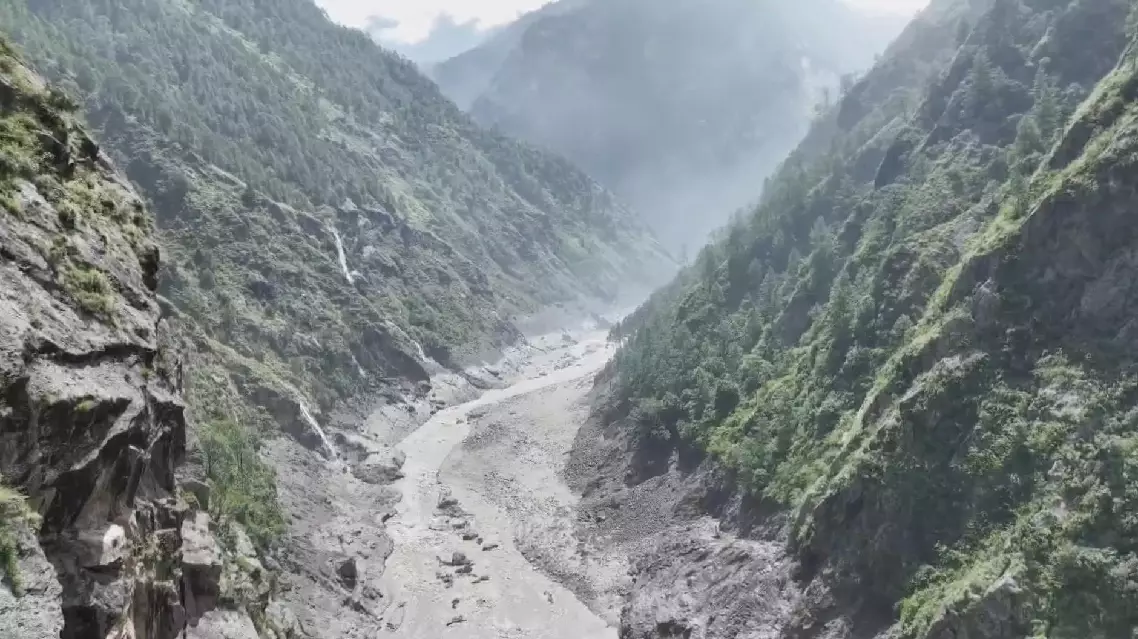
The mudslide that struck the Gyirong Port on the China-Nepal border in southwest China's Xizang Autonomous Region was triggered by a colossal ice rock avalanche with an immense volume and rapid speed, according to an expert.
On the Chinese side, seven people had been killed, and 554 others remained missing, while two local villagers had been rescued as of 01:00 Saturday.
Fan Xuanmei, director of the State Key Laboratory of Geohazard Prevention and Geoenvironment Protection and a professor with the Chengdu University of Technology, explained the primary cause of the event based on satellite and seismic data.
"Based on the satellite and seismic data, our assessment is that this event was initially caused by a very large ice rock avalanche, which filled from a slope with an elevation higher than 5,000 meters. After the materials fell into the gully, it quickly converted into a very large debris flow, which traveled about seven to eight minutes to the Gyirong Port. So, we can see this is a very typical ice rock avalanche-induced debris flow cascading hazard," Fan said.
"So, [for] some of the news on the website I saw, they said that this event was triggered by an earthquake or heavy rainstorm. Actually, we did not really see obvious triggers for this ice rock avalanche. We think that the long-term climate change and the earthquake occurred in 2015 in Nepal may have some effect on this event," she noted.
A 7.8-magnitude earthquake struck Nepal on April 25, 2015, killing about 9,000 people and damaged more than half a million houses in the mountainous country.
Fan further outlined why this mudslide was so devastating.
"[As far as] the first one is [concerned], based on the seismic data, we can estimate the volume of this event is super large. Even we don't know the exact number now, but the energy generated by this ice rock avalanche and debris flow equals to a magnitude 5.1 earthquake. And secondly, it traveled very fast with very high velocity, so we can estimate that it had a velocity of about 50 meters per second, so it was super-fast," she said.
The mudslide, which occurred on the Nepalese side, struck the Gyirong Port in Gyirong County of Xizang -- a key inland port between China and neighboring Nepal -- on Wednesday morning.
Massive ice rock avalanche with high velocity causes devastating mudslide at China-Nepal border: expert