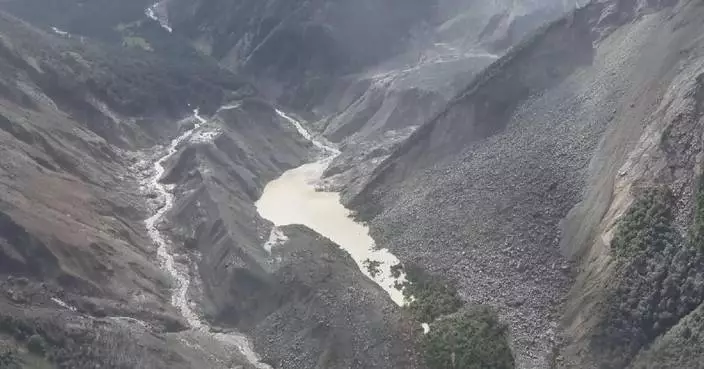
Homestays in a neighboring village have opened doors to evacuees from mudslide-hit Gyirong County in southwest China's Xizang Autonomous Region, providing food, accommodation and volunteer medical services to help them tide over the difficult time.
A mudslide that originated on the Nepalese side of the China-Nepal border struck Gyirong on Wednesday, leaving seven people dead and 554 others missing at Gyirong Port in Xizang as of Saturday morning.
A total of 499 villagers and construction workers have been properly accommodated. Among them, 158 villagers from the mudslide-affected villages of Labi and Seqiong have been resettled in Jifu Village.
In Jifu Village, 19 of the 28 households operate homestays. When the mudslide struck, these owners promptly vacated their available rooms and worked with local authorities to help accommodate residents evacuated from the stricken areas.
"I immediately provided them my rooms. They're facing such a hardship, and my heart truly goes out to them," said Lobsang, a homestay owner.
"It's very convenient. With hot water available, I can wash my feet, take a shower and get some rest. It's very comfortable," said Wangdu, an evacuated villager.
At the settlement, government officials and volunteers go door to door to provide medical services for elderly residents and deliver meals.
"We serve meals regularly everyday, and the medical team is on standby around the clock. Daily necessities are also provided. Residents can come directly to us with any concerns regarding their food or accommodation," said Rinchen Choong, a volunteer with the Jifu village work team.

Homestays open doors to villagers evacuated from mudslide-hit regions in Xizang
As Kyrgyzstan's capital city of Bishkek prepares to host the 2026 Shanghai Cooperation Organization (SCO) Summit, a Kyrgyz student studying in China shares her hopes for greater unity and more opportunities arising from closer cooperation among member states of the SCO.
Under the theme "25 Years of the SCO: Together Towards Sustainable Peace, Development, and Prosperity," the summit will take place from August 31 to September 1, bringing together leaders from more than 20 countries in the Kyrgyz capital.
Adel, a Kyrgyz student of international relations at the Tsinghua University in Beijing, said she has witnessed the deepening friendship between China and Kyrgyzstan firsthand from learning Chinese and making Chinese friends to celebrating traditional Chinese festivals.
"As a Kyrgyz girl living and studying in China, I have personally witnessed the growing friendship between our two nations. When I first arrived in China, I could barely speak Chinese and knew about Chinese culture through some videos online or books. So throughout my studies here, my Chinese got better, I started to be friends with more Chinese people and immerse myself in more Chinese cultural events, such as making zongzi (sticky rice dumplings), celebrating the Mid-Autumn Festival and the Chinese New Year, and at every event I was warmly welcomed and felt the kindness and generous hospitality of Chinese people," she said.
"In response, I love sharing Kyrgyz tradition with my Chinese friends. For example, our nomadic heritage, and our delicious cuisine. I often tell them how similar our values are, for example, respect for elders, love for nature, and the importance of community," she added.
Adel pointed to new travel policies and growing people-to-people exchanges as making a real difference.
"Recently, Kyrgyz citizens were granted ten days visa-free transit through China, as well as visa-free travel to the beautiful island -- Hainan. This is a real, noticeable improvement," said the student.
"I also see more and more young Kyrgyz people turning their eyes towards China. They're learning Chinese, winning government scholarships and coming here to study," she added.
She highlighted two signature projects, the Bishkek waste-to-energy plant and the China-Kyrgyzstan-Uzbekistan railway, as symbols of green growth and closer trade ties.
"Trade between our countries is flourishing. Two major projects stand out. One is the Bishkek waste-to-energy plant, (which) is the largest waste-to-energy plant in the whole Central Asia. It's showing China's commitment to a greener, safer planet. The other is the China-Kyrgyz-Uzbek railway. Though it's still under construction, it promises faster and better trade across our region," she said.
Looking ahead to the 2026 SCO summit in her hometown of Bishkek, Adel said she is optimistic about the future.
"I hope that this SCO 2026 summit in Kyrgyzstan will serve as a powerful symbol of unity, proving that even countries with different languages and cultures can work hand in hand for a shared progress," said Adel.
"My greatest hope is that the agreements signed during this summit will bring more opportunities for students like me, such as scholarships, exchange programs, internship opportunities, summer camps, more green technologies for our cities, mutual respect between our nations, and lastly, I hope it will inspire more people from our member states to see themselves as global citizens building bridges between our nations," she said.

Kyrgyz student hopes SCO Summit builds stronger ties among nations