
Skip to Content Facebook Feature Image

Bessent's Iran post backfires; Navy robs payroll to pay for war

Blog

Bessent's Iran post backfires;  Navy robs payroll to pay for war
Blog

Blog

Bessent's Iran post backfires; Navy robs payroll to pay for war

2026-08-31 10:35 Last Updated At:10:35

Talk about a boomerang. US Treasury Secretary Scott Bessent took aim at Iran in a post on X on the 27th, local time. The post did not produce the effect he intended. Many Americans even suspected the post was an elaborate self-own, a sly dig at the United States itself.

Commenters taunted Bessent: "replace 'Iran' in the post with 'the United States'", "Find a freaking mirror", "Read this tweet back to yourself". The post has so far drawn more than 8,000 comments.

More Images
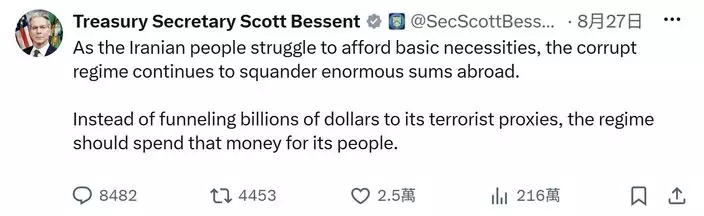
US Treasury Secretary Bessent publishes a post on X targeting Iran, and is hit by "boomerang-style" mockery.
US Treasury Secretary Bessent publishes a post on X targeting Iran, and is hit by "boomerang-style" mockery.

Bessent's post slams Iran's "corrupt regime" for squandering billions abroad.
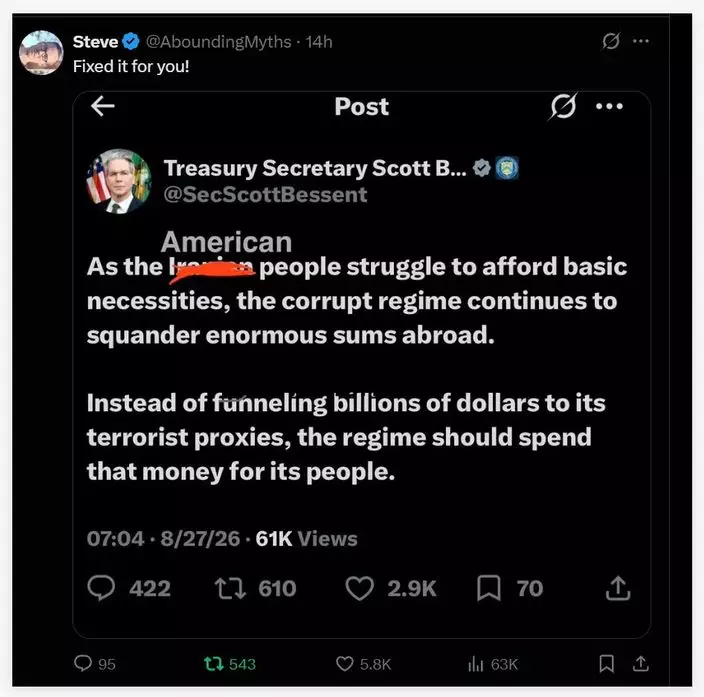
Bessent's post slams Iran's "corrupt regime" for squandering billions abroad.

A netizen offers a "correction" to Bessent's post, replacing "Iran" with "the United States".

A netizen offers a "correction" to Bessent's post, replacing "Iran" with "the United States".

A netizen bluntly tells Bessent to take a good look in the mirror.

A netizen bluntly tells Bessent to take a good look in the mirror.

A pro-Iran account posts photos of the hundreds of Iranian children previously killed by US missiles.
A pro-Iran account posts photos of the hundreds of Iranian children previously killed by US missiles.

British media reports that the US-Iran war has drained US munitions stockpiles, putting US military budgets under enormous pressure.

British media reports that the US-Iran war has drained US munitions stockpiles, putting US military budgets under enormous pressure.

The timing makes the boomerang hurt even more. On the same day, the 27th, Britain's The Guardian published an exclusive. It reveals that the US military is mired in a severe financial crisis. The US Navy has been forced to divert money from service members' payroll account and other funds to cover combat expenses.

US Treasury Secretary Bessent publishes a post on X targeting Iran, and is hit by "boomerang-style" mockery.

US Treasury Secretary Bessent publishes a post on X targeting Iran, and is hit by "boomerang-style" mockery.

In the post, Bessent declares: "As the Iranian people struggle to afford basic necessities, the corrupt regime continues to squander enormous sums abroad. Instead of funneling billions of dollars to its terrorist proxies, the regime should spend that money for its people."

Bessent's post slams Iran's "corrupt regime" for squandering billions abroad.

Bessent's post slams Iran's "corrupt regime" for squandering billions abroad.

The post draws a flood of comments from American netizens. Many feel Bessent's words read more like a description of a warmongering United States, and they pile on the ridicule.

One netizen says Bessent wrote one word wrongly and kindly corrects it for him: change "Iran" to "the United States". That comment earns plenty of likes.

Others lash out directly: "You are LITERALLY describing America." Another writes that America is "Squandering trillions into never ending wars for the benefit of the MIC and Wall Street while the bottom 90% can’t afford to live except by taking on more debt." A third tells Bessent: "Find a freaking mirror." One netizen even suggests Bessent "Read this tweet back to yourself".

A netizen offers a "correction" to Bessent's post, replacing "Iran" with "the United States".

A netizen offers a "correction" to Bessent's post, replacing "Iran" with "the United States".

A netizen bluntly tells Bessent to take a good look in the mirror.

A netizen bluntly tells Bessent to take a good look in the mirror.

Pro-Iran accounts also weigh in. One account posts photos of the hundreds of Iranian children previously killed by US missiles. Its criticism is blunt: American taxpayers' money is being used to buy weapons that kill Iranian schoolchildren, while homeless people who cannot get enough to eat are everywhere in America's own cities. It is the United States itself that should be spending its money on people's livelihoods rather than on war.

A pro-Iran account posts photos of the hundreds of Iranian children previously killed by US missiles.

A pro-Iran account posts photos of the hundreds of Iranian children previously killed by US missiles.

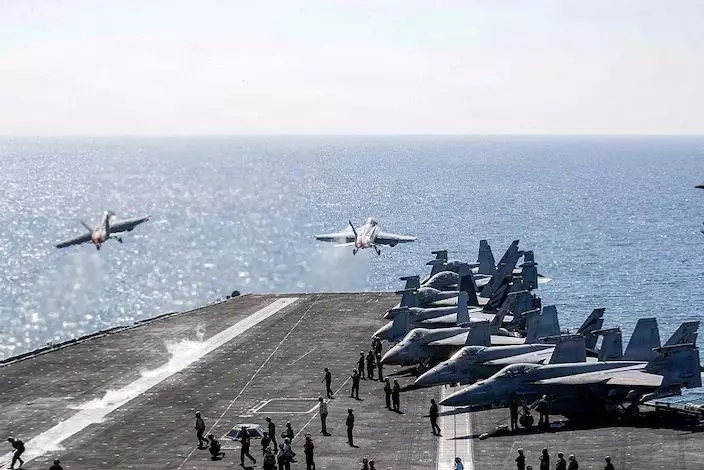
Then there is that Guardian exclusive. The paper reports obtaining a Pentagon memorandum on Navy funding. America's military operation against Iran has depleted US munitions stockpiles, and Iran's retaliatory strikes have inflicted heavy damage on multiple US military bases across the Middle East. Every part of the US military budget is now under enormous pressure.

The report says the Department of Defense has been pulling money from payroll accounts to finance combat operations. Those accounts have now developed shortfalls.

The report quotes Harlan Ullman, a retired US Navy officer: "The piggy bank is broken." Ullman sits on the National Commission on the Future of the Navy, though he stresses the interview does not represent the commission's position. One official and one Navy contractor also reveal that, owing to the funding crunch, non-emergency maintenance work at shore-based facilities has been deferred.

British media reports that the US-Iran war has drained US munitions stockpiles, putting US military budgets under enormous pressure.

British media reports that the US-Iran war has drained US munitions stockpiles, putting US military budgets under enormous pressure.

Since February this year, the United States and Israel have been waging a large-scale military assault on Iran. The US Navy not only joined the initial wave of attacks but has also shouldered a prolonged maritime blockade. The White House subsequently applied to Congress for emergency funding. Approval of that request looks unlikely.

A Navy official says the service is shifting money around in every way it can: "The money for payroll was robbed to pay for overseas contingencies and is being backfilled by money that hasn't been spent. They are backfilling payroll so we get enough money in our paycheck."

The US Navy's total budget for fiscal year 2026 runs to nearly US$300 billion, according to the report. The money is divided into different purposes: personnel pay, shipbuilding, weapons procurement, and "operations and maintenance", the day-to-day running of the fleet and its bases. The law restricts the movement of funds between these appropriation items.

The funding problem has surfaced at hearings on Capitol Hill. Republican senator Susan Collins, chair of the Senate Appropriations Committee, said on 21 July: "I’m told some military services face near-term solvency challenges." A staffer says the US Navy was among the services Collins was referring to.

A US Navy spokesperson says in a statement that maintenance and operations funds have not been exhausted: "The Department of the Navy is actively managing its resources to meet current pay obligations on time. We continue to work closely with Congress to address ongoing operational demands and sustain our personnel and readiness throughout the fiscal year."

But the real issue is what the Navy will not say out loud. Inside the US Navy, the funding shortage has long been an open secret. US defense analyst Todd Harrison of the American Enterprise Institute puts it bluntly: "They're just not speaking publicly about it."

In his view, this may be a decision made by the Pentagon's civilian leadership out of political considerations. "They don't want to look like they're damaging future military readiness over a war that is becoming increasingly a political liability."

US Defense Secretary Pete Hegseth has been lobbying Congress to pass the emergency funding. He warned in July that the department will face a serious funding gap if the money ultimately fails to arrive.


Deep Throat

** 博客文章文責自負,不代表本公司立場 **

CIA Director Ratcliffe slipped into Moscow on August 25 for a secret meeting with Russian officials. But first, the US had to ask its ally Ukraine to suspend attacks on Moscow. Just to clear a path for the visit.

The US always loudly proclaims its unwavering support for Ukraine. This time, it had to swallow its pride and fly to Moscow, begging for a meeting.

Four Hours, Kremlin's Terms

In the morning of August 25, a US Air Force C-17A Globemaster III slipped into Moscow's Vnukovo Airport, after a quiet transit through Riga, Latvia. Almost simultaneously, a US diplomatic motorcade was spotted on Moscow streets, and word of CIA Director Ratcliffe's visit began to leak.

The whole meeting lasted barely four hours. By 7 p.m., the transport plane was already gone, lifting off from Vnukovo.

It was Ratcliffe's first known trip to Russia as CIA director. And the highest-level US visit to Moscow since the Trump administration took power in January 2025.

A US Air Force C-17A quietly lands at Moscow's Vnukovo Airport on August 25.

A US Air Force C-17A quietly lands at Moscow's Vnukovo Airport on August 25.

From start to finish, the Kremlin acted like a host in total control. Spokesman Peskov initially pleaded ignorance. No meetings with US officials were scheduled this week, he said. The message was clear: we decide if we meet, not you.

By August 26, Peskov confirmed the visit involved intelligence contacts. But he stressed that President Putin did not meet Ratcliffe in person. He only received a briefing afterward. As for whether this contact could pull Russia-US relations out of their deep freeze, Moscow was cool and reserved. Peskov said it was too early to draw any conclusions.

The reality is, Moscow decided everything: whether to meet, when, and who would do the receiving. The US could only follow Moscow's script.

Multiple US media outlets, citing informed sources on August 26-27, disclosed the secret meeting's content. Ostensibly, Ratcliffe went to Moscow to negotiate. In reality, it was more like a personal visit to test Russia's bottom line. He asked Russia not to take action against NATO members, especially the three Baltic states that have long feared being targeted.

Let's be blunt. These small European nations have been constantly complaining to the US, claiming they're under threat. The US, playing big brother, felt it had to at least make a gesture. So it flew to Moscow to say a few fair words on behalf of its little brothers, telling Russia not to bully them. As for the effect? That depends on whether Russia decides to give face.

Iran, Denials and Rumors

Beyond NATO, Ratcliffe also raised the Iran issue. He warned that if the Strait of Hormuz remains closed, the US will slap additional sanctions on Iran. But think about it: even this message had to be delivered in person by America's top intelligence official. That alone shows how limited Washington's real influence over Russia is. They had to send the CIA director just to pass a note.

Ratcliffe's mission: persuade Russia not to target NATO's Baltic states.

Ratcliffe's mission: persuade Russia not to target NATO's Baltic states.

Then Trump stepped in. On August 26, he flatly denied the whole story in a radio interview. Ratcliffe's trip, he insisted, was about ending the Russia-Ukraine war. It had nothing to do with Russia testing NATO or Iran sanctions.

The problem? Washington can't even get its own story straight. The media says the trip was to stand up for European junior partners. The president says it was only about peace. That kind of chaos reveals a deeper truth: the US is on the back foot, scrambling to cobble together a coherent public line.

Swap Rumors, Empty Hands

Then there's the rumor mill. One online claim says Putin used the meeting to demand US guarantees: no future Western prosecution would force him into exile, and his frozen overseas assets would be released. It's a wild story. And it has no basis. Russia is a major power. Putin is a hardliner. He's not about to beg for exile guarantees.

So why do these rumors circulate? They reflect the anxiety gnawing at some in Washington. People are so jittery about these talks they're dreaming up unrealistic scenarios. And let's be clear: no Russian source has ever confirmed any of it.

But here's what really matters: the US choreography before the trip. Reports say Washington tipped off Ukraine well in advance. Ratcliffe was coming to Moscow, and Kyiv was told to hold its fire. No attacks on Moscow or other areas until the 'foreign guests' were gone. The ceasefire even stretched to St. Petersburg and northern Russia, lasting through August 26.

Think about that. The US constantly trumpets its support for Ukraine on the world stage. But when it needed to sneak into Moscow, it told its 'junior partner' to stand down. Hold your fire so we can do our secret diplomacy. That's the reality.

Some analysts see an echo of 2021. Back then, CIA Director Burns was dispatched to Moscow to lobby Putin: don't send troops into Ukraine. Now the US is sending envoys again, asking for restraint. But the ask has changed. This time, the message is: don't take further action against NATO.

Ratcliffe's trip lands at a stalled moment. The US-brokered peace talks are going nowhere. Since early this year, when Trump's envoy Witkoff and son-in-law Kushner visited Russia with a peace plan, negotiations have been stuck. The sticking points? Territorial division, security guarantees, ceasefire conditions. Meanwhile, the conflict grinds on.

Another online theory: the secret visit was about a prisoner swap. The possible prize? Charles Zimmerman, an American convicted in Russia. That's Ratcliffe's turf. He's personally led several US-Russia prisoner exchanges. But again, no confirmation.

To clear his path, Ratcliffe reportedly asked Ukraine to stop striking Moscow.

To clear his path, Ratcliffe reportedly asked Ukraine to stop striking Moscow.

It was billed as a grand diplomatic offensive to unite allies against Russia. Instead, the US flew to Moscow, hat in hand, to seek talks, mouthing a few perfunctory words for its European junior partners. And it even told Ukraine, another junior partner, to step aside and cooperate.

The top US intelligence official personally boarded a transport plane and flew straight to Moscow. Would he be received? At what time? By whom? Moscow decided it all.

Recommended Articles