The future belongs to artificial general intelligence (AGI). China and the United States are pursuing different strategies in the contest for global leadership.
But one US national security think tank wants to take the rivalry to an extreme. The Center for a New American Security (CNAS) has gone so far as to suggest that Washington consider extreme measures to stop China from achieving AGI first.
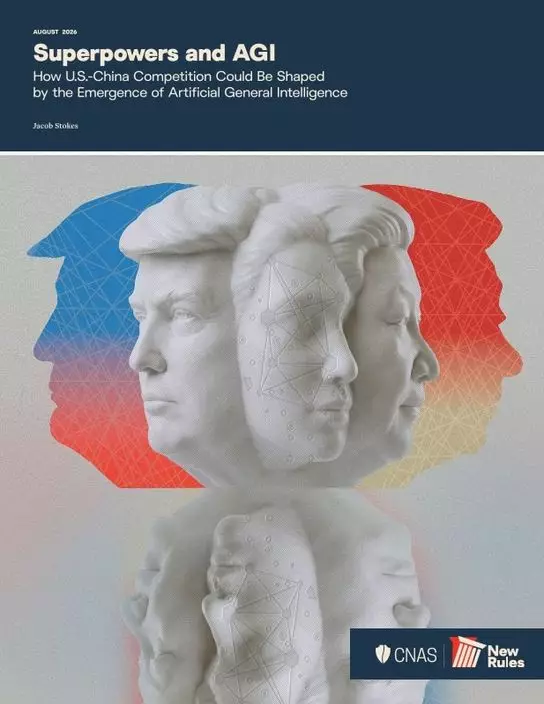
CNAS released “Superpowers and AGI” report late last month.
Jacob Stokes, one of the report's authors and a former White House official, called on the US to prepare itself. He listed possible extreme measures, from diplomacy and espionage to cyberattacks and coercive steps. Among them: military strikes on Chinese data centers.

Stokes, one of the authors of the report urged extreme steps, even strikes on Chinese data centers.
CNAS is headquartered in Washington and was founded in 2007. It has long advised the US government on defense, Indo-Pacific and China strategy. Its lean is hawkish.
Late last month, CNAS released a report titled “Superpowers and AGI”. The document reeks of gunpowder. It argues that the race for AGI, and the technology's potential emergence, could profoundly affect US-China competition. It could also heighten the risk of military conflict or catastrophe on multiple fronts.
The Containment Checklist
To that end, the report urges US policymakers to act on several fronts. First, ensure that American resources and technology do not aid China's AI development. Second, establish AI-focused diplomatic channels with allies and with China, so that the potential emergence of AGI is placed on the agenda. Third, develop a technically sophisticated method to track the inputs into AGI and the key performance thresholds of frontier AI systems.
The list goes on. Washington should conduct scenario exercises testing when and how the US should intervene to halt China's AGI development. It should prepare to reverse-engineer or steal the technology should China obtain AGI first. And it should limit and contain the reach of authoritarian digital infrastructure.
The most extreme proposal of all is military strikes. The South China Morning Post reported on 4 September that Stokes, deputy director of CNAS's Indo-Pacific Security Program, addressed an online event on Thursday.
His message was blunt. The US Department of Defense, the National Security Agency and other agencies should begin assessing what intelligence would be needed to justify such operations. That would pave the way for the "hard action" to follow.
The Cold War Playbook
Stokes served as a national security staffer under former US president Barack Obama. In the report he unabashedly lays out a menu of what he calls "diplomatic, espionage, cyber and kinetic measures." Among them are military strikes on the data centers that train and run China's AGI systems. He even touts preventive strikes before China develops AGI at all.
Stokes goes so far as to compare the undertaking to the way "in a past era, policymakers would learn about nuclear weapons." His declared method is to "work backwards from the science to the policy implications."
Citing assessments by research outfit Epoch AI, the report notes that the US currently leads China in advanced AI models by only "months." But it warns that China could pull off an "unexpected technological breakthrough" in fields such as robotics and "embodied AI."

Citing research institute Epoch AI data, the report sees China pulling off surprise breakthroughs.
Notably, Stokes also concedes a gap on the American side. The US government and its intelligence agencies have "not been organised for espionage to gather technological secrets for decades."
"The Height of Recklessness"
Stokes' extreme remarks have drawn questioning within the United States itself. William Hartung, a senior arms and defense budget expert at the Washington-based non-profit Project On Government Oversight (POGO), publicly slammed the report as "the height of recklessness."
Hartung warned that any strike on Chinese data centers would "risk starting a shooting war between two nuclear-armed powers". Such a war could bring tragic consequences for all concerned.
China has consistently maintained that AI should be people-centered and that intelligence should serve the good. Military applications must remain under human control. Beijing opposes turning technological issues into bloc confrontation or weaponry.
Make no mistake: technological competition is no casus belli. When individual American politicians and think-tank figures reach for threats of "military strikes" and "espionage" at every turn, they gravely violate the basic norms of international relations. They also expose a dangerous bid to politicize and militarize technology.
Deep Throat
** 博客文章文責自負,不代表本公司立場 **
The Japanese yen keeps sliding, and prices across Japan keep climbing. In recent days, a wave of Japanese supermarket shelf photos has swept Chinese social media and shot up the search rankings. The images show shrimp shells, chicken bones and watermelon rinds, the parts usually tossed straight into the trash during everyday cooking, washed, packaged, tagged with prices and neatly displayed, waiting for customers to buy.
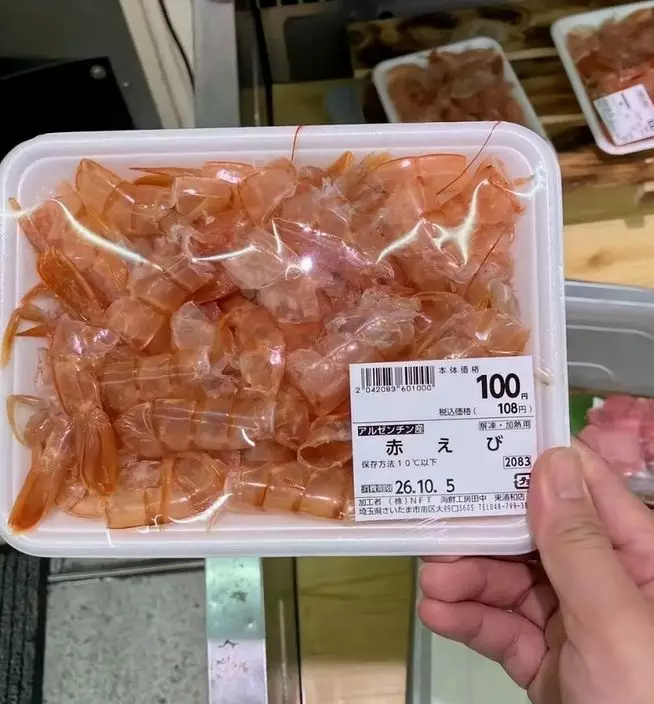
Japanese supermarket scraps—shrimp shells, bones, rinds—packaged and priced
Trash Becomes Merchandise: Shrimp Shells and Watermelon Rinds Hit the Shelves
Some netizens exclaimed that in their homes these scraps all go straight into the waste bin, while others questioned whether Japan has grown so poor that it must turn kitchen scraps into cash.
But the causes behind this trend run far deeper than the word 'poor' suggests.
Step inside a local supermarket, and the commercialization of offcuts turns out to be remarkably mature. Watermelon rind is cut into long strips, boxed in cling film and sold at a clearly marked price, while shrimp shells are packaged on their own at 108 yen a box, complete with a recipe card teaching customers how to simmer miso soup. Enoki mushroom stems, radish leaves, napa cabbage ribs, fish tails and other parts mostly discarded outright in China can be found everywhere in the refrigerated compartments.
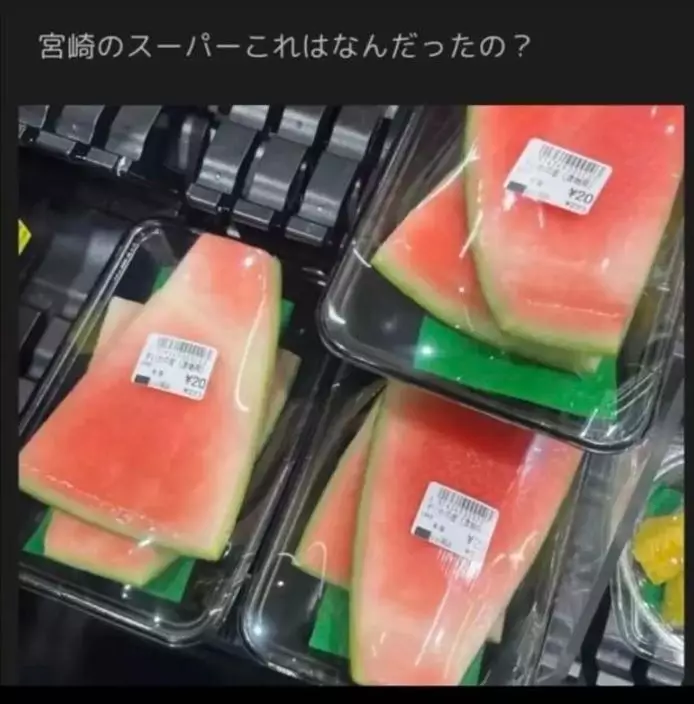
watermelon rinds
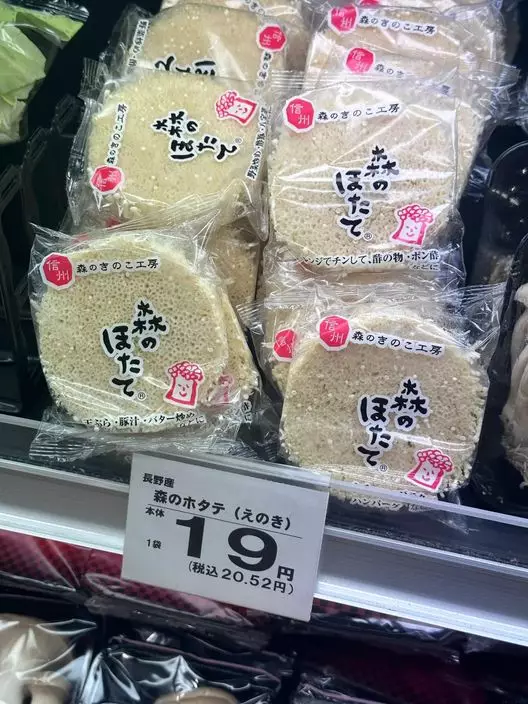
Enoki mushroom stems
Many people's first reaction is to assume the Japanese are simply born thrifty. Dig deeper, and the story changes. This is not a pure culture of thrift; it is a survival choice forced on ordinary people by the yen's collapse and persistently rising prices.
In fact, these offcuts were never entirely without value in Japan's culinary tradition. Shrimp shells can be simmered into soup stock, mushroom stems can be cooked once properly prepared, and watermelon rind can be pickled or stir-fried. Grilled pufferfish (fugu) fins are even one of the ingredients of Japan's distinctive hirezake (fin sake).
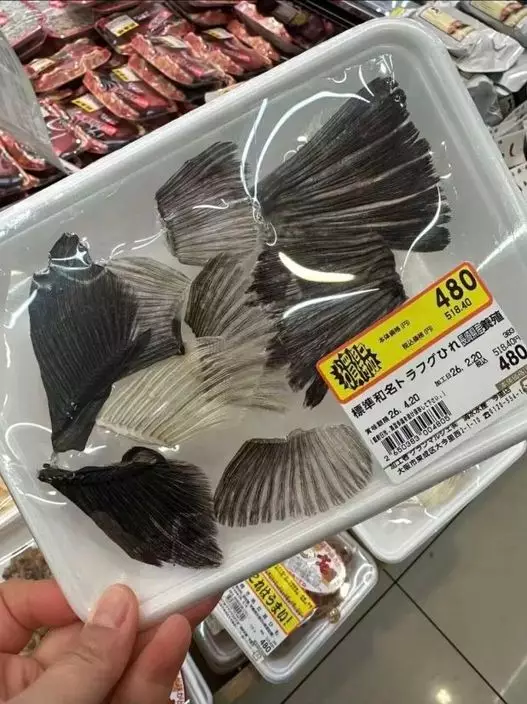
Grilled pufferfish fins flavor Japan's fin sake

In the past, making use of these food scraps was mostly a private skill of Japanese housewives. They simmered stock from shrimp shells and fish bones, mixed radish leaves into side dishes, pickled watermelon rind and pan-fried enoki stems. Such practices circulated only within the household.
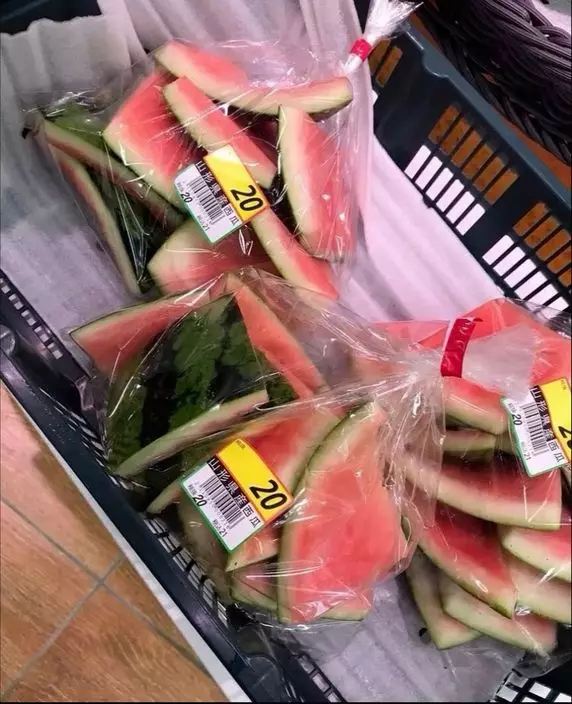
Japanese netizens: watermelon rinds feed pet insects
Today, supermarkets process, package and sell the offcuts directly. Ordinary people can simply pay for them, sparing themselves the trouble of collecting and preparing the scraps.
Some Japanese netizens explained that watermelon rinds are used to feed pet insects, while shrimp shells go into stock or get mixed into senbei rice crackers, insisting they are absolutely not food waste. They stressed that this is life wisdom that has existed in Japan since ancient times, though not all Japanese people do this.
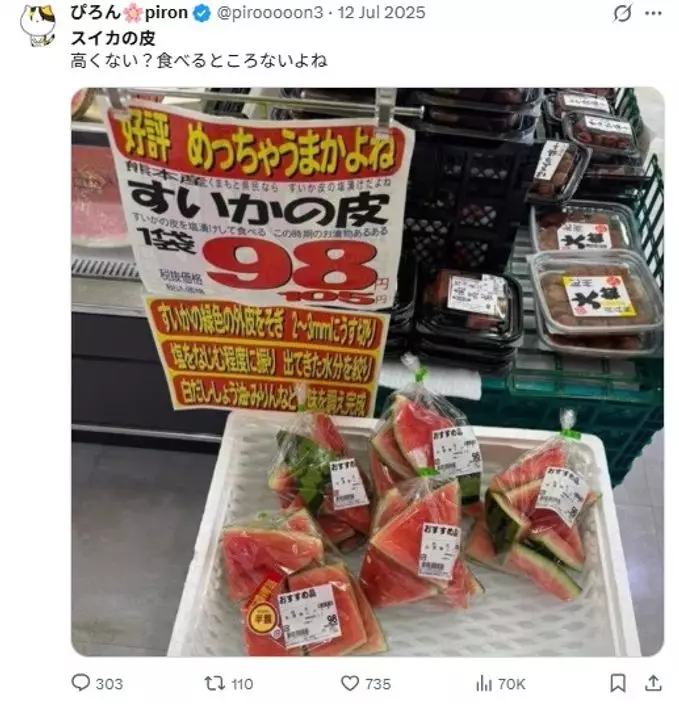
Japanese netizens: watermelon rinds feed pet insects
The Yen's Collapse Meets a Rain-Soaked Harvest
But there is a more realistic force at work right now, pushing irregular cuts onto store shelves.
Japan itself has scarce arable land and leans heavily on imported food. After the sharp depreciation of the yen, the cost of imported raw materials, energy and logistics rose across the board. Food prices then climbed one after another.
Nothing makes the point more bluntly than the price shock in local supermarket produce sections. Napa cabbage, long the cheapest standby vegetable of winter, now commands more than 1,000 yen for a single whole head, roughly 50 to 60 yuan. Even a quarter of a head costs nearly 300 yen.
Leafy greens such as spinach, komatsuna and lettuce are the hardest hit. A scrawny bunch of spinach, three or four stalks at most, once cost a little over 100 yen. Now it routinely fetches 300 to 400 yen.
Ordinary household income growth cannot keep pace with prices. So people squeeze their dining budgets by every means possible, and these irregular cuts become the substitute of last resort.
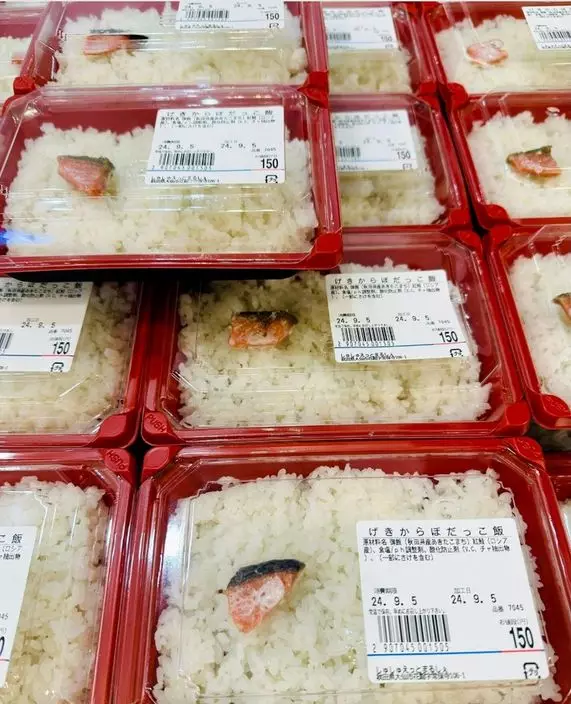
Wages lag prices; families slash food budgets
Behind the outrageous vegetable prices sits a pile-up of multiple factors. Weather ranks as one of the key reasons. By one account, Tokyo endured 37 consecutive days of rain after August 27.
September sunshine totaled just 45.8 hours, a low rarely seen for the same period in 38 years. The relentless rain and starved sunlight hurt vegetable growth and supply, sending prices of some leafy greens up rapidly.
On the other side of the ledger, fertilizer, agricultural fuel and logistics costs have all soared, pushing the supply chain cost of agricultural products to historic highs.
More fatally, Japan is confronting a full-spectrum price surge in which everything rises together.
According to data from an authoritative Japanese research institution, more than 3,000 kinds of everyday foods and beverages in Japan announced price increases on October 1 this year alone. The list spans bottled beverages, beer, milk and other everyday drinks. It also covers ham, bacon, frozen foods and other processed items, plus seasonings such as soy sauce, mayonnaise and soup stock cubes. Even public service fees like electricity, gas and postal delivery are climbing.
20,000 Price Hikes, Shrinking Paychecks
Price hikes are not just an October story. Teikoku Databank's count at the time put confirmed food price increases for all of 2026 at 20,187 items, the second straight year above 20,000. September and October alone saw more than 8,000 items go up.
Consumers are not dealing with a single supermarket suddenly jacking up prices. They are watching a widening lineup of everyday goods reprice, nonstop. What fills ordinary Japanese people with despair is not that prices are rising. It is that only prices are rising.
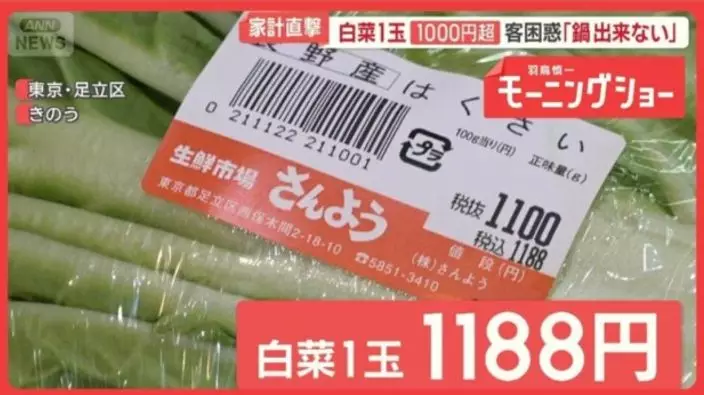
Rising prices have transformed Japanese supermarket habits
The Government of Japan keeps urging companies to pay workers more. The problem: the sliver of nominal wage growth gets devoured, instantly, by inflation running above three percent.
Numbers from the Japanese Trade Union Confederation (Rengo) show that after adjusting for price changes, Japan's real wages have posted dozens of consecutive months of negative growth. Translation: the figure on the pay slip looks bigger, but it buys less and less.
Relentless inflation has rewired how Japan shops. Housewives once raced the clock in the evening to grab half-price bento and near-expiry food. Now, waiting for discount windows to shop has become a mainstream way to consume.
Shoppers no longer buy a whole napa cabbage or a whole fish. They buy a quarter of a cabbage, or fish tails and bones, as needed. For an equally savory soup base, fish bones cost far less than a solid fillet.
Even picking habits have flipped. The old move was to reach deep into the shelf for the freshest expiration dates. Now plenty of shoppers deliberately choose the near-expiry items up front, just to snag the discount.
Bento has gone minimalist as well. The chase for polish and pizzazz is over. Many people now make their lunch boxes straight from refrigerator leftovers, prioritizing the clearing out of ingredients at home.
Campaigns against food waste have been preached for years. But the real force changing habits is prices that refuse to come down. Thrift has shifted from a virtue to a choice ordinary families are compelled to make.
The Real Difference: China's Supply Chain and the Limits of Comparison
Watching all this, many netizens start to wonder whether they themselves are too wasteful in everyday life. The truth is, no such comparison is needed.
Chinese supermarkets do not sell shrimp shells or watermelon rinds. The reason is not that Chinese people fail to understand thrift. The reason is that the country possesses a powerful agricultural supply chain.
The Vegetable Basket Project, greenhouse farming and a developed cold-chain transport system keep domestic vegetable supply abundant and ingredient prices affordable. That ample, stable supply is exactly what shaped today's consumption habits.
Thrift is always worth advocating. But we must also see clearly the differences in national conditions behind it.
Under high prices, every bit of grocery money ordinary people spend hides real life pressure. It is the hesitation when the wallet opens each day. It is the sigh at a napa cabbage priced at 1,000 Japanese yen. And it is the daily reality of having to learn to boil a whole pot of soup from shrimp shells.
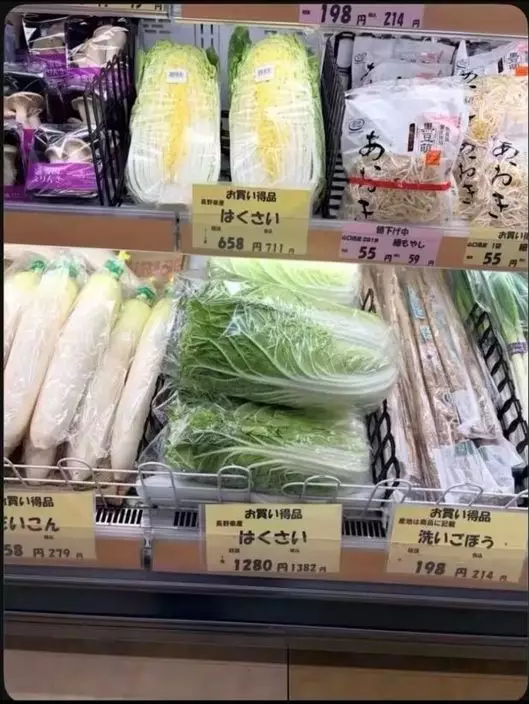
Every grocery purchase carries real cost-of-living pressure