Skip to Content Facebook Feature Image

Researchers catch sharks off NY's Hamptons, attach trackers to toothy predators

News

Researchers catch sharks off NY's Hamptons, attach trackers to toothy predators
News

News

Researchers catch sharks off NY's Hamptons, attach trackers to toothy predators

2026-09-01 18:50 Last Updated At:19:00

SOUTHAMPTON, N.Y. (AP) — Just off one of New York’s famed Hamptons beaches, shark researcher Greg Metzger reels in one of the day’s prize catches: a young but powerful sand tiger shark.

He and another marine researcher quickly lasso the tail of the sharp-toothed female to the side of the boat and hold it steady as they take tissue samples and work to attach small data collection devices. Metzger marvels as the shark’s thick, rugged skin snaps a surgical-grade scalpel.

“It’s no surprise that they’ve been around since prehistoric times and they’re still going strong,” Metzger says as he stitches up the incision and sends it along its way.

Metzger and other researchers are catching, tagging and releasing a wide range of sharks as they seek to understand the local population and shed more light on one of the world’s few confirmed great white shark nurseries, where masses of young predators spend their first vulnerable years feeding and growing. Other white shark nurseries recognized globally are in the coastal waters off California, Mexico and Australia.

“It’s that initial fear of sharks that captures people’s imagination,” said Metzger, who also teaches marine science at Southampton High School. “Hopefully, through educational opportunities like today, we’ll be able to show that these sharks are far from mindless eating machines.”

The researchers attach different types of tags. One relays location by sending an acoustic signal that can be detected by monitoring receivers set up along the coast. Another measures depth and water temperature for several months, then pops off.

The data illustrates how sharks can cover vast distances in a year, said Bradley Peterson, the Stony Brook University marine scientist working with Metzger this particular day.

“Their tags are being detected in North Carolina and Georgia and Florida and the Gulf of Mexico, and then they’ll be back here the following year,” he said. “So a lot of them are coming up here to get themselves fueled up and fattened up.”

The research also suggests more varied species of sharks are coming up from more tropical southern waters during the summer months, as the waters off Long Island's coast and elsewhere are warming, likely due to climate change, said Frank Quevedo, executive director at the South Fork Natural History Museum and Nature Center, which is coordinating the research.

“We’re seeing more spinner sharks, more black tip sharks, more bull sharks,” he said as he showed off the Bridgehampton museum’s interactive exhibit on the work. “These are temperate sharks that utilize this habitat when the food source is here. So right now is like prime time.”

To be clear, the waters off Long Island have long been known to be a haven for all manner of sharks. The bestselling Peter Benchley novel “Jaws” was set in a fictional seaside town in the Hamptons before the blockbuster film version, which Netflix is bringing back to its streaming library Tuesday along with its sequels, was shot on location on Martha’s Vineyard, Massachusetts.

The International Shark Attack File, a database at the Florida Museum of Natural History, includes no records of a fatal shark attack on Long Island, though beachgoers have been bitten in recent years, including one this summer, prompting local officials to invest in safety measures, including shark-spotting drones.

“There’s this huge misconception that there’s this surge of sharks in Long Island waters. These sharks have always been here,” Metzger said. “A reason why we’re seeing more is because of technology. There’s more drones. Everybody’s got a cellphone now.”

Quevedo says baby whites are already about 4 feet (1.2 meters) long and weigh up to 80 pounds (36 kilograms) at birth, and they aren’t reared by their mothers, meaning they must immediately fend for themselves.

That's why they're drawn to the relatively shallow, coastal areas off Long Island, where they can safely feed on schools of fish away from other predators, including older sharks, he said.

“It’s just like in nursery school, where kids learn the basics,” Quevedo explained.

As they mature, the great whites head north to feast on larger prey, particularly the teeming colonies of seals along the beaches of Cape Cod in Massachusetts.

But as local waters warm, researchers have observed young whites venturing into New England waters sooner, bringing them dangerously close to the adult predators, Quevedo said.

When “Jaws” burst onto the cultural scene more than 50 years ago, it led to a surge in recreational fishing for great whites off the Hamptons that had a devastating effect, according to Quevedo.

Great whites don’t mate until they’re into their 20s and later, meaning many likely never had a chance to reproduce.

“When you kill a shark at a size of 10 years, that shark can only be a juvenile, never reproduced before,” Quevedo said. “So you’re wiping out that whole species, that whole population.”

Conservation efforts in recent decades have helped white sharks and others rebound, though their numbers are nowhere near what they likely were more than a century ago, he added.

“The predators are the ones that are balance keepers,” Quevedo said. “If we can protect apex predators around the world, you’re pretty much sustaining the world and keeping it as healthy as possible.”

Associated Press reporters Ted Shaffrey and Julie Walker contributed to this story.

Follow Philip Marcelo at https://x.com/philmarcelo

A sand tiger shark is brought along side a boat after being caught for scientific study off the coast of Hampton Bays, N.Y., Thursday, Aug. 20, 2026. (AP Photo/Seth Wenig)

A sand tiger shark is brought along side a boat after being caught for scientific study off the coast of Hampton Bays, N.Y., Thursday, Aug. 20, 2026. (AP Photo/Seth Wenig)

Greg Metzger, lead field biologist for SOFO's shark research and education program, catches a sand tiger shark off the coast of Hampton Bays, N.Y., Thursday, Aug. 20, 2026. (AP Photo/Seth Wenig)

Greg Metzger, lead field biologist for SOFO's shark research and education program, catches a sand tiger shark off the coast of Hampton Bays, N.Y., Thursday, Aug. 20, 2026. (AP Photo/Seth Wenig)


Greg Metzger, lead field biologist for SOFO's shark research and education program, catches a sand tiger shark off the coast of Hampton Bays, N.Y., Thursday, Aug. 20, 2026. (AP Photo/Seth Wenig)

Greg Metzger, lead field biologist for SOFO's shark research and education program, catches a sand tiger shark off the coast of Hampton Bays, N.Y., Thursday, Aug. 20, 2026. (AP Photo/Seth Wenig)

MADRID (AP) — In crowded subway cars and sun-drenched plazas, an old-fashioned accessory in Spain has been everywhere thanks to the blistering summer heat.

Small enough to fit into a purse, the traditional Spanish folding hand fan, or abanico, snaps open into a semicircle. With little more than a flick of the wrist, it creates a surprisingly strong breeze.

As successive heat waves in Western Europe pushed temperatures this summer to punishing levels, the accessory has become essential, embraced by the young and old from Spain and elsewhere. Women — and a growing number of men — unfurl them on public transport, at concerts and at music festivals. In July, rainbow-colored abanicos were everywhere during Madrid’s raucous Pride celebrations.

On a recent August day, 20-year-old Ana Feliu blocked the sun with a paper abanico she was gifted during a Valencian festival. She carries it everywhere in the summer, she said.

“This one is my favorite because it's the biggest, but I have many more,” she told The Associated Press near Madrid’s Puerta del Sol square. Later in the week, temperatures in the Spanish capital were expected to reach 39 degrees Celsius (102 Fahrenheit).

Also fanning himself was David González, whose abanico featured pinks, purples and reds.

“At first, I felt a little self-conscious, because it’s something that’s mainly associated with women, but I have to admit it serves a purpose — and it brightens my day,” said González, 53.

Historians believe the folding fan reached Europe through Portuguese maritime trade with Asia in the 15th and 16th centuries.

As early as the mid-17th century, the Spanish painter Diego Velázquez made his enigmatic "The Lady with a Fan," in which a woman, possibly French, poses with what appears to be a delicate wooden abanico.

As they grew fashionable in European courts, Spain developed a taste and industry of its own. Madrid became an important center of production, and by the 18th century, Valencia had emerged as the Spanish fan-making capital.

“During the 18th century, the printing industry really took off. And printing meant that the leaves of fans could be produced quite cheaply,” said Mary Kitson, curatorial consultant to The Fan Museum in London.

So embedded was the abanico in Spanish aristocratic society by the 1800s that women used them to discreetly express flirtation, interest or disapproval through what was called “the language of the fan.”

From Spain, the hand fan traveled to Latin America. In the 19th century, flamenco dancers began using the abanico as an expressive prop, as Cuban song and dance styles such as the guajira influenced the dance form. Over time, the fan’s association with flamenco helped turn it into a quintessential Spanish symbol.

“The fan is a perfect element because, on the one hand, it evokes the heat and humidity of Cuba — that heavy, oppressive feeling,” said Carmen Torres, a 44-year-old flamenco dancer in southern Spain. “And at the same time, it gives us a way to bring out the seductive, coquettish quality.”

For more than a century and a half, Javier Llerandi’s family has sold abanicos out of Casa de Diego, a wood-paneled shop in Madrid.

“We live from the heat,” Llerandi told the AP.

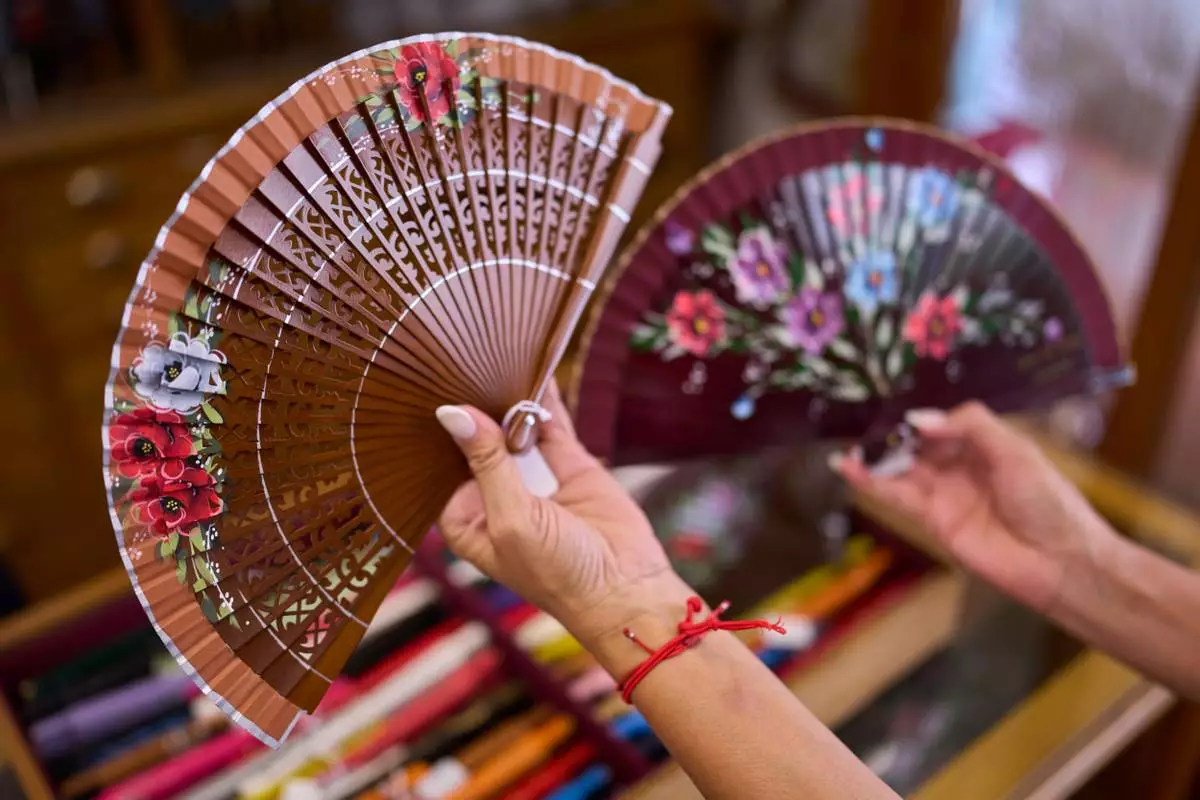
The fans at Casa de Diego are made in Spain and range from simple two-tone wooden ones to elaborate, hand-painted items crafted from mother-of-pearl with intricate floral patterns. They start at around 30 euros ($35), while others range from 200 to 500 euros (up to $580), with some high-end pieces reaching 6,000 euros (nearly $7,000). The price depends on the materials used, but even more so on the craftsmanship involved, he said.

As Madrid has grown into a tourist hot spot, foreign visitors are also snatching up his fans, which Llerandi notes are more reliable than their portable, electric counterparts.

“Battery-run items eventually run out of power, and always at the worst possible moment,” Llerandi said, adding with a smile: “Without a doubt, heat waves are good for this business.”

And for the less discerning customer, plastic fans with printed designs are sold for a few euros at souvenir kiosks, including one a couple hundred meters from Llerandi's store. There, too, a salesperson reported strong sales this summer.

Outside a towering bullfighting ring in Madrid, Juani Duran sells wooden hand fans with traditional floral designs for five euros apiece at a stall. Bullfights take place in open-air stadiums, and spectators traditionally dress up to attend them, making the elegant fans a fitting accessory.

“You’ll usually find a hand fan in any woman’s pocket — and in some men’s, too,” Duran said before a late-August bullfight.

“They're not the best quality,” she said, pointing at her stock, "but they'll get you through the summer."

Associated Press photographer Laura León in Seville, Spain contributed to this report.

A man uses a fan to cool off during the La Liga soccer match between Real Madrid and Malaga at the Bernabeu stadium in Madrid, Spain, on Aug. 30, 2026. (AP Photo/Manu Fernandez)

A man uses a fan to cool off during the La Liga soccer match between Real Madrid and Malaga at the Bernabeu stadium in Madrid, Spain, on Aug. 30, 2026. (AP Photo/Manu Fernandez)

Mass-produced fans featuring tourist images of Seville are displayed in a shop window in Seville, Spain, on Aug. 25, 2026. (AP Photo/Laura Leon)

Mass-produced fans featuring tourist images of Seville are displayed in a shop window in Seville, Spain, on Aug. 25, 2026. (AP Photo/Laura Leon)

Carmen Torres, a professional flamenco dancer, rehearses a guajira, a flamenco style that traditionally incorporates the use of a fan, in Seville, Spain, on Aug. 27, 2026. (AP Photo/Laura Leon)

Carmen Torres, a professional flamenco dancer, rehearses a guajira, a flamenco style that traditionally incorporates the use of a fan, in Seville, Spain, on Aug. 27, 2026. (AP Photo/Laura Leon)

Fans are displayed at Casa Diego, a fan shop in Madrid, Spain, on Aug. 18, 2026. (AP Photo/Manu Fernandez)

Fans are displayed at Casa Diego, a fan shop in Madrid, Spain, on Aug. 18, 2026. (AP Photo/Manu Fernandez)

A street vendor sells fans near the Royal Palace in Madrid, Spain, on Aug. 20, 2026. (AP Photo/Manu Fernandez)

A street vendor sells fans near the Royal Palace in Madrid, Spain, on Aug. 20, 2026. (AP Photo/Manu Fernandez)

A woman uses a fan to cool herself on the subway in Madrid, Spain, on Aug. 18, 2026. (AP Photo/Manu Fernandez)

A woman uses a fan to cool herself on the subway in Madrid, Spain, on Aug. 18, 2026. (AP Photo/Manu Fernandez)

Recommended Articles