Chinese emergency authorities have deployed drone teams to support frontline rescue operations and assist with critical disaster monitoring efforts after last week's devastating mudslide on the China-Nepal border, with the drones providing crucial assistance from the air.
The mudslide, triggered by an ice-rock avalanche in Nepal, hit the border port of Gyirong in southwest China's Xizang Autonomous Region on the morning of Aug 26, claiming at least 16 lives and leaving 546 people missing on the Chinese side, according to the regional government.
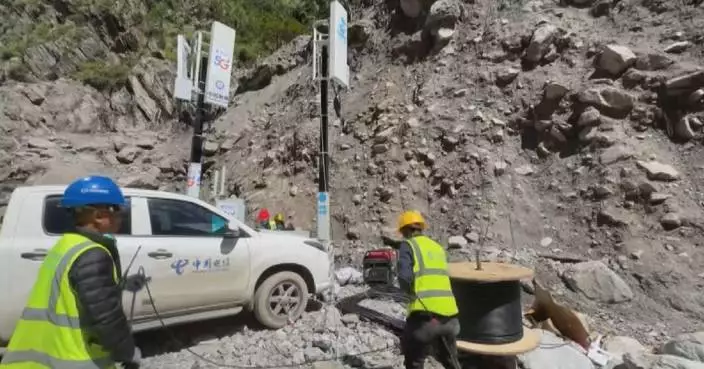
Given the difficulty posed by the mountainous terrain, a fleet of drones have been utilized to help monitor potential secondary disasters, assess damage, and deliver essential supplies to frontline rescue teams from the sky.
Wan Junya is among the 11 drone pilots deployed to Gyirong to support the ongoing rescue operations. He said the drones are giving rescuers an extra set of eyes and provide a fast way to reach areas that remain difficult and dangerous to access.
"Our team is mainly responsible for monitoring the source area of the mudslide. A barrier lake has formed after the disaster, and we're using drones to keep a real-time watch on water levels and check the stability of the natural dam. We're also keeping a close eye on whether new landslide risks are forming nearby," said Wang.
The monitoring teams are also carefully surveying damaged roads and accumulated debris in the border port area. The data collected helps measure the depth and volume of mud and debris, while providing a clearer picture of road damage and identifying areas that may pose risks to rescue operations.

Drones deployed to provide crucial aerial assistance after deadly mudslide in Xizang
Agreements signed between China and Kyrgyzstan at the 2026 Shanghai Cooperation Organization (SCO) Summit in Bishkek are expected to inject fresh momentum into Kyrgyzstan’s growing technology sector, especially in digital economy, artificial intelligence (AI) and clean energy, an expert said.
The summit, held Monday and Tuesday in the Kyrgyz capital, ran under the theme "25 Years of the SCO: Together Towards Sustainable Peace, Development, and Prosperity" and brought together leaders from more than 20 countries.
In an interview with China Global Television Network (CGTN), Chubak Temirov, deputy director of the High Tech Park of the Kyrgyz Republic, said the SCO’s 25 years of trust now pave the way for joint technology ventures beyond Kyrgyzstan’s domestic market.
"The SCO spent 25 years building relationships and trust between our countries, between China and Kyrgyzstan and all other members. And I believe the next stage should be about building things together, in relation to technology; technologies, companies, research, products, and maybe new markets. Today, technology company in Bishkek doesn't necessarily think only about our domestic market, which is only 7.4 million people. We think broader, in relation to all SCO countries, or even global market," Temirov said.
In his meeting with Kyrgyz President Sadyr Japarov on Monday, Chinese President Xi Jinping said China and Kyrgyzstan should work together to build the Belt and Road Joint Laboratory and strengthen cooperation in areas including AI.
Echoing President Xi's words, Temirov identified local-language AI applications as the most immediate opportunity for Kyrgyzstan, while emphasizing that the best form of technology transfer lies in building local capacity to develop future products independently -- a partnership model that could deepen bilateral collaboration following the summit.
"I think the immediate practical opportunities for Kyrgyzstan in AI would be the local language AI. For example, let's imagine just a farmer in rural area, in some remote mountain in Kyrgyzstan, as you know, Kyrgyzstan is a mountainous country, could speak to an AI assistant in Kyrgyz language and receive information about weather, maybe agriculture. A student could have an AI tutor, for example, in his own language, in native language. Or a citizen could interact with digital public services, right? Digital public services now, in every country, are becoming a major trend of digitalization. Everyone now, just sitting from home, can get any public service s and get different things to make his life easier, right?" he said.
"China has a big scale from infrastructure and a mature AI ecosystem. The best technology transfer is not when you receive any finished product. As I said, it's when your people gain capability to build already the next product themselves, right? This is the kind of China-Kyrgyzstan technology partnership I would see as a really good example. I truly believe that after this summit, we can go to a new layer of friendship and collaboration. And I see more opportunities between China and Kyrgyzstan in AI in general, and in other technologies," he added.
China, Kyrgyzstan double down on tech innovation at SCO Summit