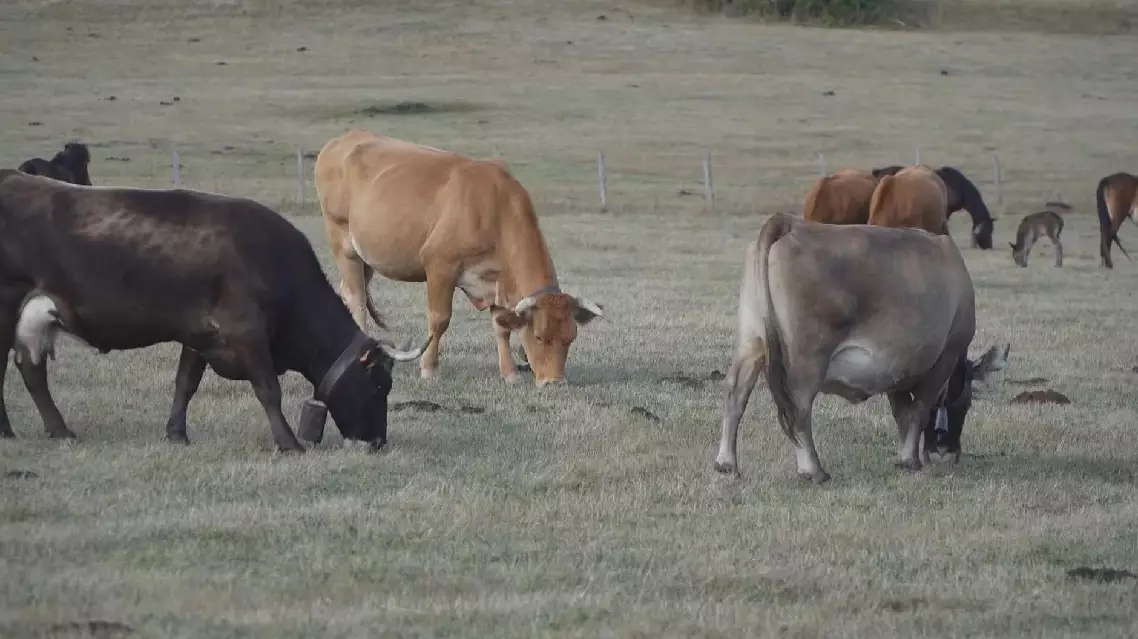
Persistent high temperatures and scant rainfall this summer are taking a severe toll on livestock farming across Spain, with the northern region of Cantabria, one of the country's key livestock bases, suffering through its hottest June and July since records began.
Temperatures in Cantabria soared 3 to 4 degrees Celsius above the seasonal average during the two-month period, wilting mountain pastures far earlier than usual and forcing farmers to dip into winter feed reserves months ahead of schedule.
In a typical year, mountain pastures in Cantabria remain lush enough at this time to sustain grazing herds. But this year, extreme heat and drought have caused the grass to wither prematurely, compelling herders to begin using feed stocks originally reserved for winter.
Jose Fernandez, a 45-year-old farmer who has operated his farm for more than two decades and currently raises 60 head of cattle and horses, said the grass shortage has disrupted his farm's usual feeding routine.
"We cut the grass and collected and stored it. It was originally stored for winter use, but now we have already started using it for them. This means that when winter comes, these reserves will be exhausted. Moreover, the animals are not growing as fat and strong as before," said Fernandez.
The latest assessment by the Cantabria regional government shows that potential pasture yields this year have dropped by an average of 25.53 percent, with declines exceeding 32 percent in some areas. The premature consumption of feed reserves has pushed up breeding costs for farmers.
Fernandez said the cost of raising each animal has risen by approximately 250 euros, affecting both cattle and horses.
Local livestock organizations say that rising feed prices are not solely due to local pasture shortfalls. Drought conditions across much of Europe are intensifying supply and demand pressures on the market.
"Spain has encountered severe forest fires this year. At the same time, there is widespread drought across Europe. Farmers and herders from France and Portugal have also come to provinces near Cantabria to make purchases. This is driving up production costs," said Luis Perez Portilla, secretary general of the Cantabrian Mountain Farmers and Herders Federation (UGAM-COAG).
Some farmers have already begun considering selling part of their herds to cover mounting feed expenses. A sustained reduction in livestock numbers would affect not only individual farm operations but also the overall production scale of the local livestock industry.
The Cantabria regional government has announced 3 million euros in aid. However, local livestock organizations say the assistance will have limited impact given that drought risks may extend into autumn and winter.
Extreme heat, drought severely impact Spain's livestock farming sector
Agreements signed between China and Kyrgyzstan at the 2026 Shanghai Cooperation Organization (SCO) Summit in Bishkek are expected to inject fresh momentum into Kyrgyzstan’s growing technology sector, especially in digital economy, artificial intelligence (AI) and clean energy, an expert said.
The summit, held Monday and Tuesday in the Kyrgyz capital, ran under the theme "25 Years of the SCO: Together Towards Sustainable Peace, Development, and Prosperity" and brought together leaders from more than 20 countries.
In an interview with China Global Television Network (CGTN), Chubak Temirov, deputy director of the High Tech Park of the Kyrgyz Republic, said the SCO’s 25 years of trust now pave the way for joint technology ventures beyond Kyrgyzstan’s domestic market.
"The SCO spent 25 years building relationships and trust between our countries, between China and Kyrgyzstan and all other members. And I believe the next stage should be about building things together, in relation to technology; technologies, companies, research, products, and maybe new markets. Today, technology company in Bishkek doesn't necessarily think only about our domestic market, which is only 7.4 million people. We think broader, in relation to all SCO countries, or even global market," Temirov said.
In his meeting with Kyrgyz President Sadyr Japarov on Monday, Chinese President Xi Jinping said China and Kyrgyzstan should work together to build the Belt and Road Joint Laboratory and strengthen cooperation in areas including AI.
Echoing President Xi's words, Temirov identified local-language AI applications as the most immediate opportunity for Kyrgyzstan, while emphasizing that the best form of technology transfer lies in building local capacity to develop future products independently -- a partnership model that could deepen bilateral collaboration following the summit.
"I think the immediate practical opportunities for Kyrgyzstan in AI would be the local language AI. For example, let's imagine just a farmer in rural area, in some remote mountain in Kyrgyzstan, as you know, Kyrgyzstan is a mountainous country, could speak to an AI assistant in Kyrgyz language and receive information about weather, maybe agriculture. A student could have an AI tutor, for example, in his own language, in native language. Or a citizen could interact with digital public services, right? Digital public services now, in every country, are becoming a major trend of digitalization. Everyone now, just sitting from home, can get any public service s and get different things to make his life easier, right?" he said.
"China has a big scale from infrastructure and a mature AI ecosystem. The best technology transfer is not when you receive any finished product. As I said, it's when your people gain capability to build already the next product themselves, right? This is the kind of China-Kyrgyzstan technology partnership I would see as a really good example. I truly believe that after this summit, we can go to a new layer of friendship and collaboration. And I see more opportunities between China and Kyrgyzstan in AI in general, and in other technologies," he added.

China, Kyrgyzstan double down on tech innovation at SCO Summit