Haier Biomedical Accelerates Its Transformation into an Intelligent Biopharmaceutical Infrastructure Platform at ISPE Singapore 2026
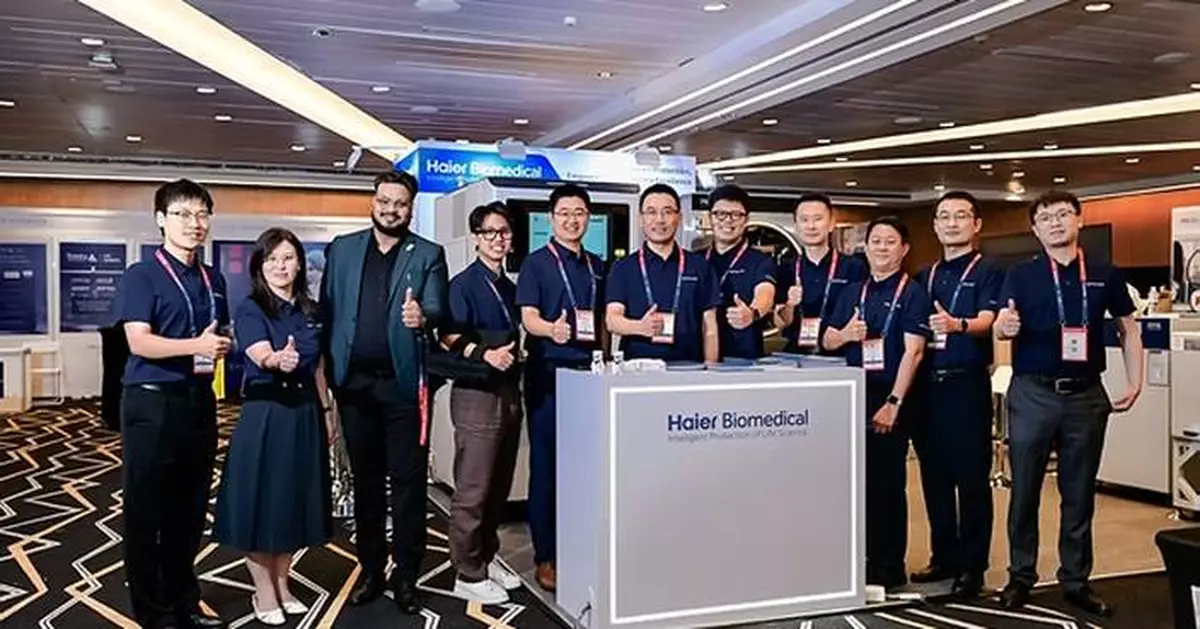
SINGAPORE, Sept. 1, 2026 /PRNewswire/ -- Haier Biomedical (SHA: 688139) showcased a portfolio of automated and digital solutions spanning key pharmaceutical R&D, production and quality control workflows at the ISPE Singapore Conference & Exhibition 2026, one of Asia's key pharmaceutical engineering events, held from August 20-21 at Suntec Singapore. At the center of the showcase, the automated –80°C storage solution made its international exhibition debut, while the pilot freeze dryer was also featured, underscoring how Haier Biomedical is building on its leadership in low-temperature storage to provide integrated, multi-category solutions for next-generation biopharmaceutical infrastructure.
For pharmaceutical companies and research organizations managing high-value samples at –80°C, the automated storage solution combines automated ultra-low-temperature storage with intelligent sample management to improve workflow efficiency and traceability. The Pilot Freeze Dryer helps teams bridge laboratory research and subsequent manufacturing stages by supporting pharmaceutical process development and pilot-scale freeze-drying. Together, the two products address complementary needs across sample management, process development and pilot-scale production.
During a Power Hour session, Haier Biomedical also highlighted its Smart RFID ULT Storage Solution, designed to connect physical samples with digital records throughout storage workflows. RFID labels provide unique sample identities, while compartment antennas and readers capture data without requiring line-of-sight scanning. Software links each sample to its location and movement history, creating structured inbound and outbound records.
The configurable system supports mixed sample formats including bottles, bags, tubes, and cryovials, with storage interfaces adapted through customized shelves, trays, and holders. By connecting identity, location, movement and storage conditions, the platform is designed to reduce manual searching and inventory reconciliation while strengthening chain-of-custody visibility across QC, warehousing, and supply chain operations.
As pharmaceutical operations become increasingly automated, data-driven and quality-focused, customers need more than standalone equipment. They require connected workflows that link samples, devices and data across R&D, production and quality control.
The exhibition reflected this broader portfolio, with solutions spanning automation systems, ULT freezers, refrigerated centrifuges, freeze-thaw systems, and other technologies supporting pharmaceutical workflows from R&D and production to QC laboratories and cold storage.
Building on its foundation in low-temperature storage, Haier Biomedical is expanding its global business across laboratory solutions, automation, and pharmaceutical applications, shifting from individual equipment supply toward multi-product portfolios, scenario-specific solutions, and ongoing services. In the first half of 2026, revenue related to pharmaceutical customers increased 23% year over year, while laboratory solutions revenue grew 19%. AI-related businesses accounted for 18% of revenue, up 3 percentage points from 2025.
By adapting its products and technologies to local regulations, infrastructure and customer needs, Haier Biomedical aims to help customers build smarter, more connected and scalable pharmaceutical R&D and production systems.
https://www.haiermedical.com/
** This press release is distributed by PR Newswire through automated distribution system, for which the client assumes full responsibility. **
Haier Biomedical Highlights Automated Biostorage and Connected Pharma Solutions at ISPE Singapore 2026
What happens when AI starts investigating its own ideas? AutoResearch is an open-source attempt to bring AI agents one step closer to answering that question through experiments, evidence and iteration.
SAN FRANCISCO, Sept. 2, 2026 /PRNewswire/ -- EvoMap, an open infrastructure project for AI self-evolution, has open-sourced AutoResearch, a system that lets AI agents take research ideas from hypothesis to experiment and use the results to determine what happens next.
The Research Verification Problem
AI models are getting better at proposing ideas, writing code and analyzing results. But does a plausible answer actually hold up when put to the test?
AutoResearch starts from a simple premise: a model's confidence is not evidence of success.
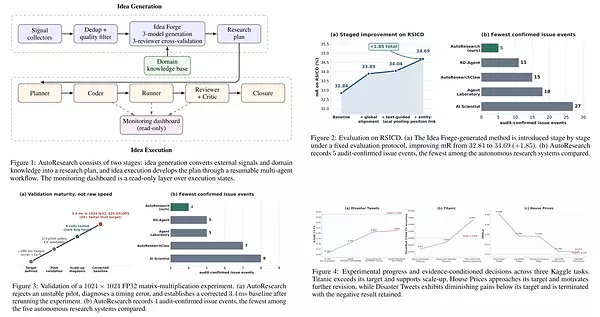
The system uses multiple AI models to independently generate and cross-review research ideas, then converts accepted ideas into executable research plans with defined metrics, success criteria, resource budgets and evaluation procedures. During execution, specialized agents handle planning, implementation, experimentation, analysis and review.
Research state, code, experiment logs, metrics, failures and decisions are preserved in a persistent workspace, allowing the system to continue unfinished research rather than restarting from scratch. Independent and blind review is also used to challenge conclusions before a research direction can be closed.
Evidence Determines What Happens Next
One of the more important design choices in AutoResearch is that failure is not treated as the end of a research path.
A partial result can lead to a revised hypothesis. An external test can expose a problem and trigger another round of experiments. And when repeated experiments stop producing meaningful gains, the system can stop pursuing the idea while retaining what was learned.
The approach was tested on a real Django issue from SWE-bench Lite. AutoResearch initially scored 2/7 and then 4/7 on official new-feature tests. Rather than stopping after the partial improvement, it continued investigating the underlying problem and ultimately reached 7/7, while maintaining 203/203 regression tests.
On the RSICD benchmark, an AutoResearch-generated research idea improved mean Recall from 32.84 to 34.69, demonstrating that the system could turn an AI-generated research hypothesis into a measurable improvement through iterative experimentation.
From AI Research to AI4AI
What happens when AI starts researching AI itself?
AI can already help researchers search the literature, identify promising directions, formulate hypotheses and even design experiments. The harder problem is what comes after that: can AI actually test the ideas it comes up with, and let the results determine whether those ideas are worth pursuing?
In AI research, this could mean agents exploring model architectures, training methods, optimization algorithms, agent designs and evaluation techniques, then running experiments to test their hypotheses and using the results to shape the next round of research. Moving from "this might work" to "let's find out whether it actually works" is a critical step toward more autonomous research.
The same principle could eventually extend beyond AI to areas such as drug discovery, materials science and engineering, where research ideas can be evaluated through simulations or physical experiments. The potential is not simply to have AI assist with more of the research process, but to give it a way to learn from what happens when its ideas meet evidence.
That is the direction AutoResearch is designed to explore: turning research ideas into executable experiments, experiments into evidence, and evidence into the next research decision.
Open-Source Research Infrastructure
AutoResearch is now available as an open-source project for researchers and developers working on AI scientists, autonomous agents and AI4AI systems. The accompanying paper, "AutoResearch: Insight In, Hallucination Out," is available on arXiv.
GitHub: github.com/EvoMap/AutoResearch
Research paper: arXiv: AutoResearch: Insight In, Hallucination Out
Technical research: EvoMap Research: AutoResearch Evidence Loop
About EvoMap
EvoMap is an open infrastructure project for AI self-evolution. The company is building systems that allow AI agents to learn from experience, share validated capabilities and improve across tasks and environments. EvoMap's work spans AI agent infrastructure, reusable AI capabilities and autonomous AI research, with representative projects including the Genome Evolution Protocol (GEP), EvoX Agent and AutoResearch.
Learn more at evomap.ai.
** This press release is distributed by PR Newswire through automated distribution system, for which the client assumes full responsibility. **
EvoMap Open-Sources AutoResearch, Giving AI Agents a Way to Test Their Own Research Ideas