What happens when AI starts investigating its own ideas? AutoResearch is an open-source attempt to bring AI agents one step closer to answering that question through experiments, evidence and iteration.
SAN FRANCISCO, Sept. 2, 2026 /PRNewswire/ -- EvoMap, an open infrastructure project for AI self-evolution, has open-sourced AutoResearch, a system that lets AI agents take research ideas from hypothesis to experiment and use the results to determine what happens next.
The Research Verification Problem
AI models are getting better at proposing ideas, writing code and analyzing results. But does a plausible answer actually hold up when put to the test?
AutoResearch starts from a simple premise: a model's confidence is not evidence of success.
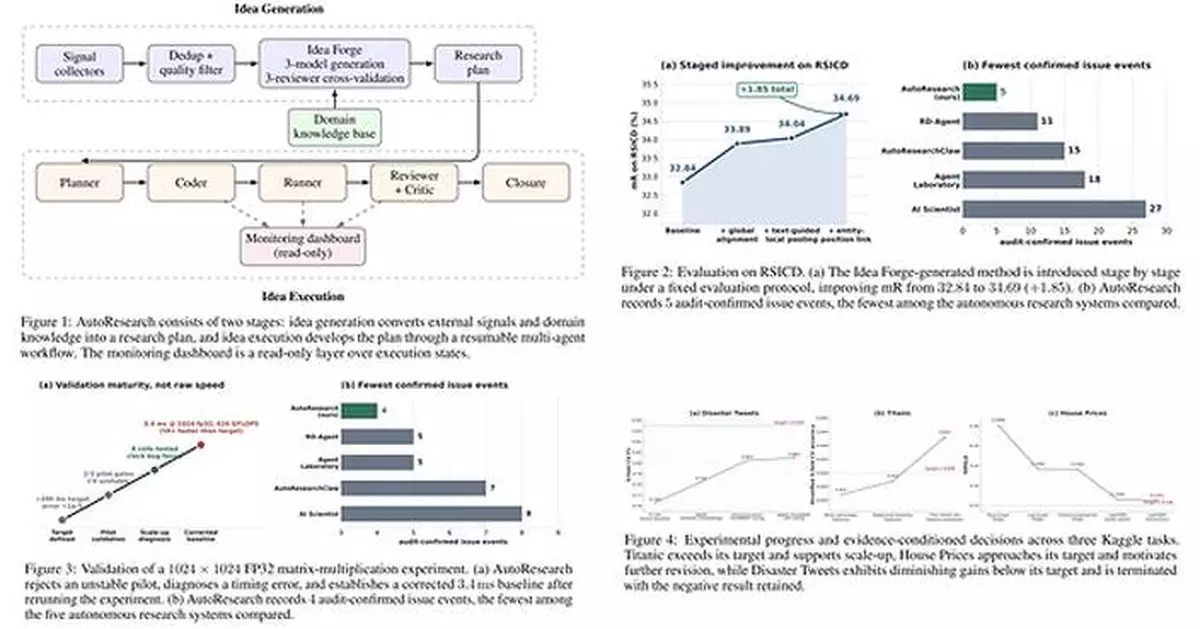
The system uses multiple AI models to independently generate and cross-review research ideas, then converts accepted ideas into executable research plans with defined metrics, success criteria, resource budgets and evaluation procedures. During execution, specialized agents handle planning, implementation, experimentation, analysis and review.
Research state, code, experiment logs, metrics, failures and decisions are preserved in a persistent workspace, allowing the system to continue unfinished research rather than restarting from scratch. Independent and blind review is also used to challenge conclusions before a research direction can be closed.
Evidence Determines What Happens Next
One of the more important design choices in AutoResearch is that failure is not treated as the end of a research path.
A partial result can lead to a revised hypothesis. An external test can expose a problem and trigger another round of experiments. And when repeated experiments stop producing meaningful gains, the system can stop pursuing the idea while retaining what was learned.
The approach was tested on a real Django issue from SWE-bench Lite. AutoResearch initially scored 2/7 and then 4/7 on official new-feature tests. Rather than stopping after the partial improvement, it continued investigating the underlying problem and ultimately reached 7/7, while maintaining 203/203 regression tests.
On the RSICD benchmark, an AutoResearch-generated research idea improved mean Recall from 32.84 to 34.69, demonstrating that the system could turn an AI-generated research hypothesis into a measurable improvement through iterative experimentation.
From AI Research to AI4AI
What happens when AI starts researching AI itself?
AI can already help researchers search the literature, identify promising directions, formulate hypotheses and even design experiments. The harder problem is what comes after that: can AI actually test the ideas it comes up with, and let the results determine whether those ideas are worth pursuing?
In AI research, this could mean agents exploring model architectures, training methods, optimization algorithms, agent designs and evaluation techniques, then running experiments to test their hypotheses and using the results to shape the next round of research. Moving from "this might work" to "let's find out whether it actually works" is a critical step toward more autonomous research.
The same principle could eventually extend beyond AI to areas such as drug discovery, materials science and engineering, where research ideas can be evaluated through simulations or physical experiments. The potential is not simply to have AI assist with more of the research process, but to give it a way to learn from what happens when its ideas meet evidence.
That is the direction AutoResearch is designed to explore: turning research ideas into executable experiments, experiments into evidence, and evidence into the next research decision.
Open-Source Research Infrastructure
AutoResearch is now available as an open-source project for researchers and developers working on AI scientists, autonomous agents and AI4AI systems. The accompanying paper, "AutoResearch: Insight In, Hallucination Out," is available on arXiv.
GitHub: github.com/EvoMap/AutoResearch
Research paper: arXiv: AutoResearch: Insight In, Hallucination Out
Technical research: EvoMap Research: AutoResearch Evidence Loop
About EvoMap
EvoMap is an open infrastructure project for AI self-evolution. The company is building systems that allow AI agents to learn from experience, share validated capabilities and improve across tasks and environments. EvoMap's work spans AI agent infrastructure, reusable AI capabilities and autonomous AI research, with representative projects including the Genome Evolution Protocol (GEP), EvoX Agent and AutoResearch.
Learn more at evomap.ai.
** This press release is distributed by PR Newswire through automated distribution system, for which the client assumes full responsibility. **
EvoMap Open-Sources AutoResearch, Giving AI Agents a Way to Test Their Own Research Ideas
Alerts escalate through the on-call rotation until someone answers. Free for up to five users, with paid plans starting at USD $6 per user per month. On-call scheduling and escalation are included rather than sold as separate modules.
SYDNEY, Sept. 2, 2026 /PRNewswire/ -- JAMS Software today released JAMS Incident Management, on-call alerting and incident management software for IT operations, service desk, and engineering teams. The product accepts alerts from any system that can send an email, call a webhook, or reach an API. It delivers those alerts over voice, SMS, push, email, Microsoft Teams, and Slack. It then escalates through the on-call rotation until a person acknowledges and tracks the incident through to resolution. The product is generally available across Australia and New Zealand now, following a customer early access period that opened on 1 August.
JAMS Software built the product for its own teams. As a customer of other incident management products, the company felt the pain of a feature-bloated tool with overdone AI hype at a price that was not worth it. So the company built a tool that would reliably alert the right human, every time an incident occurs, at a reasonable price.
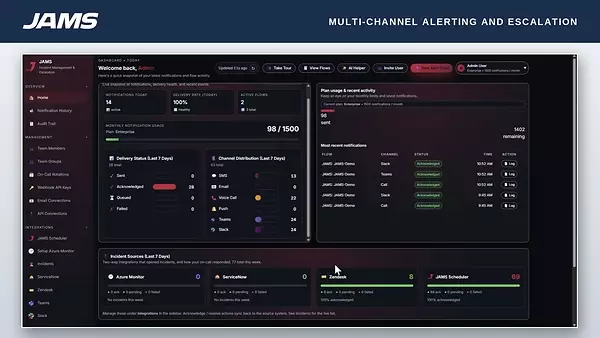
JAMS Incident Management natively integrates with JAMS Scheduler. Teams running JAMS Scheduler can open an incident automatically from a failed job and restart that job directly from the phone call or the text message with JAMS Incident Management. The two products are fully independent, and neither one requires the other.
"We built JAMS Incident Management for people like us," said Peter Hegland, chief executive officer of JAMS Software. "A service desk team using Zendesk that needs an on-call schedule and escalation path for human team members. A batch processing team that needs to know when a critical job fails or when it's about to miss its SLA. A DevOps or SRE team that needs to know an outage has happened and that someone is already on it. It works for us, and we hope it works for you."
INTEGRATIONS
JAMS Incident Management can connect to any monitoring, orchestration, or IT service management system through email, webhook, or REST API. JAMS Incident Management also has prebuilt two-way integrations for Azure Monitor, ServiceNow, Zendesk, and JAMS Scheduler, with more integrations coming soon.
AVAILABILITY IN AUSTRALIA AND NEW ZEALAND
Teams in Australia and New Zealand hit the on-call problem at an awkward hour. Overnight batch windows, and cover for offices across Asia Pacific, put failures outside local working hours, where an alert either reaches a person or waits until morning.
Voice and SMS notifications reach on-call staff on Australian mobile networks, and JAMS staffs support in Australia alongside the United States and the United Kingdom. Teams elsewhere in Asia Pacific can request voice and SMS coverage directly, and the email, push, Microsoft Teams, and Slack channels work in every market today.
PRICING
JAMS Incident Management is priced per user in United States dollars. A free plan supports up to five users with no time limit and no credit card. The Starter tier is USD $6 per user per month billed annually for up to 25 users, and the Professional tier is USD $16 per user per month billed annually for up to 50 users. Enterprise pricing is available on request. On-call scheduling and escalation policies are included in the paid plans rather than sold as separate modules. A fourteen-day trial unlocks every feature and requires no credit card. Teams can purchase subscriptions to JAMS Incident Management online directly without interacting with a sales team.
SECURITY AND AVAILABILITY
JAMS Incident Management runs on Microsoft Azure, with TLS in transit, stored provider credentials encrypted at rest, tenant isolation, and an audit trail covering every action. Single sign-on uses OIDC, with setup guides for Microsoft Entra ID, Okta, Google Workspace, and Auth0. Voice and SMS delivery covers Australia, the United States, and the United Kingdom, with additional regions available on request. Email, push, Microsoft Teams, and Slack notifications work anywhere.
Teams can start today at jamsscheduler.com/incident-management. The free plan supports five users with no credit card, and paid plans can be purchased online without a sales call.
JAMS INCIDENT MANAGEMENT AT A GLANCE
Category: On-call alerting and incident management software
Notification channels: Voice, SMS, push, email, Microsoft Teams, Slack
Alert sources: Email, webhook, REST API, Azure Monitor, ServiceNow, Zendesk, JAMS Scheduler
Two-way integrations: Azure Monitor, ServiceNow, Zendesk, JAMS Scheduler
Free plan: Up to five users, no time limit, no credit card. One alert flow and one on-call schedule
Starter: USD $6 per user per month billed annually, up to 25 users. Unlimited alert flows, schedules, and escalation policies
Professional: USD $16 per user per month billed annually, up to 50 users. Adds Azure Monitor, ServiceNow, and Zendesk
Enterprise: Custom pricing, unlimited users
Metering: Email, push, Microsoft Teams, and Slack unlimited on every plan. SMS and voice pooled across the team
Trial: Fourteen days, every feature, no credit card
Voice and SMS coverage: Australia, United States, United Kingdom. Other regions on request
Single sign-on: OIDC, with setup guides for Microsoft Entra ID, Okta, Google Workspace, and Auth0
Auditing: Every action written to an audit trail
Hosting: Microsoft Azure
General availability: September 1, 2026
Product page: jamsscheduler.com/incident-management
About JAMS Software
JAMS Software builds IT orchestration and alerting products for the teams that keep critical processes running. JAMS Scheduler, released in 1987, centralises, automates, and manages scheduled jobs across Windows, Linux, UNIX, IBM i, z/OS, and OpenVMS environments for over 850 customers worldwide. JAMS Incident Management handles alerting and on-call escalation for those same teams, and works on its own or alongside the scheduler. The company separated from Fortra in June 2025 and now operates independently, backed by PSG, 2ndWave Software, and its employees. JAMS serves customers across Australia, New Zealand, and Asia Pacific through its regional team. Learn more at jamsscheduler.com.
Media Contact
Bobby Schmidt
Vice President of Marketing, JAMS Software
marketing@jamssoftware.com
** This press release is distributed by PR Newswire through automated distribution system, for which the client assumes full responsibility. **
JAMS Software Launches JAMS Incident Management for On-Call Alerting and Escalation
JAMS Software Launches JAMS Incident Management for On-Call Alerting and Escalation