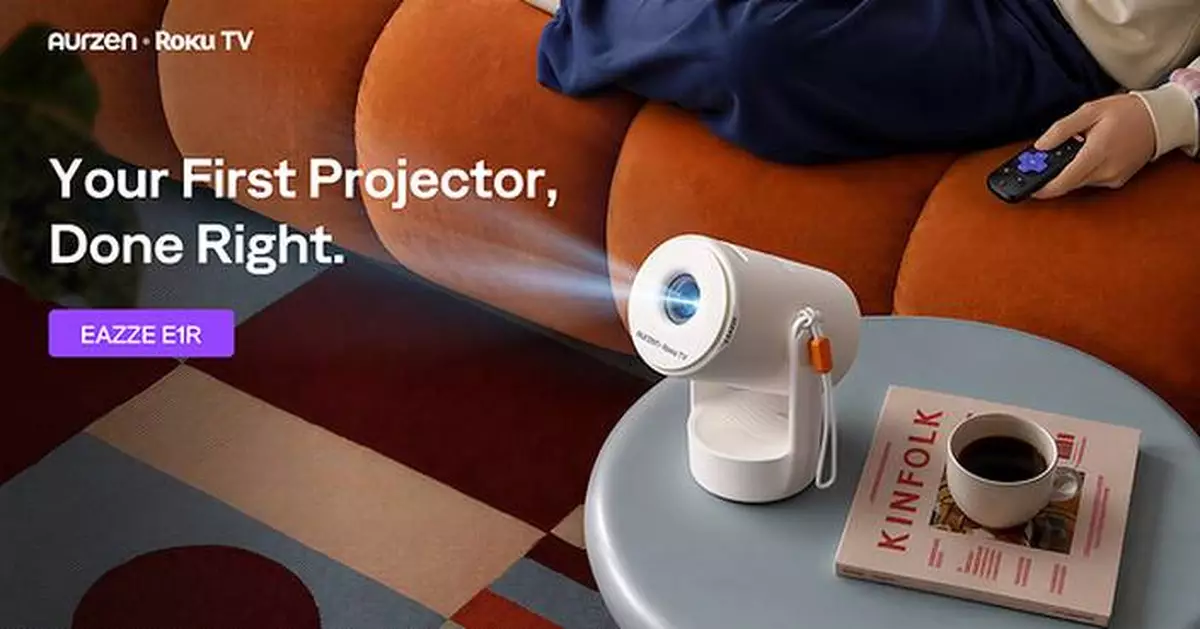
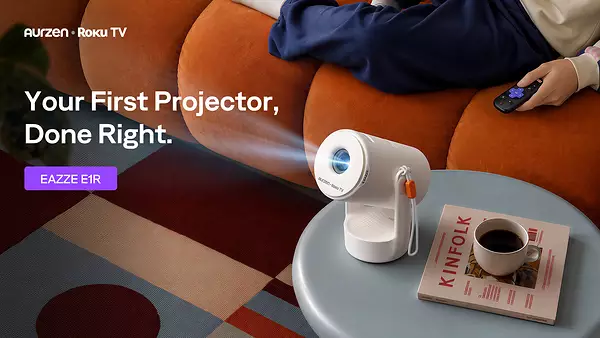
IRVINE, Calif., Sept. 1, 2026 /PRNewswire/ -- Aurzen today unveiled the EAZZE E1 series, a compact projector family designed to make big-screen entertainment more accessible in bedrooms, dorms, apartments and other small living spaces. The lineup includes the Aurzen Roku TV EAZZE E1R Smart Mini Projector and the Aurzen EAZZE E1 Smart Mini Projector, two models built around the same everyday-use concept but tailored to different streaming preferences and regional launch plans.
Both models extend Aurzen's value-focused EAZZE lineup with a compact, home-friendly design for first-time projector buyers and everyday streamers, featuring an integrated stand, a woven carrying strap and a softer design language that fits naturally into modern living spaces.
Both models share the same hardware, pairing a compact body with native 720P resolution, 1080P content support and 160 lumens of brightness. A 180-degree adjustable stand, vertical auto keystone correction and 4D electronic keystone keep setup flexible, with an accessory ecosystem supporting floor-standing and wall-mounting options. Sound comes from a built-in 3W speaker with an approx. 80–100cc Soundbase chamber, plus bidirectional Bluetooth audio for external speakers or headphones.
The two models differ only in their built-in streaming platforms, and neither requires an external streaming stick. The E1R features the official Roku TV platform, with access to major streaming apps, The Roku Channel, free live content, Roku mobile app control and Roku Smart Picture, delivering a familiar Roku experience in a compact projector form factor. The E1 comes with a built-in Smart OS and officially licensed apps including Netflix, Prime Video and YouTube, providing easy access to popular streaming services without additional devices.
Availability
The E1R is available now on Amazon in the U.S. and Canada for $139.99 in the U.S. and CAD 159.99 in Canada, with limited-time introductory price of $89.99 in the U.S. and CAD 139.99 in Canada, and will launch in Europe later this season.
The E1 is now available in Germany, France and Spain at €129.99 (€99.99 intro).
About Aurzen
Aurzen is a global innovator in smart projection technology. By combining advanced optical engineering with intuitive software and user-focused design, Aurzen delivers products that bring big-screen experiences to any space. The company pioneered the world's first Tri-Fold Truly Portable Projector, ZIP, and its designs have been recognized with multiple international awards, including the iF Design Award, Red Dot Award, G-Mark Award, and IDEA Award. For more information, visit www.aurzen.com.
** This press release is distributed by PR Newswire through automated distribution system, for which the client assumes full responsibility. **
Aurzen Launches EAZZE E1 and E1R at IFA 2026, Bringing Smart Big-Screen Entertainment to Everyday Spaces
What happens when AI starts investigating its own ideas? AutoResearch is an open-source attempt to bring AI agents one step closer to answering that question through experiments, evidence and iteration.
SAN FRANCISCO, Sept. 2, 2026 /PRNewswire/ -- EvoMap, an open infrastructure project for AI self-evolution, has open-sourced AutoResearch, a system that lets AI agents take research ideas from hypothesis to experiment and use the results to determine what happens next.
The Research Verification Problem
AI models are getting better at proposing ideas, writing code and analyzing results. But does a plausible answer actually hold up when put to the test?
AutoResearch starts from a simple premise: a model's confidence is not evidence of success.
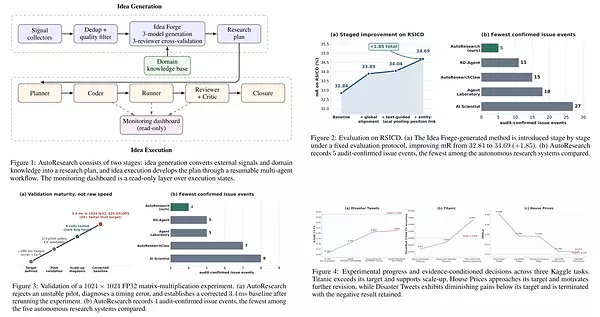
The system uses multiple AI models to independently generate and cross-review research ideas, then converts accepted ideas into executable research plans with defined metrics, success criteria, resource budgets and evaluation procedures. During execution, specialized agents handle planning, implementation, experimentation, analysis and review.
Research state, code, experiment logs, metrics, failures and decisions are preserved in a persistent workspace, allowing the system to continue unfinished research rather than restarting from scratch. Independent and blind review is also used to challenge conclusions before a research direction can be closed.
Evidence Determines What Happens Next
One of the more important design choices in AutoResearch is that failure is not treated as the end of a research path.
A partial result can lead to a revised hypothesis. An external test can expose a problem and trigger another round of experiments. And when repeated experiments stop producing meaningful gains, the system can stop pursuing the idea while retaining what was learned.
The approach was tested on a real Django issue from SWE-bench Lite. AutoResearch initially scored 2/7 and then 4/7 on official new-feature tests. Rather than stopping after the partial improvement, it continued investigating the underlying problem and ultimately reached 7/7, while maintaining 203/203 regression tests.
On the RSICD benchmark, an AutoResearch-generated research idea improved mean Recall from 32.84 to 34.69, demonstrating that the system could turn an AI-generated research hypothesis into a measurable improvement through iterative experimentation.
From AI Research to AI4AI
What happens when AI starts researching AI itself?
AI can already help researchers search the literature, identify promising directions, formulate hypotheses and even design experiments. The harder problem is what comes after that: can AI actually test the ideas it comes up with, and let the results determine whether those ideas are worth pursuing?
In AI research, this could mean agents exploring model architectures, training methods, optimization algorithms, agent designs and evaluation techniques, then running experiments to test their hypotheses and using the results to shape the next round of research. Moving from "this might work" to "let's find out whether it actually works" is a critical step toward more autonomous research.
The same principle could eventually extend beyond AI to areas such as drug discovery, materials science and engineering, where research ideas can be evaluated through simulations or physical experiments. The potential is not simply to have AI assist with more of the research process, but to give it a way to learn from what happens when its ideas meet evidence.
That is the direction AutoResearch is designed to explore: turning research ideas into executable experiments, experiments into evidence, and evidence into the next research decision.
Open-Source Research Infrastructure
AutoResearch is now available as an open-source project for researchers and developers working on AI scientists, autonomous agents and AI4AI systems. The accompanying paper, "AutoResearch: Insight In, Hallucination Out," is available on arXiv.
GitHub: github.com/EvoMap/AutoResearch
Research paper: arXiv: AutoResearch: Insight In, Hallucination Out
Technical research: EvoMap Research: AutoResearch Evidence Loop
About EvoMap
EvoMap is an open infrastructure project for AI self-evolution. The company is building systems that allow AI agents to learn from experience, share validated capabilities and improve across tasks and environments. EvoMap's work spans AI agent infrastructure, reusable AI capabilities and autonomous AI research, with representative projects including the Genome Evolution Protocol (GEP), EvoX Agent and AutoResearch.
Learn more at evomap.ai.
** This press release is distributed by PR Newswire through automated distribution system, for which the client assumes full responsibility. **
EvoMap Open-Sources AutoResearch, Giving AI Agents a Way to Test Their Own Research Ideas