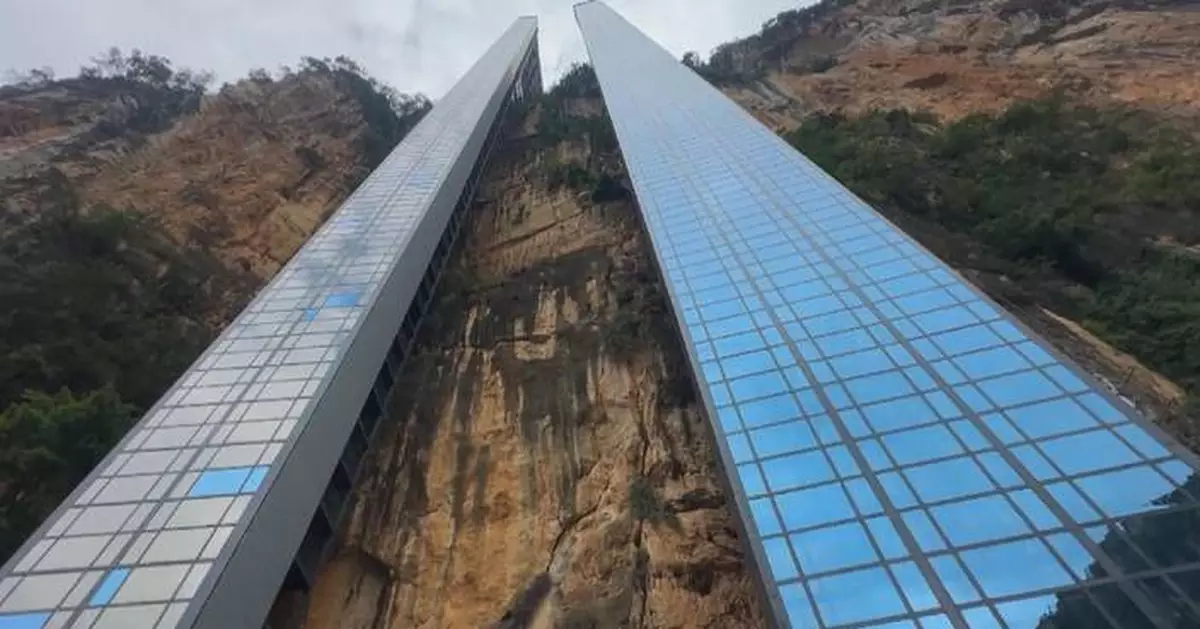
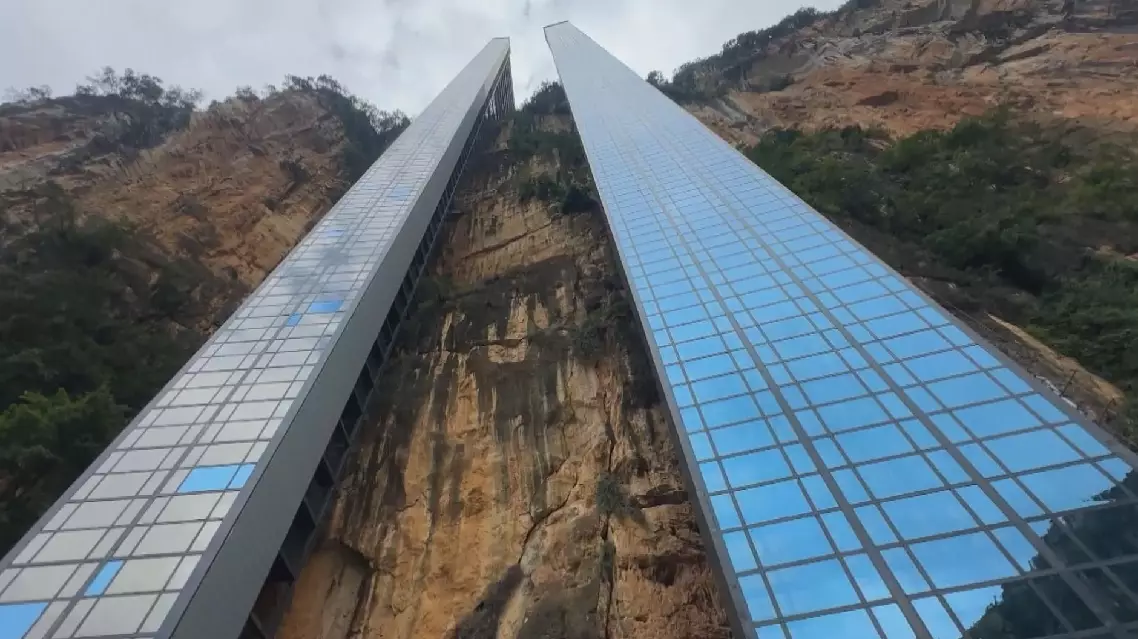
Two towering elevators rising from the floor of a deep canyon in southwest China's Yunnan Province have slashed the school commute for village children from more than three hours to around 30 minutes, transforming what was once a grueling daily trek into a swift vertical ascent.
The elevators, dubbed the "sky school bus," serve the Nizhuhe Village at the bottom of the Nizhu River Grand Canyon and the Guanzhai Primary School perched atop the mountain. What separates them is a vertical drop of over 500 meters -- a gap that used to consume nearly half a day for students to navigate.
The two structures stand 268 meters and 288 meters tall respectively. The second, taller elevator began operating just a month ago, completing a transit link that has replaced an arduous mountain climb with a direct ride to the school gates.
"It turns what used to take hours into a journey of less than a minute. And it saves us so much energy, so we can focus and calm down to study," said Qian Jiahao, a primary school student.
For many people, it's hard to imagine the challenges local people once faced.
Going to school used to be an uneasy task. They had to climb steep cliffs and narrow trails like this one, a journey that could take at least three hours each way.
A major turning point came in 2022, when the local government began developing the canyon as a tourist destination as part of its poverty alleviation efforts. The project included construction of the first cliffside elevator.
For local villagers, the outside world is no longer beyond reach.
"The old trail was really hard to walk. There was mud and moss, so it was very slippery. Now, with the elevator, we save about three hours on the journey," said Wang Jiao, another primary school student.
The cable car completes the second leg of the journey. Farm produce can be transported out more easily, while tourists can travel in, creating new opportunities for villagers to earn a better living.
Thirty-six-year-old Chen Guanpeng is one of those benefiting from the change. After years of working in factories in major cities, he eventually returned home and opened a homestay. During peak holiday seasons, he says, the rooms are often fully booked.
"Back then, we mainly grew a little ginger, and at most, we could make 5,000 to 6,000 yuan (744 to 892 U.S. dollars) a year. Now, we can earn at least 300,000 to 400,000 yuan (44,644 to 59,526 U.S. dollars) in gross income a year. Life has really changed dramatically," said a local villager named Chen Guanpeng.
Today, local officials are aiming to better utilize modern infrastructure and unlock additional opportunities for villagers.
"We want to make the best possible use of idle resources and vacant houses, turning villagers' homes into guesthouses and these untapped resources into a major source of income for local residents," said Yang Jie, Communist Party secretary, the Puli Township Government in Xuanwei City.
From a treacherous cliffside trail to a "sky school bus," Nizhuhe's transformation reflects the country's push for rural revitalization -- ensuring that no one is left behind.
"Sky school bus" in mountainous southwest China province eases children's journey to school