Chinese authorities have completed preliminary inspections of the Fuchun River crossing section of the Gansu-Zhejiang ultra-high voltage (UHV) flexible direct current transmission project, a major link designed to deliver renewable electricity from northwest China's Gansu Province to power-consuming centers in east China's Zhejiang Province more than 2,000 kilometers away.
Once finished, the project, spanning 2,370 kilometers as a key part of China's west-to-east power transmission program, is expected to become the world's first UHV transmission line to deploy flexible direct current technology at both the sending and receiving ends.
The line will transmit wind and solar power generated in the Hexi Corridor, an energy-rich region in northwest China, directly to major electricity-consuming areas in east China.
The Fuchun River crossing is one of the project's most challenging and high-risk sections due to its long span, large height difference and strong winds over the river surface.
"This river-crossing section has an extremely long span and a large height difference, with strong winds over the river surface. Under such working conditions, very high requirements are placed on the line-walking personnel in terms of balance control and inspection accuracy. Therefore, during this inspection for acceptance appraisal, we carried out a synchronized approach that combines manual line-walking checks with drone-based 3D point-cloud scanning (the process of using a 3D laser scanner to capture different points to measure an area), X-ray nondestructive testing (radiographic testing), and inspections using anti-fall rail robots. These methods complement one another to ensure the acceptance appraisal inspection work is highly efficient with higher quality," said Yang Ke, a technical team leader at the State Grid Hangzhou Power Supply Company.
According to Yang Zhengqing, a project management lead at the State Grid Hangzhou Power Supply Company, the Gansu-Zhejiang UHV project will channel clean energy over long distances into Zhejiang.
"The Gansu-Zhejiang UHV project will be able to deliver clean electricity continuously from thousands of kilometers away to Zhejiang. It is expected to transmit about 36 billion kilowatt-hours of electricity from Gansu to Zhejiang each year, including more than 21.2 billion kilowatt-hours of renewable energy. This will inject stronger green driving forces into Zhejiang's common prosperity demonstration zone construction, as well as the development of Hangzhou's artificial intelligence industry and the construction of computing power centers there," Yang said.
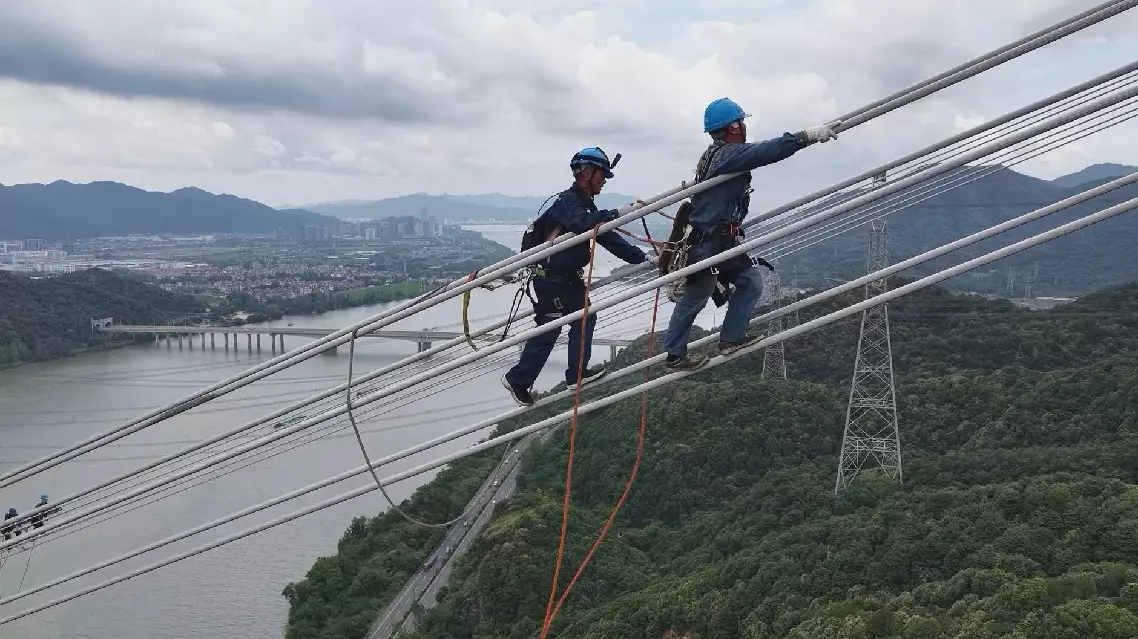
China completes preliminary inspections of river-crossing section in ultra-high voltage power project