Japan’s Defense Ministry plan to develop AI‑equipped satellites for military use runs counter to the country’s defense-only policy, the Tokyo Shimbun said in an editorial Saturday.
The Nikkei reported on Friday that the ministry is developing satellites equipped with artificial intelligence (AI) to process surveillance data collected from other satellites in space. The data would then be transmitted to the ground to accelerate decision-making.
According to the report, the system would enhance the operational capability of long-range missiles and bolster what Japan calls its "counterstrike capability."
For such a plan, the Tokyo Shimbun issued the editorial, voicing deep concern that reliance on AI could lead to miscalculations.
It noted that the United States used AI to select attack targets in its strikes on Iran, and that Israel also used such technology in its operations in the Gaza Strip.
However, the editorial argued, AI-assisted targeting is not always accurate, citing U.S. media reports suggesting that a missile strike on an Iranian elementary school may have been a misfire.
The editorial further pointed out that Japan's exclusively defense-oriented policy limits the use of force to the minimum level necessary to respond to an armed attack.
Using AI to locate targets and launching large-scale missile strikes can hardly be called minimum, it added.
Attacks on civilians are prohibited under international humanitarian law. It is unacceptable to condone attacks that may violate international law, the editorial said.
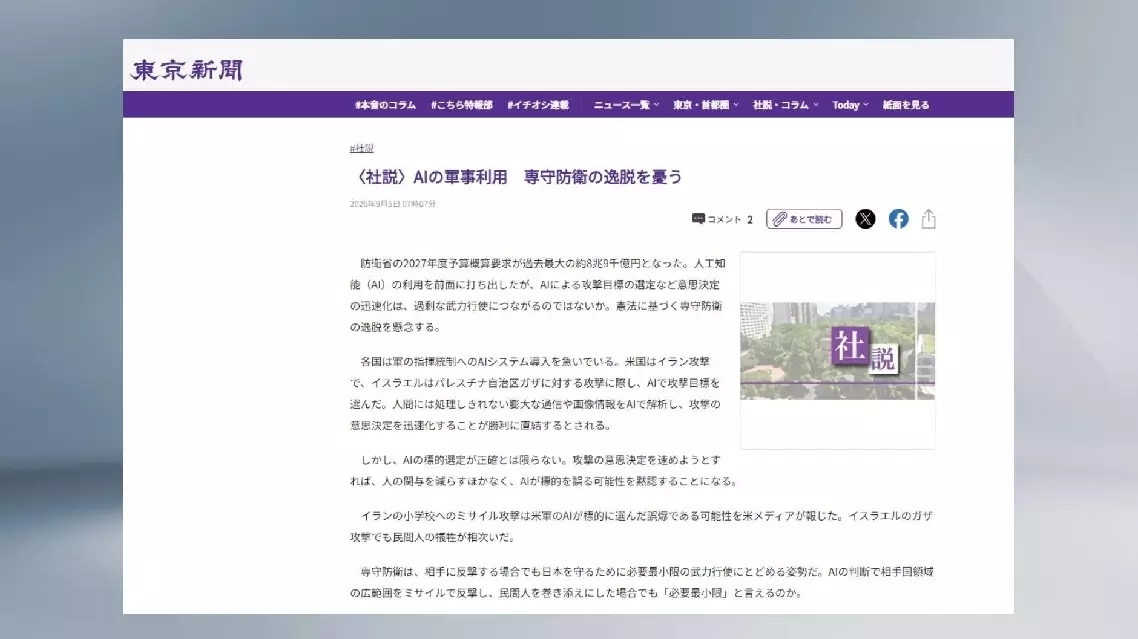
Japan Defense Ministry AI satellite plan sparks policy debate
Rescuers involved in the huge operation to re-open a crucial road link leading to the core disaster area of the Gyirong Port following the deadly mudslide in southwest China's Xizang Autonomous Region have shared their story of the huge undertaking and the enormous challenges and dangers they faced at the site.
The mudslide, triggered by a high-altitude glacier collapse in Nepal, hit Gyirong Port on Aug 26, killing at least 43 and leaving 519 missing as of Saturday, according to authorities.
The disaster sparked a large-scale search and rescue effort, with China Anneng, a state-owned engineering enterprise which is also specialized in natural disaster emergency rescue work, being called in to assist with the highly challenging operation.
In the wake of the massive mudslide, China Anneng mobilized 310 emergency responders and 120 units of equipment to the disaster zone. Their first task was to monitor two moraine-dammed barrier lakes upstream of the Donglin Zangbo River and downstream of the glacier collapse area.
"We sent a ten-member team with laser scanners, detection radar, and other monitoring devices. They trekked over mountains to the upper reaches of the river. The journey took seven to eight hours on foot. Sometimes, there was the risk of secondary disasters. Our rescuers encountered collapses while surveying the barrier lake," said Li Hongjun, chief commander of the rescue team on site.
After the barrier lake was naturally breached, the team was reassigned to reopen National Highway G216 -- a key road which offered the only land route to the Gyirong Port.
The disaster had damaged an almost three-kilometer section of the highway.
Efforts to repair the road were seen as essential in order to restore access and bring in more heavy machinery and specialist equipment to the port. "We were in a race against the clock. Our responsibility was to reopen the road as quickly as possible. It was extremely tough to push forward. It rained almost every night, a moderate level of rain. We couldn't afford to wait. We had to keep on going," said Li.
Rescue personnel worked in extremely hazardous conditions, as they carved a passage along the steep, unstable slopes and worked alongside the raging river torrents at the foot of the mountains.
Despite the urgency of the mission, extensive safety preparations were also made to protect the rescuers amid fears about secondary disasters occurring on this unsteady ground, Li said.
"The operation was carried out right next to the water. The river channel was extremely narrow, with the sheer volume and speed of the water flow being very high. Along the left bank, there were large amounts of sediment deposits that could collapse any moment. We made thorough assessments and took all the risks into consideration. Operators in the control room had to wear life jackets, and the doors were removed [from the rescue command center] so they could jump out in case of any emergency. We also set up cable escape routes along the bank, so they could climb to higher ground if needed," said the rescue chief.
The efforts to clear the crucial highway began to gather steam, as more heavy machinery was brought in to bolster the effort. Huang Xun, an excavator operator with Anneng, was the first to move forward in reopening the highway.
"I was the first. If I got in, then the second and third excavators could follow up, and more machines could come in behind. The faster I moved, the sooner everyone else could get in. We had to push ahead as fast as we could to reach the core area and get the road open. As we paved the way forward, the tracks were completely submerged most of the time," Huang said.
Overcoming multiple warning risks, including secondary landslides and the potential breach of barrier lakes, rescue teams finally restored the passage on Sept 2 -- one week on from the disaster -- enabling search and rescue operations to be stepped up significantly and allowing for the smoother transport of supplies as efforts continue.
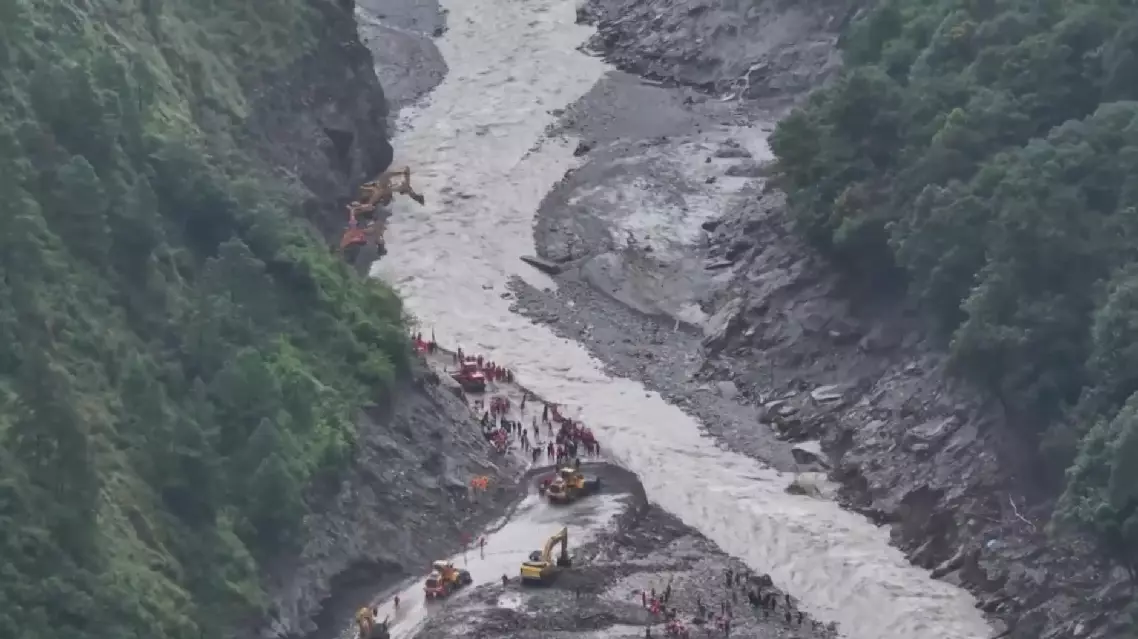
Rescuers recall race against time to reopen road lifeline in mudslide-hit Gyirong