China announced on Monday that the Pinglu Canal in south China's Guangxi Zhuang Autonomous Region will open to navigation on September 16, delivering a landmark waterway project that is set to serve as a new strategic artery for regional development and cross-border trade.
At a press conference held by the Information Office of the People's Government of Guangxi Zhuang Autonomous Region, it was introduced that after four years of arduous construction, the main works of the Pinglu Canal have passed acceptance inspections, and an integrated smart dispatching platform for river and sea shipping in Guangxi has been put into full operation.
Emergency support, cargo source organization and operational preparations have all been completed, with all procedures now in place. The canal is now ready for navigation.
The nautical chart of the Pinglu Canal estuary was also officially published on Monday, providing navigational support for vessels.
The Pinglu Canal is the first canal project planned and built at the national level since the founding of the People's Republic of China in 1949 to connect rivers and seas.
It is also a backbone project of the New International Land-Sea Trade Corridor and a key project linking the Belt and Road Initiative.
Construction began on August 28, 2022, with a total investment of about 72.7 billion yuan (about 10.8 billion U.S. dollars).
The canal stretches 134.2 kilometers, starting from the Pingtang River mouth in the Xijin reservoir of Hengzhou City in Nanning in the north, passing through Luwu Town in Lingshan County of Qinzhou City, and reaching the Beibu Gulf along the Qinjiang River.
It is built to the highest navigation standard in China, meeting the Class I standard for inland waterways and capable of accommodating 5,000-tonne vessels.
Once operational, the canal will shorten the inland waterway route for cargo from southwestern China to the sea by more than 560 kilometers compared with traditional routes. The shipping distance to major ASEAN ports will be significantly reduced, and overall logistics costs will drop by 18 to 30 percent.
The project is expected to save more than 5 billion yuan in transportation costs for society each year. It is also of great significance for promoting Guangxi's maritime development, advancing the large-scale development of western China in the new era, and contributing to the building of a closer China-ASEAN community with a shared future.
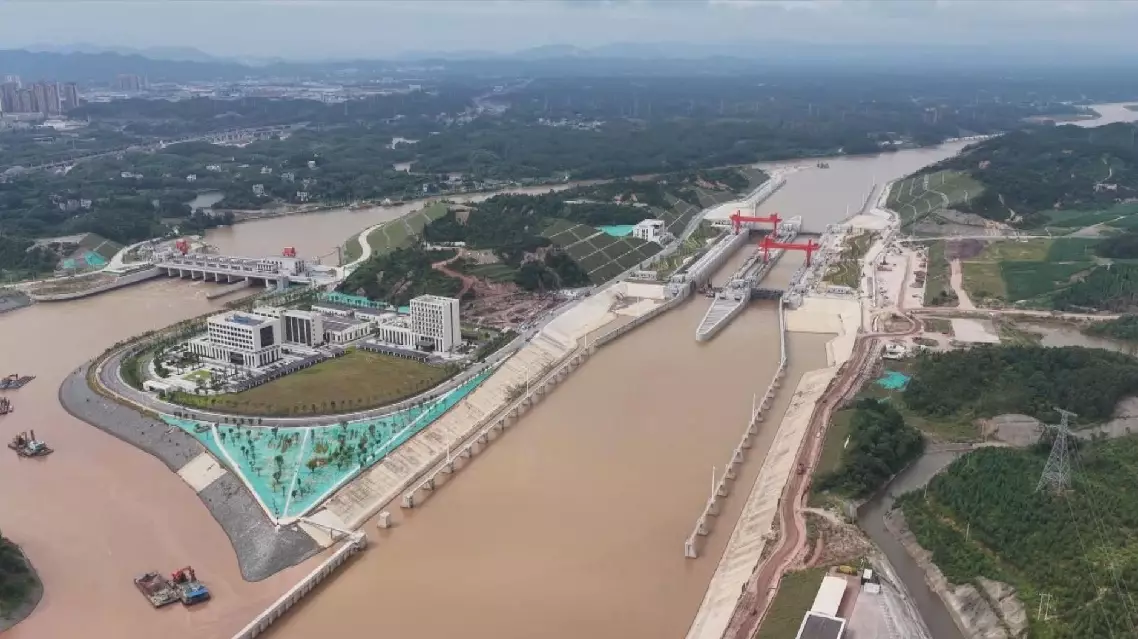
Major Chinese river-to-sea canal to start navigation