“The Uprising” starts as a true story of medieval England in the grip of economic revolution. That's good stuff. Then it gets inexplicably hijacked by an origin story for one of the West's most popular folk heroes. That's head-scratching stuff.
Paul Greengrass' movie mixes fact and fiction in such an anachronistic, uncomfortable way that it undercuts the movie-maker's initial populist scream and ceases to hold its historical power, like air escaping a deflated balloon.
It begins with a simple farmer — played with unflinching commitment by Andrew Garfield — plowing his marshy plot in east England in 1381. It builds to the blood-soaked streets of London, where this simple farmer's demands helped put the mighty British crown in real jeopardy during the Peasants’ Revolt. Then it turns out the farmer is Robin Hood. What? “The Uprising” might be 2026’s worst case of cinematic overreach.
Greengrass has said he was inspired to write and direct “The Uprising” following the pandemic, recalling how the Black Death plague of the late 1300s had killed so many and led to spasms of violence against those in power. But he’s ended up meshing fact — real rebel leaders Wat Tyler and John Ball — and fiction, that Hood dude. And no one is merry, if you know what I mean.
The arc of Garfield's character — only known as “Ploughman,” a nod to William Langland’s poem “Piers Plowman” — is fascinating, going from a humble widower-farmer to leading ragtag armies of urchins against the mighty crown like an English version of “Les Miserables.” He's a little too perfect — a noble, grieving philosopher-warrior-diplomat-everyman.
Ploughman is motivated by unrelenting taxes and cruelty by the king’s men — “We’ve given you enough!” he screams — to demand change only to get swept up in the eat-the-rich movement and watch in disgust as his demands for economic rights and dignity dissolve into widespread looting and anarchy. “I did not come for this,” he says. “Where is God in any of this?” But to be fair, he does also kill a sergeant-at-arms to kick the whole thing off. It’s a pity he’s entirely fictional.
Jamie Bell, who plays the priest Ball, and Cosmo Jarvis' Tyler, are outstanding as leaders of the people, with slightly different agendas. Woody Norman is brilliant as the teenage Richard II, simpering one moment and lethal the next, and Katherine Waterston is awesome as the king's mother. The rebels naively believe all they need is to get the king to hear their demands. They're in for a shock. “Justice has a price, does it not?” a simpering royal counselor says.
Greengrass' movie is gloriously rooted in the medieval muck. Animals bleat, smoke billows, hair is stringy, cloaks are filthy, no one has washed. You can almost smell the body odor through the screen. The violence is also not stylized — it's brutal, from beheadings and arrows slicing into bodies to our Ploughman suspiciously good at close-contact swordplay.
For three-quarters of the movie, we’re on Greengrass’ side, helped by his penchant for shaky, handheld camerawork, which here matches the kinetic, always-on-the-move drama.
Movie audiences are facing an affordability crisis and here is a populist rebellion against an out-of-touch aristocracy. “Can you not hear their rage?” the king asks. But violence is violence and some viewers will wince when a mob bursts into royal offices to burn and pillage, recalling scenes from the 2021 Capitol riot.
That good will Greengrass has built — he even supplied lyrics to marching songs — evaporates when Ploughman becomes Robin Hood. It doesn't even make temporal sense: Those stories were set during the reign of Richard the Lionheart, who died nearly two centuries before the Peasants’ Revolt took place. Putting him in “The Uprising” is like putting Paul Bunyan at the Chernobyl disaster. You can do it, but why?
Also, it doesn't make much character sense. Ploughman goes from embracing populism to the depths of cynicism only to re-emerge as an outlaw in the woods robbing rich folks? And a morose Robin Hood is not what we want in 2026, especially a second one following Hugh Jackman’s “The Death of Robin Hood.” Greengrass has quite simply robbed his own movie. We did not come for this.
“The Uprising,” a Focus Features release that's in theaters Friday, is rated R by the Motion Picture Association for “violence/bloody images.” Running time: 127 minutes. Two and a half stars out of four.
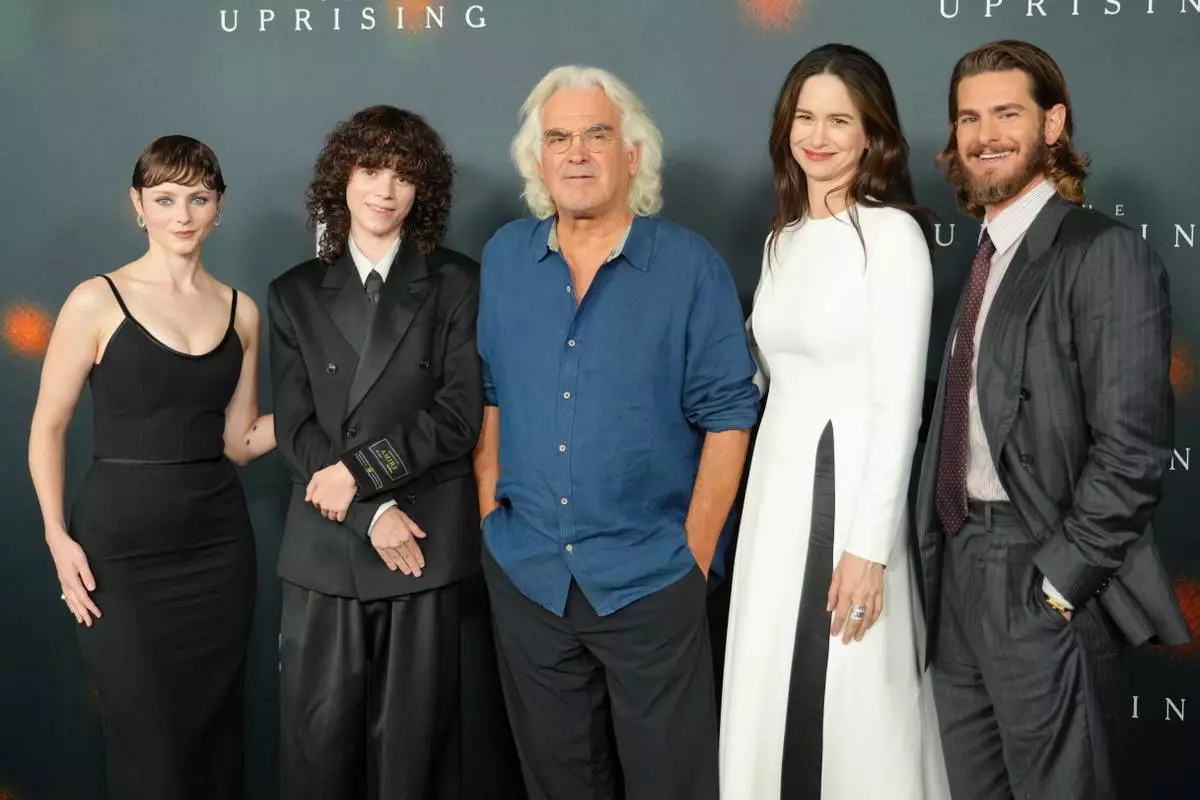
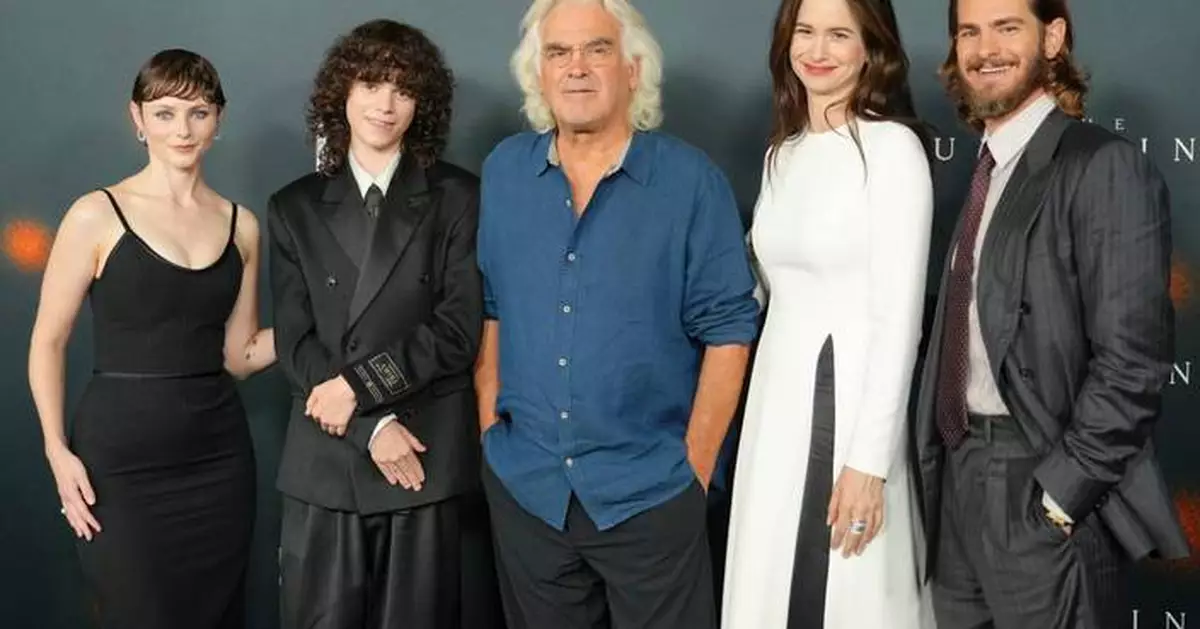
Thomasin McKenzie, from left, Woody Norman, Paul Greengrass, Katherine Waterston and Andrew Garfield arrive at the premiere of "The Uprising" on Wednesday, Sept. 2, 2026, at the DGA Theater Complex in Los Angeles. (Photo by Jordan Strauss/Invision/AP)
LONDON (AP) — British Prime Minister Andy Burnham defended his government's decision to ban trade with Israeli settlements in the occupied West Bank on Wednesday, saying that Britain was being true to its roots by taking a stand for justice.
“Britain has to stand for fairness against injustice where people are being bullied out of their homes,” Burnham told Parliament. “We will always stand with the underdog and take what action we can to support them.”
The U.K. announced the ban on Tuesday, and Israel responded by closing the British consulate in east Jerusalem and banning 11 lawmakers from the country.
The U.K.’s tougher stance was followed by France and Canada’s leaders saying they would take similar action to prevent expanding settlements and growing violence from making it impossible to establish a future Palestinian state.
Foreign Secretary Ed Miliband said “settler terrorists” were carrying out “ethnic cleansing” of Palestinians in the U.K. government’s biggest pushback to Israel since it recognized Palestinian statehood a year ago. He said there had been “houses bulldozed, roads and public infrastructure destroyed, families displaced from their homes.”
Israeli Foreign Minister Gideon Saar condemned the “despicable” move and said Israel would expel U.K. representatives from a joint military center monitoring the Gaza ceasefire and end U.K. training of the Palestinian Authority’s security forces in the West Bank. In addition, Israel barred entry to a dozen British lawmakers and other U.K. citizens whom Saar said were “involved in antisemitic and anti-Israel activity.”
Miliband, who is Jewish, said he was disappointed with Israel’s response and rejected criticism from the U.K.’s chief rabbi, saying it would not lead to more antisemitism in the U.K.
Ephraim Mirvis, the chief rabbi in the U.K., accused the government of “gesture politics” that would bolster “the very extremism they seek to target.”
“We all need to do more to tackle antisemitism, but I believe we can do that and stand up for British values,” Miliband said.
The ban covers imports of all goods from the settlements and bars companies from providing services for the settlements, including financing, construction, infrastructure, real estate and advertising. It will take effect in up to nine months.
Denmark, Finland, Iceland, Poland, Portugal and Sweden have pledged to “support further action,” Miliband said. The Netherlands, Ireland, Belgium, Spain and Norway have either banned goods from settlements or are in the process of doing so, he said.
Miliband also tightened Britain’s embargo on weapons sales to Israel for use in Gaza to include arms “that materially contribute to the occupation” of Palestinian territories.
Conservative lawmaker Bernard Jenkin said he was concerned that the government's decision could affect counterterror cooperation with Israel to keep Britons safe.
“We are now embarked, it seems, on a full diplomatic dispute with Israel and tit-for-tat expulsions of diplomats,” Jenkin said.
The economic impact of the ban is likely to be limited, since the settlements produce only a small amount of largely agricultural exports. But the move is a symbolic expression of displeasure with Israel by some of its closest allies, and it offers a new sign of the Israeli government’s growing isolation as a result of the Gaza war.
Under Israeli Prime Minister Benjamin Netanyahu 's ultranationalist government, settlement construction in the West Bank — seized by Israel in the 1967 Mideast war — has surged. Netanyahu’s government views the West Bank as the biblical and historical homeland of the Jewish people and is opposed to the creation of a Palestinian state.
The international community overwhelmingly considers such construction to be illegal. Britain and other countries have voiced particular concern about the E1 settlement project approved by Israel, which would effectively cut the territory in two.
There have been marked increases in attacks by settlers on Palestinians, evictions from Palestinian towns, Israeli military operations and checkpoints that choke freedom of movement, as well as several Palestinian attacks on Israelis.
Britain's action was applauded by former Ireland President Mary Robinson and ex-New Zealand Prime Minister Helen Clark, both former U.N. officials. The two said the EU should follow suit.
“A coordinated international defense of the two-state solution is needed now more than ever,” they said. “Palestine must not be erased.”

A view of the the British Consulate in east Jerusalem after Israeli Foreign Minister Gideon Sa'ar announced that Israel would close the facility in response to U.K sanctions on Israeli settlements in the West Bank, Tuesday, Sept. 8, 2026. (AP Photo/Mahmoud Illean)
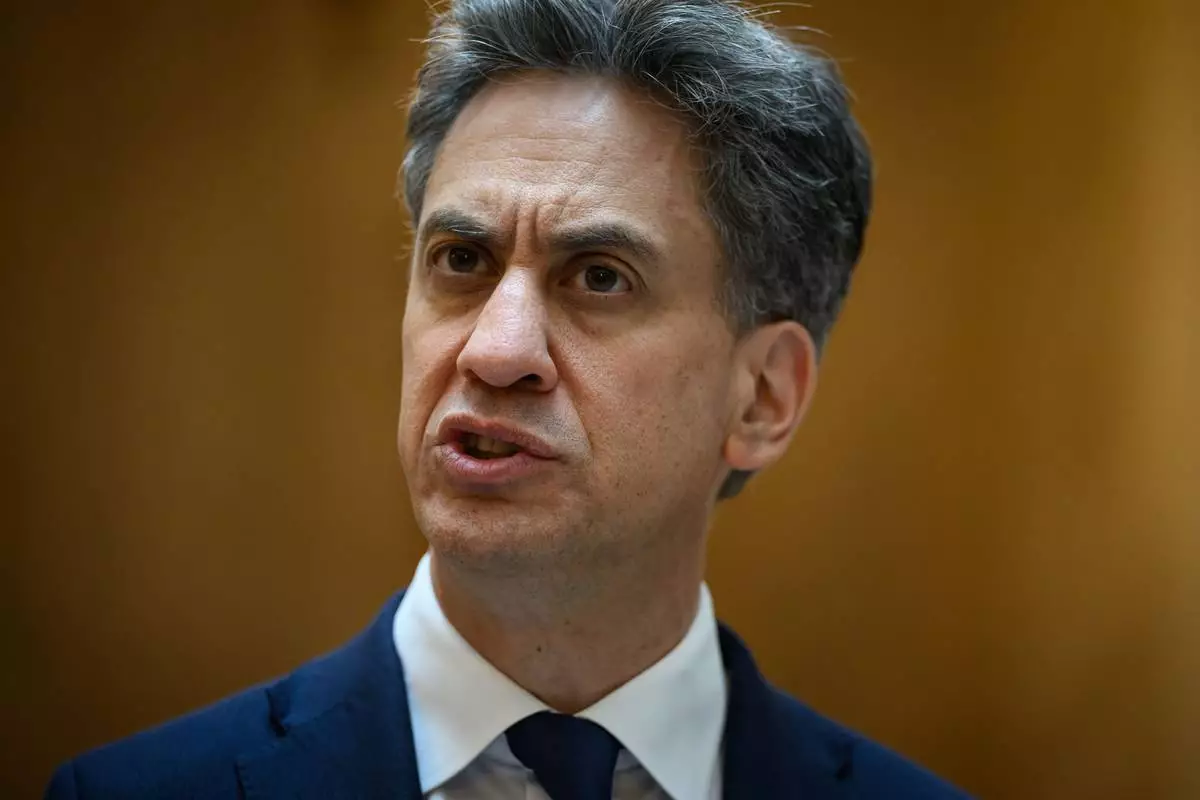
FILE - Britain's Foreign Secretary Ed Miliband speaks during a press conference in Madrid, Spain, on July 29, 2026. (Leon Neal/Pool Photo via AP, File)