China's annual token consumption is expected to reach 100 quadrillion this year, as the country's AI industry shifts its focus from competition in large models and computing power to the large-scale deployment and commercialization of AI agents, according to a report released on Saturday.
AI is now entering a new stage of development in which AI agents are becoming a primary form of application, said the report titled "Research Report on AI Infrastructure Development in the Agent Era (2026)" released by the China Telecom Research Institute.
AI agents are making complex AI technologies invisible and accessible, which allows individuals and enterprises to complete sophisticated, end-to-end tasks without mastering specialized technical expertise, it said. "China's annual token consumption is expected to reach 100 quadrillion in 2026 and exceed 35 quintillion by 2030, a compound annual growth rate of nearly 12-fold," said Rao Shaoyang, head of the industry and enterprise strategy institute at the China Telecom Research Institute.
The surge of AI agents will drive sustained, rapid growth in China's demand for computing power, Rao said, adding that China's computing power demand is expected to increase by nearly tenfold annually over the next two to three years.
In terms of the structure of that demand, inference computing will far outpace training computing, and by 2029, inference computing is projected to account for 80 percent of China's computing market.
Chinese companies are already preparing for the surge in token consumption.
Qian Ling, a chief expert at China Mobile, said the group has established two high-level management institutes for computing power and tokens to coordinate the development of computing infrastructure and token consumption.
"The average daily token output of China Mobile was about 3.4 trillion tokens last year, according to our calculation. The production capacity will for sure surpass that level this year," said Qian.
According to the global market research firm International Data Corporation, the number of active AI agents worldwide is expected to expand from roughly 28.6 million in 2025 to 79.4 million in 2026 and 2.216 billion by 2030.

China's token consumption to reach 100 quadrillion in 2026: report
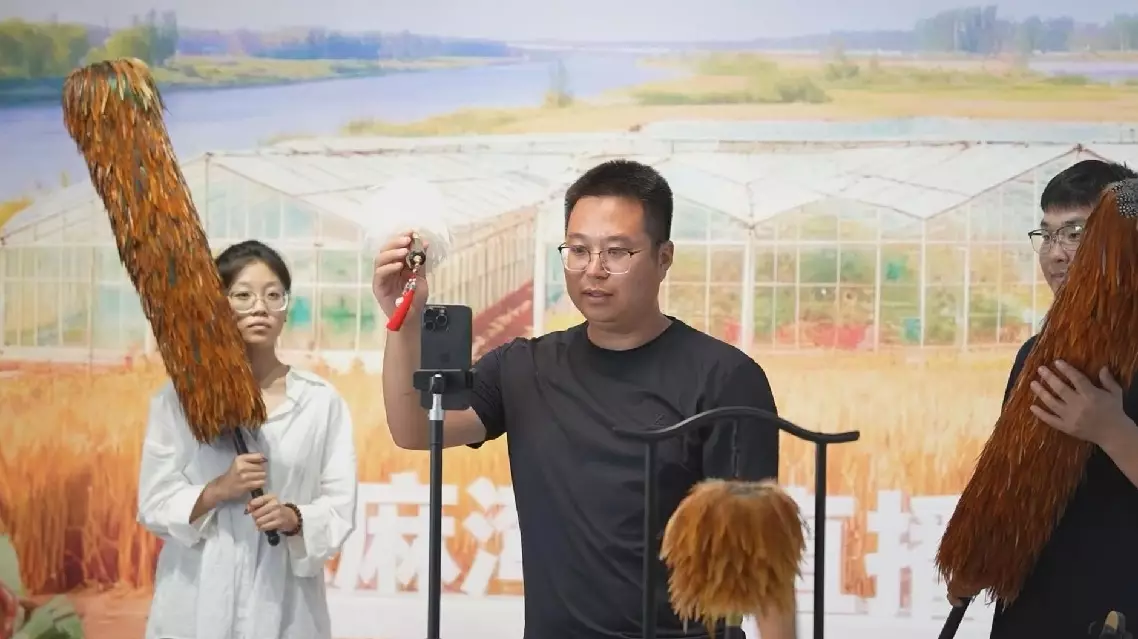
An age-old feather duster craft in north China's Hebei Province has found new life online, as livestreaming turns a village tradition into a source of income for elderly residents. In Luan'nan County, Tangshan City, Liu Wenhao, Party secretary of Zhangmawan Village, is promoting the village's handmade feather dusters alongside fellow villagers in livestreams. Since 2024, he has led villagers in bringing the traditional craft online, quickly turning it into an internet sensation.
Elderly villagers now craft dusters while also serving as online hosts, participating in livestreams and welcoming tourists. Liu Huiying is one of them.
"This is no small income. I earn about 20,000 yuan (about 2,981 U.S. dollars) a year, which is more than enough. They call me an internet celebrity. I'm happy," she said.
The feather duster craft has a long history in Zhangmawan. Once a sideline for villagers during the agricultural off-season, craftsmen worked from dawn to dusk only to sell a single duster for 0.3 to 0.5 yuan. Sales were slightly better at rural fairs, but earnings were barely enough to make a living. As modern cleaning products diversified, traditional feather dusters gradually faded from daily life.
In recent years, with the rise of short-video platforms, several young people in the village began experimenting with short videos. Their first video showing the making of a feather duster garnered more than 600,000 views.
"Our village's traditional craft was well-known throughout the region. So we thought, with so many people here skilled at making feather dusters, why not sell them online and help boost their incomes?" said Liu.
Zhangmawan has more than 200 residents over the age of 60. To boost their incomes and pass on the craft, product transformation was key. Young villagers pooled their ideas and decided to enter the cultural and creative market.
While veteran artisans persisted in handmade production, younger people focused on innovative designs, launching new items such as car hangings, bag charms, desktop ornaments and cat teasers, tailored to modern aesthetics and lifestyles.
Online popularity has also boosted offline tourism. The village has leveraged its advantages to offer craft workshops, rural sightseeing, farm meals and educational study tours, attracting a large number of visitors and children.
"You can hang it on a schoolbag or car keys -- it can go in many places. And if something gets dirty, you can use it to sweep," said Meng Shixuan, a young visitor.
"We want to keep updating our cultural and creative feather duster products, and through short videos and livestreaming, develop the village's study tour and sightseeing businesses to provide more jobs and income opportunities," Liu said.
Chinese village turns traditional feather duster craft into online hit