China's computing power platform has achieved integrated nationwide monitoring of computing resources, with a framework of "one network, coordinated planning, and unified development" for computing power sector basically taking shape.
This was officially announced at the opening ceremony of the 2026 China Computing Power Conference in Langfang City of northern China's Hebei Province on Saturday.
The China Computing Power Platform serves as the national comprehensive service hub for computing resources.
It now hosts more than 10,000 registered enterprise users, lists over 2,000 high-quality computing products, and has accumulated billions of data entries on computing power operations.
All 31 provincial-level regions on the Chinese mainland have been connected to the platform, enabling authorities to clearly map the national computing base, track real-time trends, and monitor operational status across regions.
"By the end of June this year, China's intelligent computing scale reached 2,185 EFLOPS (ExaFLOPS of floating-point operations per second), up 177 percent year on year. More than 70 backbone transmission channels linking national computing hubs and key regions had been built, significantly improving compute-network coordination," said Zhong Zhihong, chief engineer of the Ministry of Industry and Information Technology.
"Compute-network integration continues to deepen. The three-tier computing network with '1-5-20 millisecond' latency rings has initially taken shape, constantly consolidating the groundwork for cross-region scheduling," said He Baohong, chief engineer of the China Academy of Information and Communications Technology.
While ground-based computing expands rapidly, China is also looking to space.
At the conference, industry players launched a Beijing-Tianjin-Hebei Space Computing Industrial Corridor Initiative and started a Space-Earth Integrated Domain Intelligent Computing Network Project.
"Progress has been made in reusable rockets, radiation-hardened chips, and on-orbit data processing. An innovation ecosystem blending aerospace information and computing power is being formed more quickly," said Li Yantao, deputy director of the Beijing Economic-Technological Development Administration.
Industry observers said the push toward space-ground integrated infrastructure, from domestic computing power construction to high-speed compute-network interconnection, is opening new opportunities across the value chain.
"Driven by the waves of AI infrastructure, our overall optical transmission, optical components, and end-to-end solutions have all improved markedly. In the first half of this year, sales revenue was nearly 10 billion yuan," said Zheng Xin, vice president of the Yangtze Optical Fiber and Cable Joint Stock Limited Company.
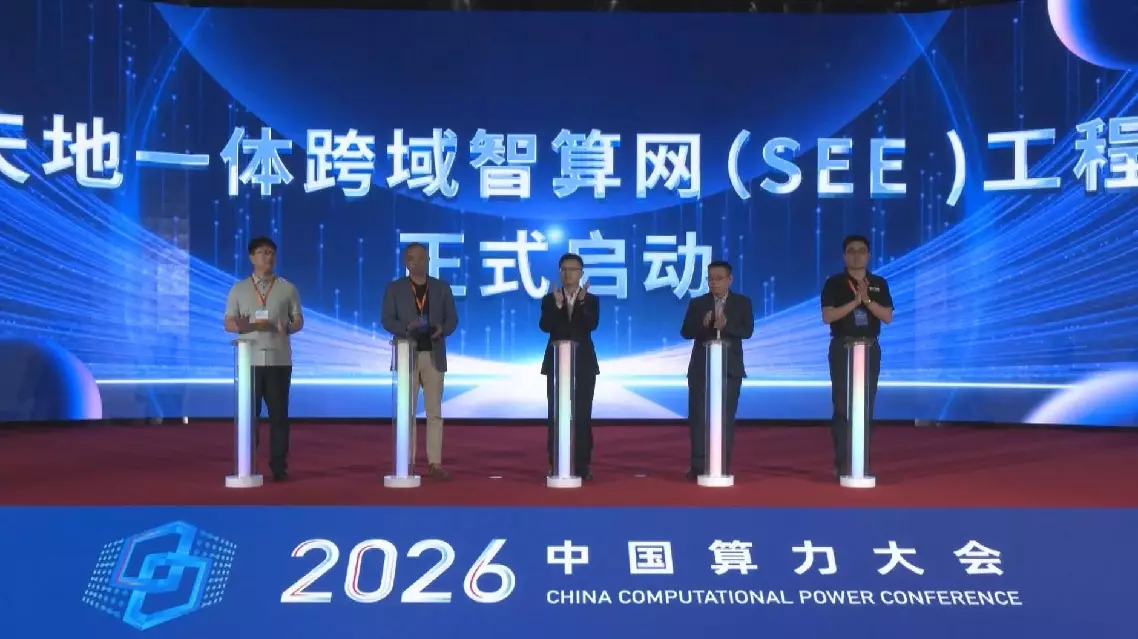
China achieves unified nationwide computing power monitoring