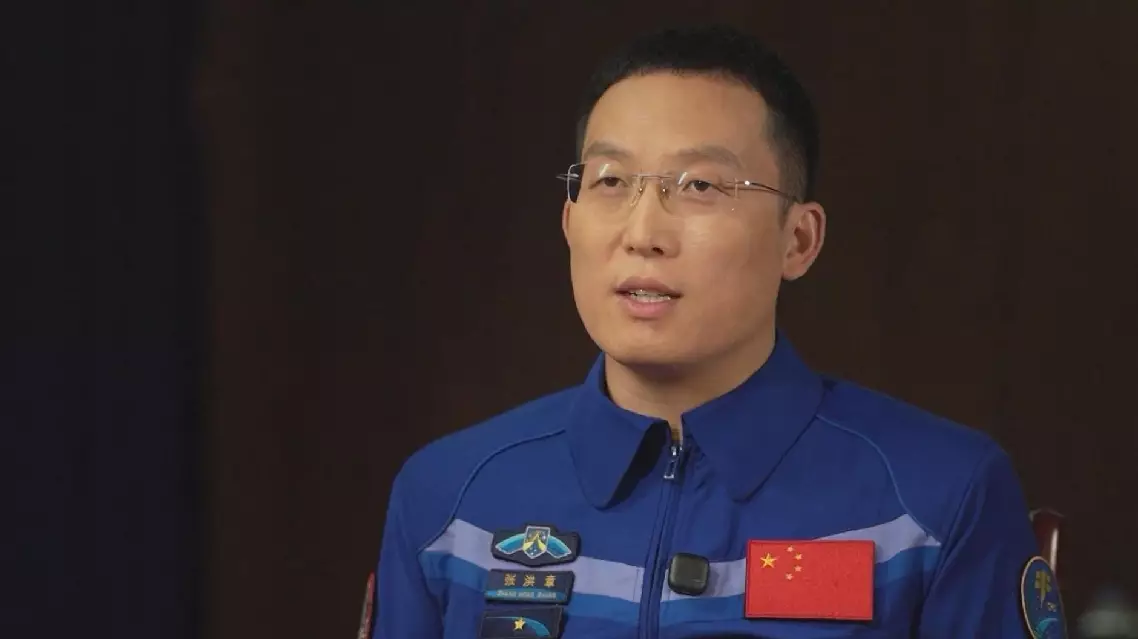
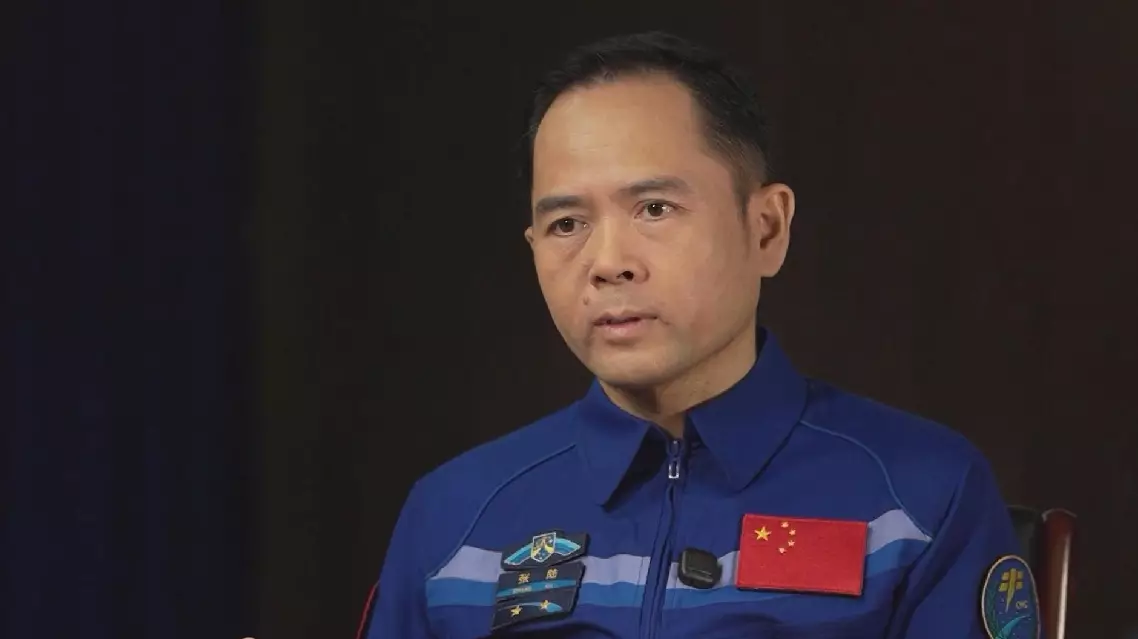
Zhang Lu, commander of the Shenzhou-21 crewed mission and record holder for the most extravehicular activities by a Chinese astronaut, spoke about his most challenging tasks in space and his role of passing the torch to a new generation of space explorers in a recent interview.
On October 31, 2025, The Shenzhou-21 spaceship lifted off from the Jiuquan Satellite Launch Center in northwest China, carrying astronauts Zhang Lu, Wu Fei and Zhang Hongzhang.
Originally, Shenzhou-21 was launched to facilitate a crew rotation with the Shenzhou-20 mission. However, the Shenzhou-20 return capsule's viewport window had sustained damage from suspected space debris, making it unsafe for reentry.
As a result, the Shenzhou-20 crew returned to Earth aboard the Shenzhou-21. China's space station was then left with only the damaged Shenzhou-20 and the Tianzhou-9 cargo spacecraft. The Shenzhou-21 crew experienced an 11-day gap before the emergency launch of the Shenzhou-22.
In an interview with China Central Television (CCTV) in Beijing, Zhang said the crew had emergency plans in place, but without a spacecraft as backup, every task had to be carried out with extra caution.
"If an emergency occurs, we have a strategy for whether to evacuate to the Wentian lab module or an isolated module. Without a spacecraft as backup and support, all our work had to be done with extra care, even greater care. We could not afford any further problems on that basis, otherwise it would add extra burden to the ground and extra risks for ourselves," he said.
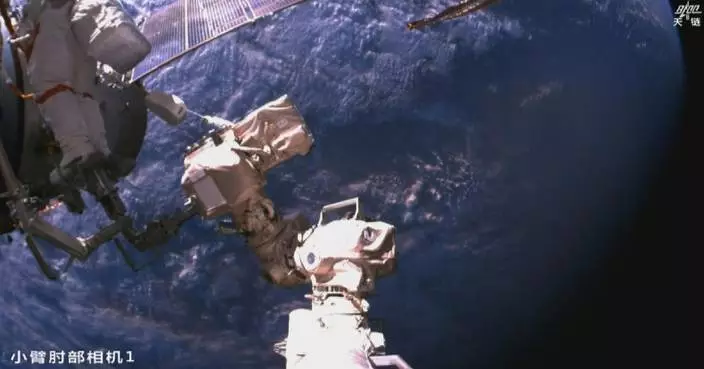
On December 9, 2025, Zhang climbed onto the robotic arm outside the space station to conduct a close inspection of the Shenzhou-20's window and surrounding body.
"I carried a camera with me and placed it on the robotic arm's operating platform, about two meters away from the spacecraft, to take photos. I thought I could take more photos from more angles so you could distinguish things more clearly," Zhang said.
It was the first time the space station conducted an extravehicular activity with two crewed spacecraft docked, placing higher demands on the robotic arm's path planning and movement safety.
Adjusting posture outside the spacecraft is difficult, and reaching the right position often depends on coordination between the ground and the robotic arm, as Zhang explained.
"In space, if you want to change your posture, it is actually very difficult, because the feet of the person on the robotic arm are already fixed, so it is hard to change your left-right or pitch. To save time, I might lift up, lower down or move left and right on my own, but actually that range of movement is very difficult for me," he said.
Because Zhang wore pressurized gloves while photographing outside the spacecraft, his movements were far less flexible than on the ground. The camera also required multiple protective measures outside the spacecraft, and some operations had to be handled from the ground, making space photography much more difficult than on Earth.
After completing the inspection and photography of the spacecraft, Zhang arrived at the exterior of the Tianhe core module via the robotic arm at 15:21 and began installing space debris protection devices for the space station.
Installing the protection panels also posed significant challenges.
"Actually, installation may not be the hardest problem. How to fix the protection panel on my operating platform and then how to take it off may be a big problem. Our protection panels are not uniformly shaped boards. Each panel is different, with various shapes, including square, rectangular, diamond, isosceles trapezoid, and even wavy shapes. Our operating platform, as you know, only has two supports for placement and fixation. Each time I went out, I had to carry at least four, five, or even six panels. Besides installation, I have to prevent these panels from drifting away, because if they were not properly fixed after installation, or if they were bumped when fixing the next panel and drifted away, that would be a very big problem," Zhang said.
From 12 years of preparation to his first spaceflight, and then to his return to space two years later, Zhang, a member of China's second batch of astronauts, led two third-batch astronauts, Wu Fei and Zhang Hongzhang, back to space as mission commander.
Since China's space station missions began, 27 extravehicular activities have been conducted, and Zhang has participated in seven of them, setting a new record for the most spacewalks by a Chinese astronaut.
Reflecting on his role as commander, Zhang said his mission was to help the next generation grow.
"For me, during the Shenzhou-15 mission, my commander Fei Junlong mentored me, taking me outside the spacecraft and giving me a deeper understanding of spacewalks. Now I'm experienced. This time, as commander, my task is to lead Wu Fei outside, so that through three spacewalks he can also become seasoned. All three of my spacewalks were to install protection panels for the space station, to better maintain and protect our space station. Because the space station is our space home, we need to work and live in it, and we need to pass on the torch from one mission to the next. In the future, our solar panels may need to be replaced or transferred. If one day I get to go outside and replace the entire solar panel, like holding a giant banana leaf outside the spacecraft, how cool would that be?" he said.
China's spacewalk record holder reflects on career, missions as astronaut