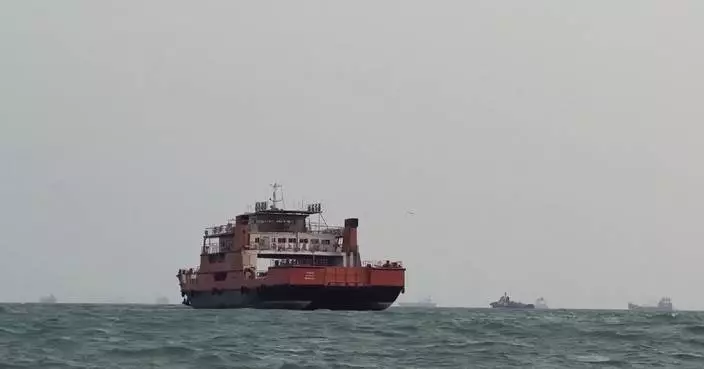
Escalating hostilities along Yemen's western coast have displaced more than 100,000 people and forced thousands more to seek safety across the Bab al-Mandeb Strait in Djibouti, the United Nations said on Tuesday.
Stephane Dujarric, spokesman for the UN Secretary-General, highlighted the severe toll of the renewed violence during a briefing at the UN headquarters in New York.
Citing a report from the UN Refugee Agency (UNHCR), he noted that the situation on the ground is increasingly desperate, with many families forced to flee in haste, carrying only a few meager belongings.
To address the worsening humanitarian crisis, UN Emergency Relief Coordinator Tom Fletcher announced the allocation of 9 million U.S. dollars to provide urgent assistance to the displaced families and to the communities receiving them.
Dujarric warned that the escalating conflict is complicating humanitarian efforts in the region.
"The widening escalation is adding further pressure on already underfunded and overstretched humanitarian operations in the region, where the needs remain high, while disruptions to trade, energy and essential supplies risk compounding humanitarian needs both within and beyond the region," said Dujarric.
He reiterated the UN's call for protecting civilians and preserving aid access.
"We call yet again on the parties to protect civilians, to respect international humanitarian law, to respect international law and to facilitate the safe and unhindered passage of humanitarian aid, so it can reach all those who need it, wherever they may be," said Dujarric.
The UN noted that Yemen's Houthi group is continuing their advance along the western coast toward the strategic Bab al-Mandeb Strait, prompting counteroffensives from Yemeni government forces.
Amid the clashes, UN Special Envoy for Yemen Hans Grundberg is actively engaging with all relevant parties, focusing on keeping communication channels open and preserving space for dialogue in hopes of halting the escalation.

Over 100,000 displaced amid escalating clashes along Yemen's western coast: UN
China's Gravity-1 Y3 carrier rocket successfully placed nine satellites into planned orbits during a sea launch from the eastern waters off Shanghai at 06:00 Beijing time on Wednesday,, setting new records for payload weight and orbit altitude in a single mission.
The mission was carried out by the Taiyuan Satellite Launch Center. The rocket carried a new group of Qianfan Constellation satellites and an EUHT technology test satellite. It was the fourth flight of the Gravity-1 rocket.
Gravity-1 is a solid-fuel rocket developed by a Chinese commercial aerospace company, OrienSpace, with a maximum payload capacity of 6.5 tonnes. This launch was the second time Gravity-1 conducted a far-sea maneuver and launch, following the first on July 22, when the Gravity-1 Y4 rocket lifted off from the same area and sent nine satellites into the planned orbits.
It once again fully tested the rocket's adaptability to high temperature, high humidity and high salt fog at sea, further verifying its reliability, according to experts.
"We've fully used the rocket's entire carrying capacity, just leaving a ballistic margin of slightly more than 100 kilograms, with everything else devoted to launch payload. For the 800-kilometer orbit, our current utilization has exceeded three tonnes," said Xu Guoguang, chief designer of Gravity-1 at Orienspace.
The mission also marked the world's first solid rocket launch of stacked satellites, designed to meet the networking needs of large-scale constellations. Gravity-1 adopted a stacked arrangement, placing multiple satellites on top of one another like "stacking blocks" to improve the utilization of space inside the fairing and the payload ratio.
"In the past, when it came to multi-payload launch, the satellites were usually mounted on a load-bearing cylinder in a wall-mounted way, so the rocket's space utilization was not particularly high. The biggest advantage of stacked satellites is that they significantly boost rocket efficiency. For the satellites, the average launch cost is correspondingly lower," Xu said.
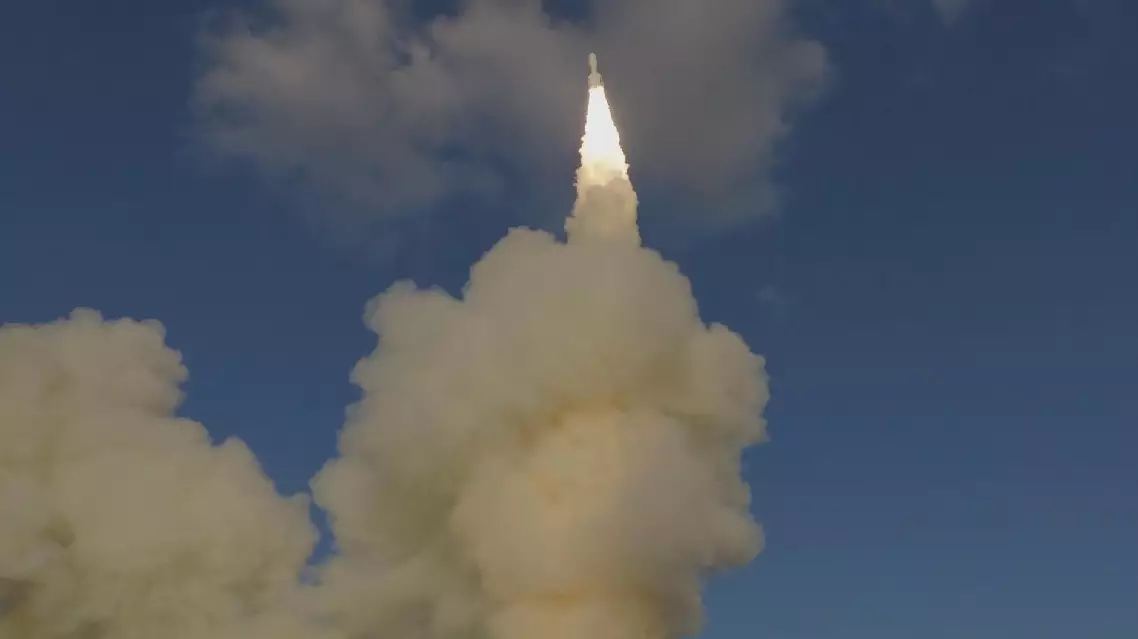
China's Gravity-1 commercial rocket successfully carries nine satellites into orbit