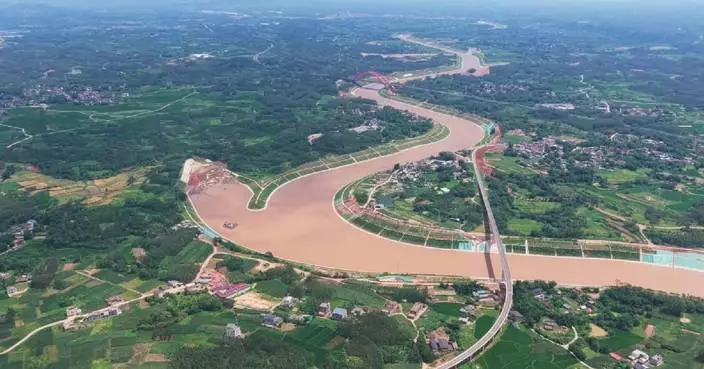
The Madao hub, the largest of the three major ship lock hubs along China's Pinglu Canal in south China's Guangxi Zhuang Autonomous Region, has been fully completed, allowing the canal to begin carrying cargo vessels this week.
The hub has set world records for the largest water-saving ship lock in terms of both water-level lift and overall scale for an inland waterway. It features a world-class water-saving lock system, intelligent monitoring networks, and an innovative ecological restoration model that turns construction waste into fertile farmland.
Following the hub's completion, the 134.2-km-long Pinglu Canal, which links the Xijiang River shipping route up in the north with the Beibu Gulf in the south, will become operational on Wednesday. It is China's first major river-to-sea canal project planned and coordinated at the national level since 1949.
The canal's three major hubs, Madao, Qishi, and Qingnian, were constructed along the canal from upstream to downstream to address water-level differences. All of them have passed joint commissioning tests.
Located in Qinzhou, Guangxi Zhuang Autonomous Region, Madao was carved through mountains and valleys over four years to form a critical node connecting the inland waterway network to the Beibu Gulf. Its cascading lock system appears massive and solid from the outside, yet its operation depends on a series of refined design features.
The system can accommodate 12 vessels of 5,000 tonnes each in a single operation, allowing them to overcome a water-level difference nearly as tall as a 10-story building and proceed smoothly toward the Beibu Gulf.
The principle behind such a large lift is straightforward. The passage where vessels sail is the lock chamber, and the structure beside it is the water-saving basin. When a vessel travels downstream, the chamber automatically drains water into the basin. Once the water level in the chamber matches that downstream, the gate opens, and the vessel exits safely and steadily.
The water released into the basin is not wasted, but stored and recycled. When the next vessel heads upstream, the water is returned to the chamber. The design sustains navigation efficiency while minimizing freshwater consumption, achieving both smooth transit and water conservation.
Madao hub sits in Madaotou Village in Qinzhou, an area historically separated from the sea by mountains and lacking an accessible water route. Digital technologies have now transformed the once-continuous hills into a modern hub connecting rivers to the sea.
Innovative technologies supported the hub's construction and will continue to support its operation. Arrays of automated intelligent monitoring devices cover its slopes and operate around the clock to detect displacement or deformation caused by rainstorms, strong winds and other severe weather.
All monitoring data is transmitted wirelessly to the Pinglu Canal digital twin platform, allowing engineers in the control center to track slope conditions in real time.
When data reaches a preset warning threshold, the system automatically issues an alert. On-site personnel then prohibit vessels from berthing or sailing below the slope, providing comprehensive protection for crews and ships.
The interior of the lock's water conveyance culverts contains another layer of smart protection. During construction, engineers embedded a large number of sensors in key locations, such as the culverts and operating valves, and applied specialized waterproofing and reinforcement so the equipment can adapt to long-term underwater operation.
These sensors detect risks early and monitor equipment health in real time, supporting the lock's long-term, stable and safe operation.
To open the new waterway, builders excavated more than 300 million cubic meters of earth and rock, equivalent to three times the total earth-rock excavation of the Three Gorges Project.
In many large projects, excavated spoils are mainly transported elsewhere for stockpiling. The Pinglu Canal has instead adopted a green ecological approach, avoiding ecological debt and turning every cubic meter of excavated material into a usable resource.
A lush sugarcane field near the hub illustrates how the approach works. The level, fertile land was entirely reclaimed from earth and rock generated during Madao's construction, and this area alone has absorbed more than 2 million cubic meters of engineering spoils.
The process involves far more than simple filling and leveling. A scientific, professional soil reclamation system turns rigid engineering spoils into farmland suitable for cultivation.
A planting team from the College of Agriculture at Guangxi University has trial-grown more than 300 new fruit and vegetable varieties on the improved canal land. The team will select the best high-yield, high-quality and profitable varieties for promotion among nearby farmers, turning land used for the project into ecological farmland that helps increase local incomes.
Combining heavy engineering capacity with ecological care, project managers say the Maodao hub has been built to be efficient, smart and green, and it is ready to support canal operations.
Loaded vessels are expected to pass through its giant locks in an orderly manner and travel along the canal toward the Beibu Gulf, opening a shorter, more economical and more convenient sea route for southwestern China.
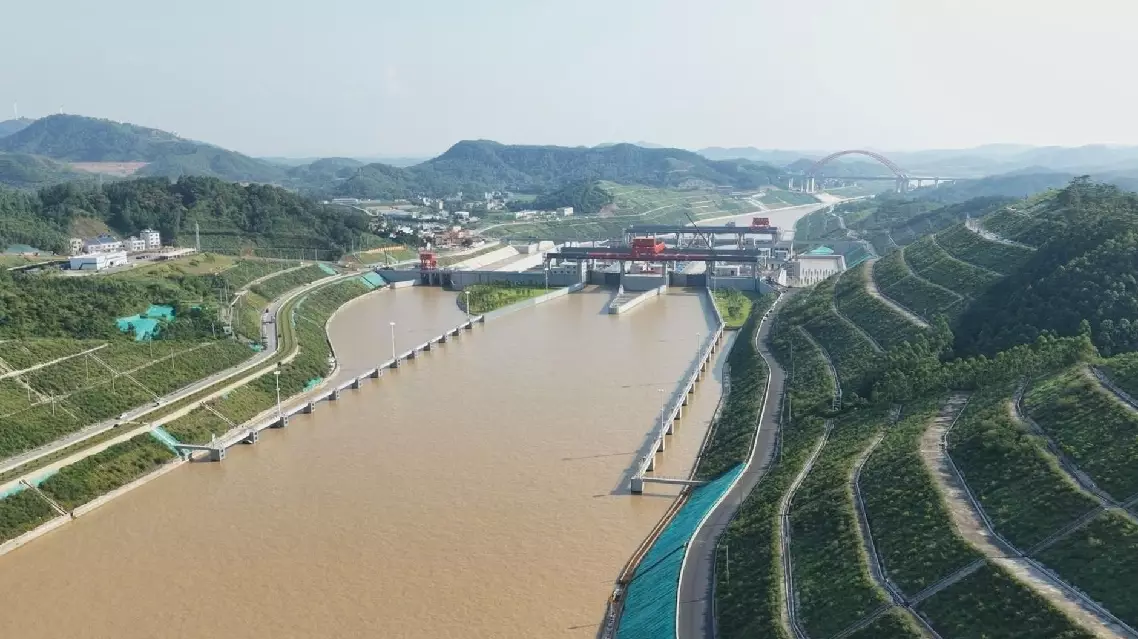
Pinglu Canal's record-setting Madao hub showcases smart, green ship-lock engineering