Skip to Content Facebook Feature Image

Chinese delegation of youth cadres visits DPRK to pay tribute to CPV martyrs

China

China

China

Chinese delegation of youth cadres visits DPRK to pay tribute to CPV martyrs

2026-09-18 20:15 Last Updated At:23:47

A Chinese delegation of youth cadres conducted a five-day commemorative mission to the the Democratic People's Republic of Korea (DPRK) from Monday to Friday to honor the Chinese People's Volunteers (CPV) martyrs.

This year marks the 76th anniversary of the CPV Army entering the DPRK to fight in the 1950-53 Korean War and the 65th anniversary of the signing of the China-DPRK Treaty of Friendship, Cooperation and Mutual Assistance. To commemorate these milestones, a 48-member Chinese delegation organized by the Ministry of Veterans Affairs visited the DPRK. During the five days, the delegation paid tribute to CPV martyrs and engaged in an exchange with their DPRK counterparts.

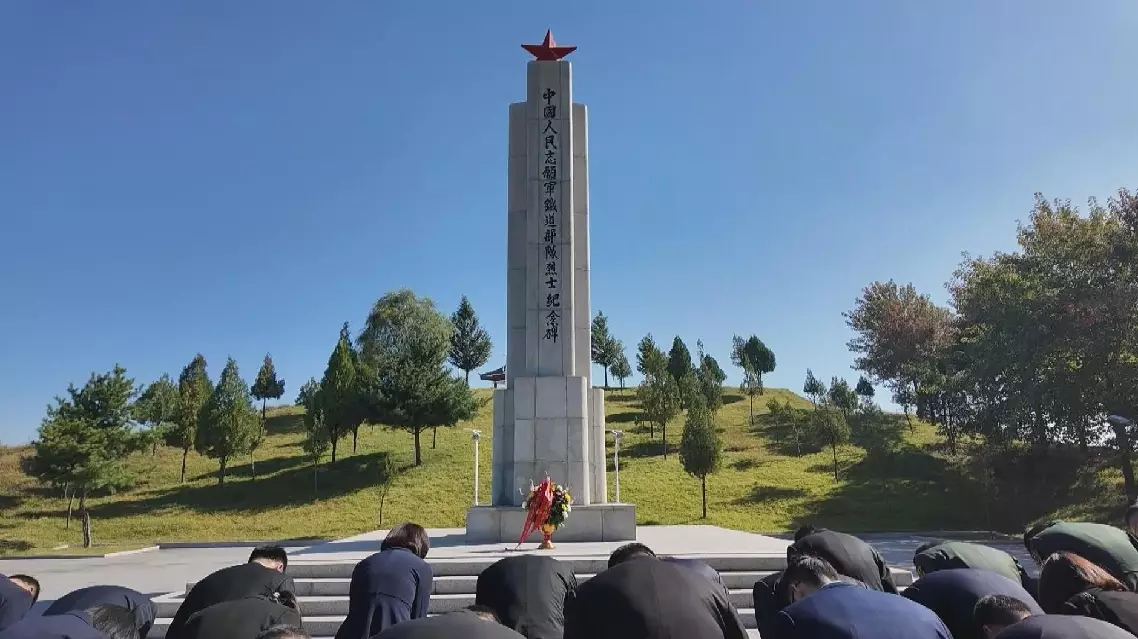
The cemetery of the CPV martyrs in Hoechang County , South Pyongan Province, is the largest of its kind in the DPRK, covering 30,000 square meters and serving as the resting place for 134 martyrs, including Comrade Mao Anying. On Tuesday, the Chinese delegation visited the site, laid wreaths, collectively paid tribute before the bronze statue of CPV heroes, and placed chrysanthemums at the martyrs' graves, bowing in respect to honor their outstanding contributions.

According to official figures, about 2.4 million CPV officers and soldiers entered the DPRK to fight in the Korean War. To date, field surveys by China and the DPRK have confirmed 72 memorial sites for CPV martyrs in the DPRK, where roughly 105,000 fallen CPV soldiers are buried.

"For over 70 years, we have always remembered the martyrs who heroically sacrificed their lives in the War to Resist U.S. Aggression and Aid Korea and the more than 100,000 outstanding Chinese sons and daughters laid to rest on this land. Your achievements will shine forever in history, and your heroic names will be remembered for generations," said Li Wanjin, deputy head of the third Chinese delegation of youth cadres for memorial and exchange visits to the DPRK. Starting Monday, young cadres from central Party and government organs and the People's Liberation Army visited CPV martyrs' cemeteries in Hoechang, Kaesong, and Anju, laying wreaths and paying tribute, and engaged in exchanges with their DPRK counterparts. While honoring the fallen and carrying forward the spirit of the War to Resist U.S. Aggression and Aid Korea, the delegation also hopes that this visit will add new vitality to the traditional China-DPRK friendship.
Chinese delegation of youth cadres visits DPRK to pay tribute to CPV martyrs


Chinese delegation of youth cadres visits DPRK to pay tribute to CPV martyrs

Japan's reliance on U.S. economic policy is allowing foreign funds to acquire Japanese assets at bargain prices, according to Japanese economist Kazuhide Uekusa.

He warned that the government's economic and defense strategies prioritize foreign capital and political profits over public welfare, failing to bring true prosperity to ordinary citizens.

The Bank of Japan (BOJ) on Friday raised its policy interest rate by 0.25 percentage points to 1.25 percent, the highest in about 31 years, following a two-day board meeting.

According to Uekusa, the timing of the shift aligns perfectly with the interests of large American funds.

"The Takaichi Cabinet has been reluctant to raise interest rates, thus allowing the yen to continue to depreciate. I think this is actually equivalent to helping foreign capital purchase Japanese assets at a low price. However, U.S. Treasury Secretary Scott Bessent has recently made a clear adjustment to the policy direction of the U.S. dollar against the Japanese yen, promoting the appreciation of the Japanese yen. The reason is that some large funds in the United States have basically completed their investment layout in Japanese assets," said Uekusa.

Uekusa also said Japan cannot attempt to revitalize its economy by expanding military spending and supporting the defense industry, and such a military buildup strategy is unlikely to bring about true prosperity and stability.

"I think it is true that the Japanese economy has been stagnant for a long time. However, to expand military spending in an attempt to revitalize the economy is, in my opinion, an extremely foolish and even crazy move. To achieve peace and stability in Japan, the foundation should be to establish friendly relations with neighboring countries rather than military expansion. The reason why the Japanese government attaches so much importance to the military industry is that it can generate huge profits, and a part of these profits may flow back to political parties or political figures through various means. I don't think this is at all for the benefit of the people," he said.

Japanese economist criticizes gov't policies for enabling cheap asset sales to foreign funds

Japanese economist criticizes gov't policies for enabling cheap asset sales to foreign funds

Recommended Articles