PHILADELPHIA (AP) — Bill Giles, who rose from a Philadelphia Phillies business executive to become an owner and CEO during more than a half-century with the team, died Friday at his home in Gladwyne, Pennsylvania. He was 92.
A son of former National League president Warren Giles, Bill Giles started with the team in 1969 as vice president, business operations, and was promoted to executive vice president three years later.
In 1981, he organized a group that purchased the club from the Carpenter family. He served as president and CEO until 1997, then became chairman. He shifted to chairman emeritus in 2015, a title he held at the time of his death.
The Phillies honored Giles with a moment of silence before Friday's game against Tampa Bay.
Philadelphia had just four winning seasons during Giles' time as CEO but went to the World Series in two of them. Giles also played a major role in building the Phillies team that won the World Series in 1980, including convincing former owner Ruly Carpenter to sign free agent Pete Rose.
“Bill helped to reshape our franchise from a traditional baseball club into a highly visible entertainment and business operation," Phillies managing partner and CEO John Middleton said in a statement. “His profound impact in overseeing one of the greatest eras in franchise history, both on and off the field, will forever be his legacy.”
Giles, whose father headed the NL from 1951-69, became honorary president of the NL in 2001 and was a recipient of the Bud Selig Executive Leadership Award for lifetime achievement in baseball in 2010.
Giles helped push for the opening of Veterans Stadium in 1971 and current home Citizens Bank Park in 2004. He also was inspired to create a mascot for the Phillies that would become the beloved Phillie Phanatic.
In 1999, the Phillies established the Bill Giles Award to honor minor league players who share the same attributes as the namesake: a love and respect for the game of baseball, an outstanding work ethic and pride in being a member of the Phillies organization.
Giles began his baseball career as a teenager working various jobs in the Cincinnati Reds’ public relations department. He went on to advance his career in Houston, serving as traveling secretary, publicity director and promotions director before joining the Phillies following the 1969 season.
Giles gave up his day-to-day responsibilities with the team in 1999 and remained on as chairman.
“It wasn’t: ‘Do it or else.’ I wasn’t forced out," Giles said. "It was a strong suggestion, but it was my decision. The business part of the game had gotten to me. I wasn’t as effective as I had been. Some of the partners said ’Don’t you think it’s time to let a younger man worry about all those things?'”
Giles authored the book “Pouring Six Beers at a Time: And Other Stories from a Lifetime in Baseball,” and co-authored another on the business of baseball.
“Bill was the heart and soul of the organization for over two decades," Hall of Famer and former Philles third baseman Mike Schmidt said in a statement. “He was a close personal friend to so many of us. He will always be a big part of Phillies history.”
See AP’s full MLB coverage here
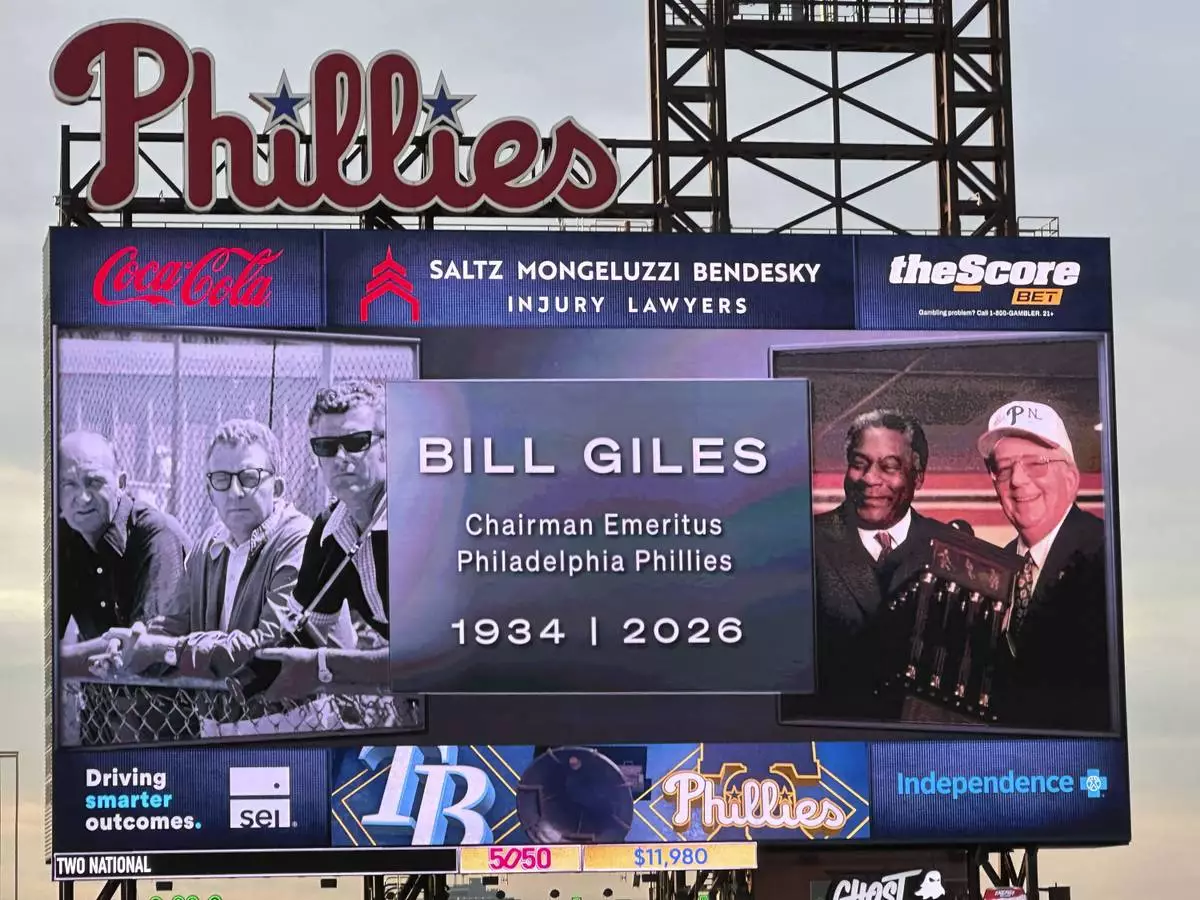
Photos of Chairman Emeritus for the Philadelphia Phillies, Bill Giles is displayed on the scoreboard at Citizens Bank Park in Philadelphia, Pa. on Friday, Sept. 25, 2026. (AP Photo/Daniel Gelston)
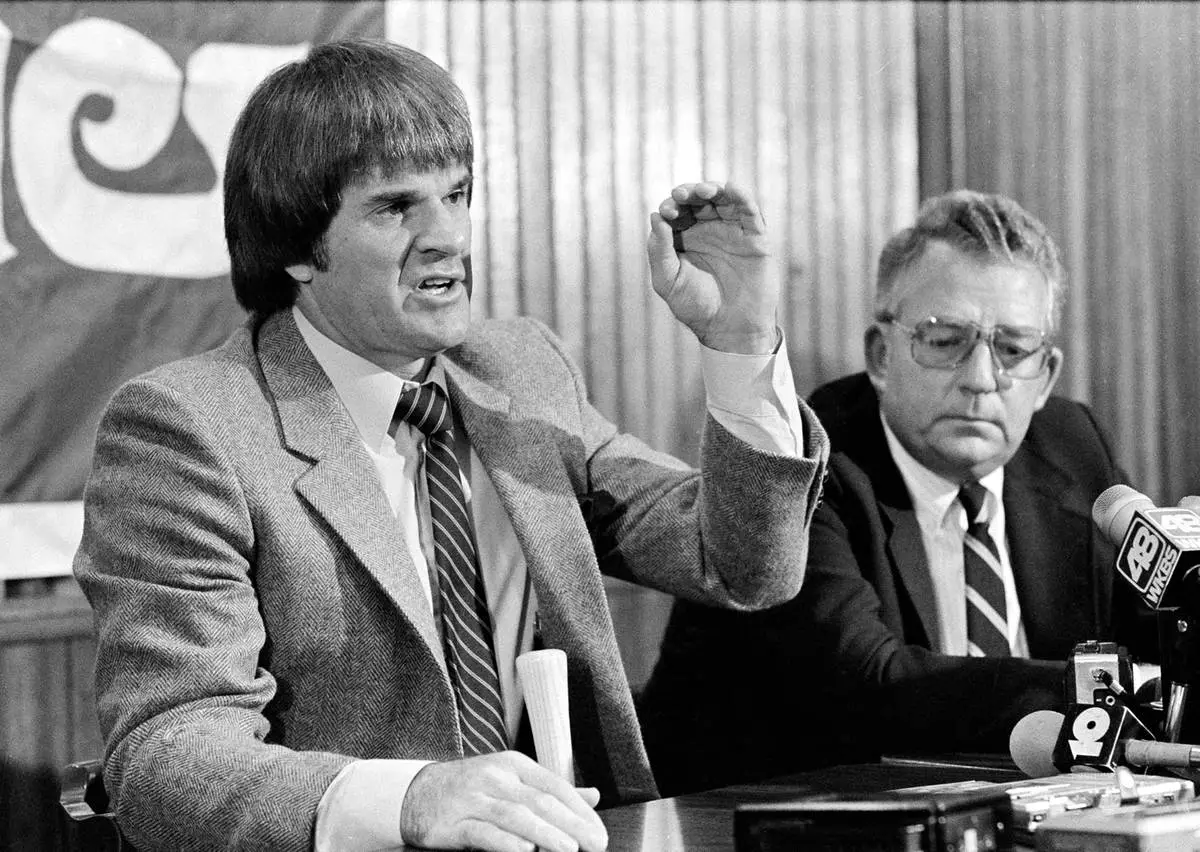
FILE - Phillies president Bill Giles looks on as first baseman Pete Rose gestures as he talks about his one-year, $1.2 million contract, at a news conference in Philadelphia, Pa., on November 2, 1982. (AP Photo/Al Schell,File)
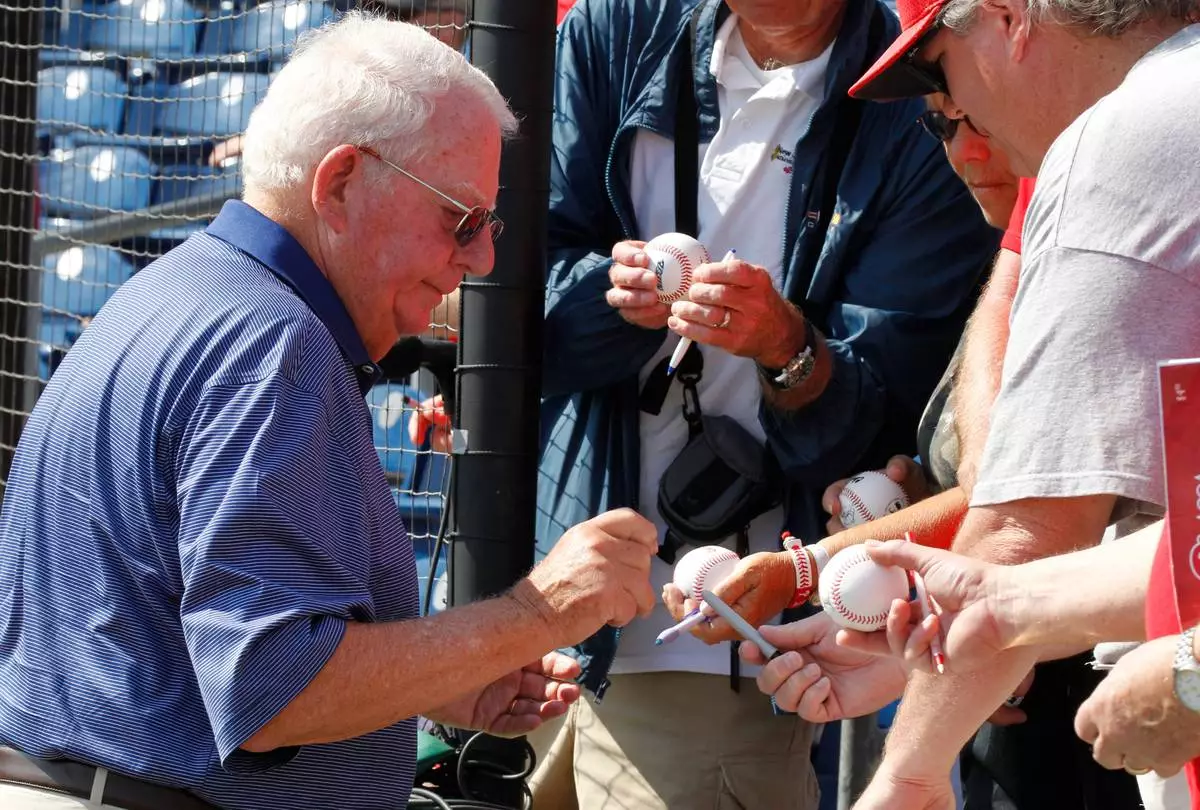
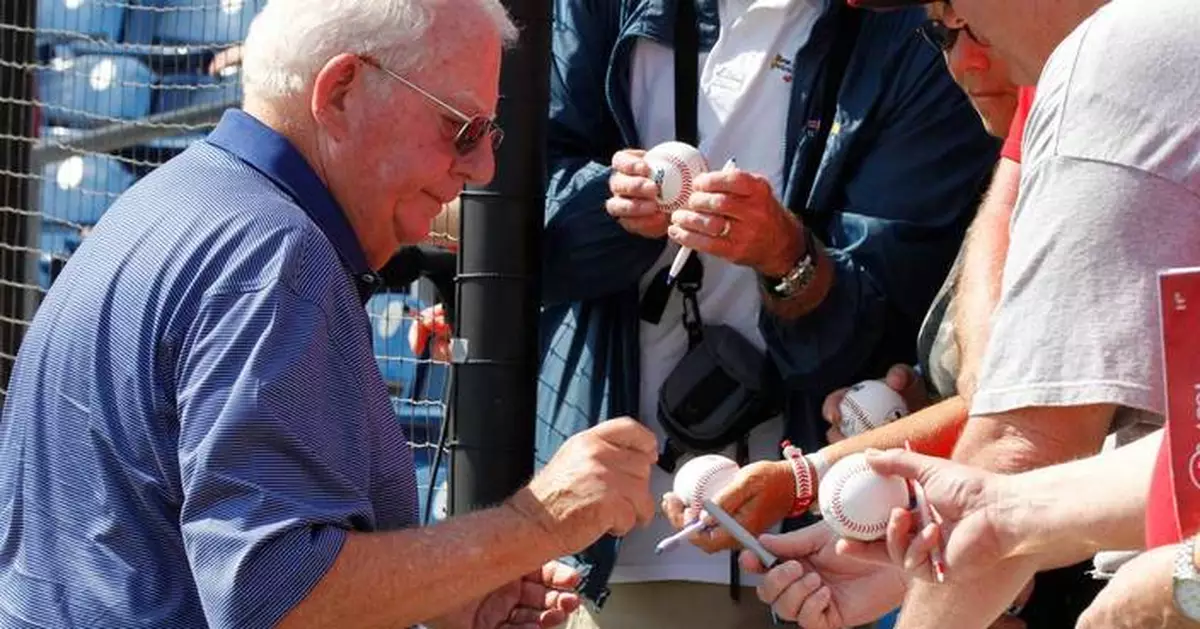
FILE - Philadelphia Phillies chairman Bill Giles signs autographs before a spring training baseball game in Clearwater, Fla., Monday, March 21, 2011. (AP Photo/Gene J. Puskar,File)
NEW YORK (AP) — The Supreme Court on Friday lifted restrictions on a controversial federal voter database before November’s elections, granting President Donald Trump a temporary win in his aggressive campaign against noncitizen voting.
The court's three liberal-leaning justices publicly dissented from the decision.
The emergency order allows states, for now, to use the Trump administration's revamped version of a Department of Homeland Security program, called Systematic Alien Verification for Entitlements, or SAVE, in their efforts to verify the eligibility of voters on their rolls. It's a program that has drawn scrutiny for its use of voters' sensitive personal data and its tendency to wrongly flag some eligible voters as noncitizens.
States' use of the SAVE program is voluntary, limiting the ruling's impact on the midterm elections. Existing law also blocks most states from systematically purging voters from their rolls within 90 days of an election, said David Becker, an election law expert who leads the Center for Election Innovation and Research. He said DHS itself has admitted the data is not perfect.
Maine Secretary of State Shenna Bellows, a Democrat who has refused to participate in the SAVE program, said the ruling will have no effect in her state because it “does not force states to change the way we run our elections.”
The plaintiffs and their lawyers in the case called the ruling “profoundly disappointing” and said it puts “millions of Americans at risk of being unlawfully targeted by the administration’s unreliable voter purge database” before the midterms.
On X, James Percival, the general counsel for DHS, responded to a post about the decision with, “Yes, you read that right. We had to file an emergency petition in the Supreme Court just so we could use government data to help states stop noncitizens from illegally voting.”
The White House did not immediately respond to a message seeking comment.
The court’s order puts on hold a federal judge’s June ruling that had deemed the Republican administration’s recently revamped version of SAVE illegal. U.S. District Court Judge Sparkle L. Sooknanan had blocked the use of the tool, saying it violated Americans’ privacy rights and could result in voters being wrongly removed from the rolls.
A federal appeals court let her order stand.
But the Supreme Court majority found that a 1996 law explicitly allows DHS to obtain information on citizenship and immigration from other federal agencies. The federal government also has “an obligation to respond” to states seeking to verify citizenship.
“The order below prevents the Federal Government from using the program it believes is best suited to the task,” the majority wrote in the unsigned order.
Justice Ketanji Brown Jackson dissented, joined by Justices Elena Kagan and Sonia Sotomayor. The database has long been seen to fall under federal privacy laws, she wrote, and there are real risks that legitimate voter registrations could be mistakenly revoked.
“The harm caused by burdening or disenfranchising even a few lawful voters outweighs the nonexistent harm that the Government experiences when it is prevented from taking an action that it likely lacks the authority to take,” Jackson wrote.
The plaintiffs pledged to do “everything in our power” to ensure the district court decision stands.
The SAVE program was created under an immigration law mandating that DHS help federal, state and local agencies prevent government benefits from going to noncitizens. The Trump administration last year moved to significantly expand its search abilities. Since then, at least 67 million registrations have been scanned through the program, but critics worry it could purge valid voters from the rolls.
Some registrants have already been wrongly flagged. In Travis County, Texas, for example, officials said they investigated 97 voters flagged by SAVE as apparent noncitizens and found that at least 10% of them — and likely up to 21% — were U.S. citizens. The county urged the Supreme Court to reject the administration’s appeal, while the state of Texas submitted its own brief defending the database.
In Denton, Texas, north of Dallas, voter Anthony Nels was disappointed that the Supreme Court allowed the continued use “of a system that harms people’s constitutional right to vote.”
Last year, after Texas ran its voter registrations through the SAVE system, Nels, 29, was flagged as a potential noncitizen, even though the South Africa native had become a U.S. citizen more than a decade ago. His local election office temporarily canceled his registration while he obtained a new passport to replace an expired one.
“This just seems like another illegitimate way to affect upcoming and future elections,” he said in a text to The Associated Press.
Stephen Richer, the Republican former top election official in Arizona's largest county, said the Supreme Court's ruling could be a positive step “if used responsibly.”
“That being said, the SAVE program has been shown time after time to be a highly-imperfect tool, so election administrators should only use it as a starting point, not as a definitive indicator of citizenship,” he wrote on social media.
Even though the use of the SAVE program was blocked for months ahead of Friday's ruling, the administration has said in court filings that it has continued using Social Security Administration data "in certain cases to verify information and help determine whether illegal voting may have occurred."
DHS in August launched its own investigation to find noncitizen voters on state rolls, according to a federal whistleblower statement that said the effort is rushed, filled with errors and potentially violates state laws. DHS has defended that investigation as being conducted “diligently and professionally.”
Homeland Security Secretary Markwayne Mullin also suggested over the summer that there could be as many as 250,000 noncitizens registered to vote across four states, an unsubstantiated claim that puzzled state election officials who said the numbers dramatically exceeded their own findings. In one of those, Nevada, DHS said it had identified 185 noncitizens on the voter rolls, but the state attorney general's office wrote to the agency earlier this week, saying a records check found that all of them were, in fact, U.S. citizens.
The effort to create a national voter list is one of the many steps Trump has taken during his second term to try to overhaul how elections are run. Most of those steps have been blocked by various courts, in part because the Constitution gives states and Congress the authority to set election rules, but provides no such power to the president. In mid-September, the Supreme Court rejected Trump’s bid from Trump to restrict mail ballot procedures before the midterms.
Trump has remained fixated on the idea that massive numbers of noncitizens are voting in U.S. races, but all evidence says otherwise.
Ahead of the 2024 presidential election, Georgia’s secretary of state found that 20 of the state’s 8.2 million registered voters were not U.S. citizens. In Ohio, prosecutors secured indictments against nine people for voting as noncitizens over the span of 10 years. The state has some 8 million registered voters. Even with the Trump administration laser-focused on the issue in his second term, DHS said its investigations into potential noncitizens on voter rolls nationwide had led to 160 arrests.
Those numbers are supported by a mountain of research at the national and state level that has found the percentage of noncitizens on voter rolls is a tiny fraction of the nation's nearly 228 million registered voters.
Hanna reported from Topeka, Kansas, and Whitehurst reported from Washington. Associated Press writer Jessica Hill in Las Vegas also contributed.
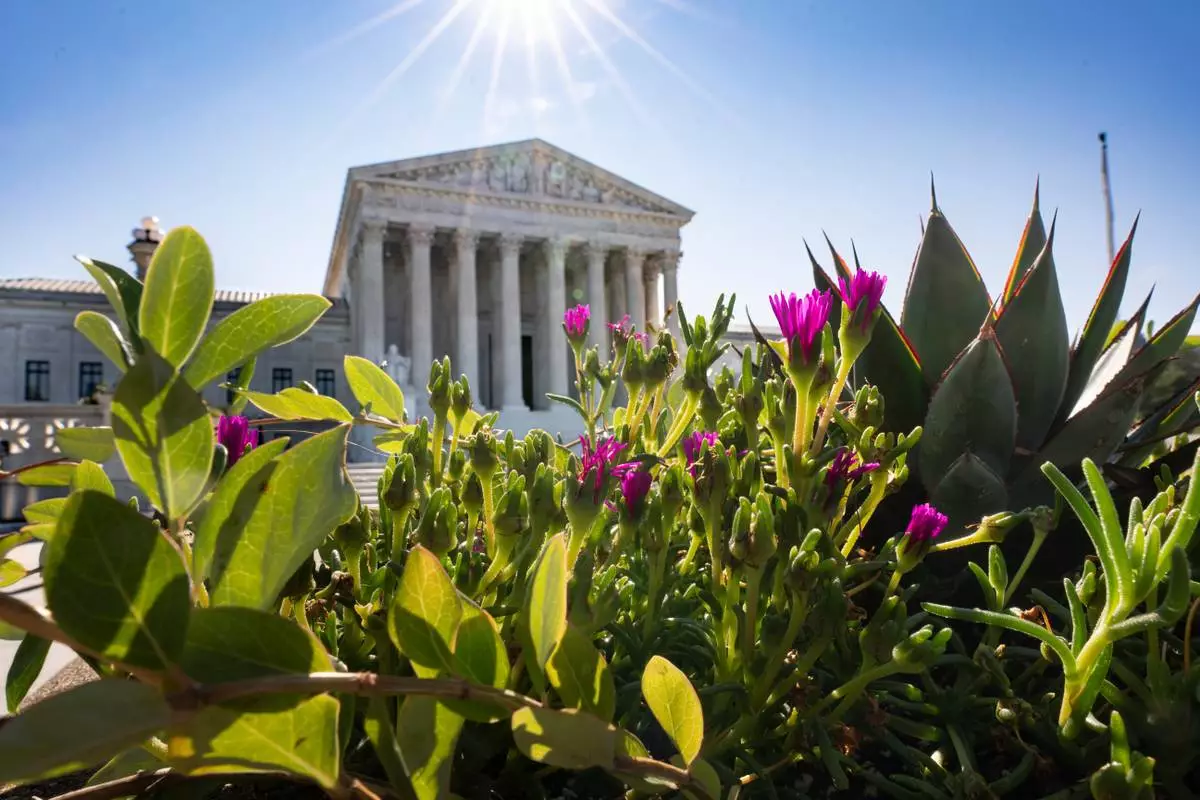
FILE - The Supreme Court is seen on Capitol Hill in Washington, Aug. 25, 2026. (AP Photo/J. Scott Applewhite, file)