The arrival of Ping Ping and Fu Shuang in Atlanta has opened a new chapter in a China-U.S. conservation partnership that helped keepers in China train pandas to cooperate with blood draws and other medical procedures without anesthesia.
The pair arrived on Sunday, bringing pandas back to Zoo Atlanta after a nearly two-year absence. Their predecessors, Lun Lun and Yang Yang, spent 25 years there, producing seven cubs and contributing to advances in panda research and care.
Their first cub, Mei Lan, born in Atlanta in 2006, fathered three of China's best-known pandas: Meng Lan and twins He Hua and He Ye. He Hua, nicknamed Hua Hua, is a star attraction at the Chengdu Research Base of Giant Panda Breeding in southwest China's Sichuan Province.
A documentary released by iPanda on Wednesday explores another legacy of the partnership: How collaboration between Chengdu keepers and an American trainer helped make blood collection without anesthesia part of routine care.
Before systematic behavioral training began at the base around 2005, many health checks, blood draws and milk collection procedures relied on anesthesia. Even giving an injection could be difficult, retired panda keeper Hou Guifang recalled.
"Before we started training pandas, the vet often hid the syringe behind their back, then quickly gave the panda an injection before it noticed. Sometimes the panda would run off before the vet had even injected the medication," Hou said.
Caring for newborns was especially delicate. If a mother did not nurse her cub, keepers needed to collect colostrum - the first milk produced after birth - and feed it to the cub themselves. Approaching the mother required careful timing.
"We could only collect colostrum when the mother panda was asleep or resting with her cub in her arms. If we disturbed her while collecting it, she might attack us keepers. She might also drop the cub during the process, which could injure it," said Deng Tao, a panda keeper at the base.
Anesthesia made essential procedures possible, but carried risks of its own. Anesthetic drugs could pass into a mother's milk and affect her cub, while stress responses associated with anesthesia could influence blood test results.
"Pandas may have a stress response during anesthesia. That can affect some of the results we get from blood samples collected at that time," Deng said.
Exchanges with overseas zoos in the early 2000s offered another approach: training pandas to participate in their care while awake.
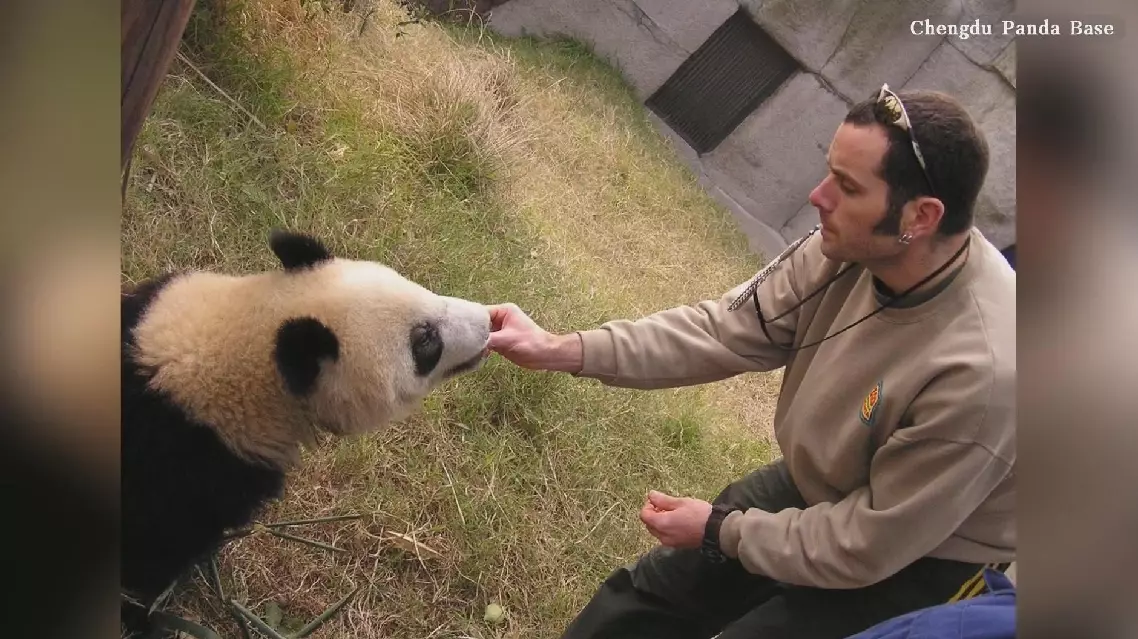
Jay Pratte, a former giant panda keeper at Zoo Atlanta, specialized in operant conditioning. The zoo uses positive reinforcement, rewarding animals for performing a requested behavior. For pandas, that can mean presenting an arm and holding it still for a blood draw. Participation is voluntary.
"I had been working at Zoo Atlanta as a giant panda keeper. My specialty was in operant conditioning behavior training. I actually published a paper about giant panda blood draws and later won an award for that paper. Two different colleagues from the Chengdu base had visited Zoo Atlanta, had seen our training in action. I earned my invitation to come and visit the base myself in person and to work with the team," Pratte said.
At Chengdu, Pratte found keepers eager to learn how building trust with pandas could make medical procedures easier.
"My understanding at the time was that the base was really focused on the importance of voluntary blood draw technique. I think that when I got there, there were a handful of the keepers and some of the managers that were very excited about the concept, about what we were bringing to the table and working on. And I think that excitement, plus the dedication to caring for the animals, plus the willingness to ask a lot of questions - we worked with - and we were able, Deng Tao and I, to complete a voluntary blood draw with one of the female pandas when I was there. The keeper that was working with me was Shu Qing['s keeper]. We were able to perform a voluntary injection, and there was a big male panda named Kobe. And so I demonstrated how we could build a relationship with him and what a difference that would make to the keeper and to Kobe. And seeing those changes was really gratifying and positive for me," Pratte said.
Deng and Pratte put the approach into practice with two pandas, Qi Zhen and Qi Yuan.
"When Jay, the giant panda trainer from Zoo Atlanta, came to the base, he worked with me to develop a training plan for blood collection. After each training session, we would discuss any problems that had come up. Working together, we systematically trained the two pandas, Qi Zhen and Qi Yuan. Within a month, both had successfully completed the training, and we were able to draw blood from them without anesthesia," Deng said.
The team then shared its experience with other keepers.
"Our work with Qi Zhen and Qi Yuan showed us that this approach to training pandas made sense. We then shared what we had learned and the experience we had gained from training them" Deng said.
Behavioral training gradually became part of daily care, breeding management and medical treatment at the base.
Training mothers to cooperate with milk collection, alongside improvements in twin rearing, helped raise the cub survival rate from 70 percent in the 1990s to more than 90 percent today, with both twins now routinely surviving - an outcome once considered exceptional.
Today, pandas at the base can cooperate with blood draws, oral swabs and ultrasound examinations while awake and relaxed. That helps staff monitor their health and gives researchers samples less affected by anesthesia-related stress.
For the animals, the benefit is more immediate: routine examinations with less stress, made possible by keepers sharing their expertise across borders.
Atlanta's new pandas renew partnership that helped transform panda care