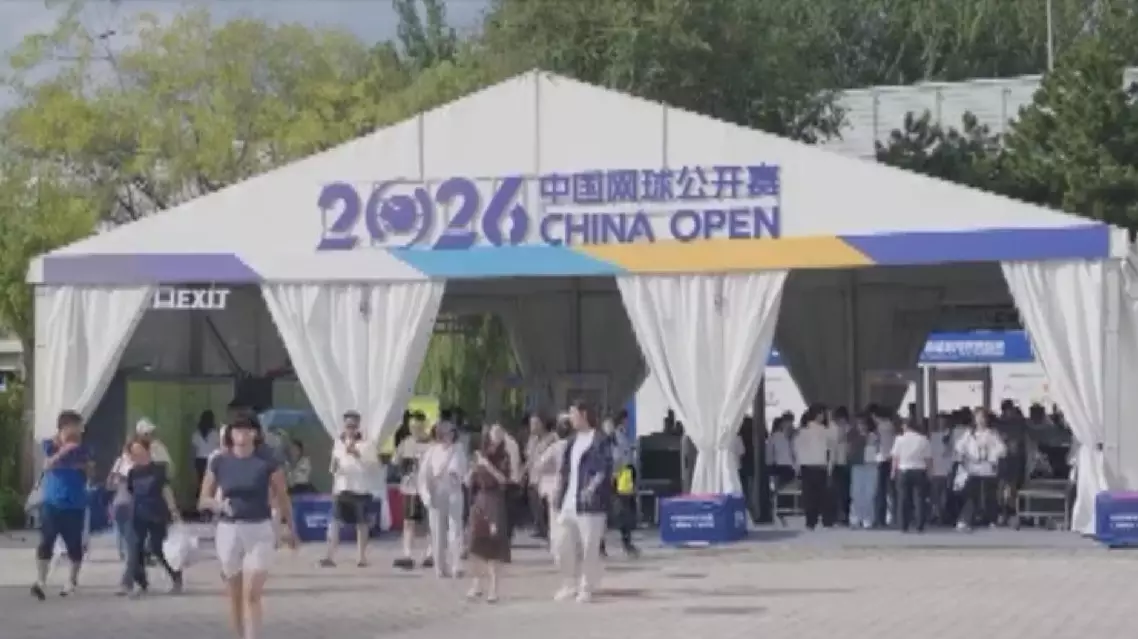
The 2026 China Open is drawing both tennis fans and curious tourists during the week-long National Day holiday, with the "ticket-stub economy" helping to drive extra spending beyond the courts.
The tournament, which features both an ATP 500 men's event and a WTA 1000 women's event, is taking place at the National Tennis Center in Beijing from September 30 to October 11.
Before the official start, an open day held during the Mid-Autumn Festival had already attracted many fans. Visitors watched players train, enjoyed performances and food, and bought merchandise, getting an early taste of the tournament atmosphere.
"I've been here before, but I think this year's China Open is bigger and has more to offer, making spectators and tennis fans feel more involved," said Sun Chen, a spectator.
According to the organizers, families with children accounted for about 70 percent of visitors during the Mid-Autumn holiday. Meanwhile, people aged 30 to 50 made up 60 percent of the total and contributed the majority of spending.
Following strong family turnout during the Mid-Autumn Festival, organizers have put their energy into welcoming another wave during the ongoing National Day holiday from Oct 1 to 7.
"The food and beverage offerings and some innovative interactive experiences at the venue have also drawn a lot of attention. Our main focus is the National Day holiday. So we feel that this year's China Open should give a big boost to tourism during the Golden Week," said Li Xuhua, executive deputy secretary general of the China Open Organizing Committee.
Beyond the matches themselves, the "ticket-stub economy" is extending the economic impact. Fans can use their China Open ticket stubs to enjoy discounts at museums, restaurants and hotels, as well as experience traditional Beijing culture.
China Open boosts spending in Beijing during National Day holiday
After more than three months at sea, members of China's 16th Arctic Ocean expedition have jointly created a painting that captures both the triumphs and trials of polar scientific research.
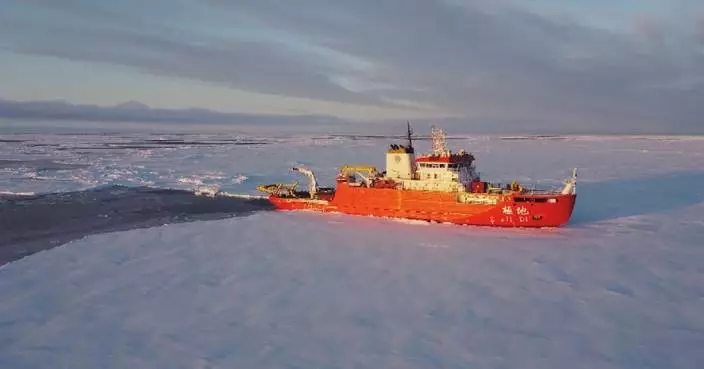
Organized by the Ministry of Natural Resources, the expedition deployed four ships, Xuelong, Xuelong 2, Jidi, and Tansuo 3, to study extreme environmental changes in the Arctic against the backdrop of accelerating global warming. On September 29, Xuelong and Xuelong 2 returned to Shanghai after completing their missions.
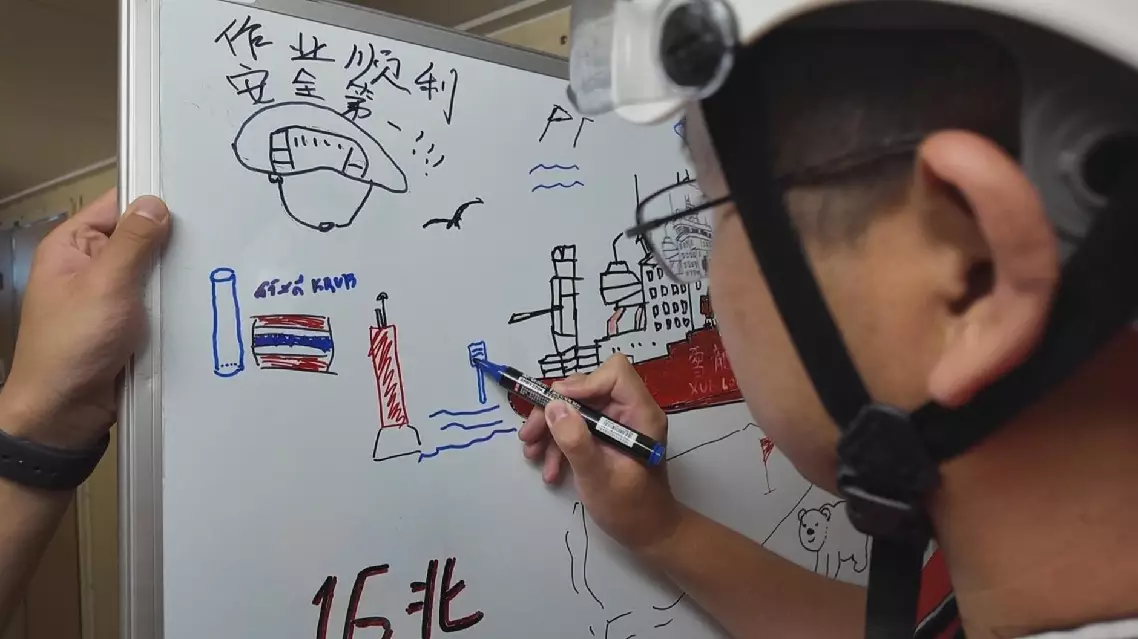
During the voyage, China Media Group (CMG) reporters aboard Xuelong invited nearly 100 crew members to collaborate on a canvas, sharing their experiences. The painting depicts the difficulties and challenges they faced, the honors and expectations of their research, and the images of those dedicated to science.
Before any crew member ever picked up a brush, the Arctic had already sketched the background with its extreme weather. Strong winds, torrents, and a harsh environment posed major challenges for the researchers.
"After staying outside for some five or ten minutes, our hands would already be frozen red. When we reached the trough of the waves [on a boat], it would look as if the waves were coming right over our heads," recalled Zhu Chengwei, an expedition member.
Despite the hardship, the researchers successfully tested and used domestically produced advanced ocean observation equipment in polar research -- one of their proudest moments, which they recorded on the canvas.
Qin Chuan, captain of the Xuelong ocean team, chose to paint a domestically produced monitor float.
"This is an Argo float we deployed, which automatically monitors ocean profiles. It has great significance for understanding the basic marine environment, and it's made in China," he said.
Xie Haixiang, director of the Xuelong laboratory, sketched a fundamental research equipment for the trip.
"I will draw a CTD (Conductivity, Temperature, and Depth instrument). The CTD is the most important equipment for ocean surveys, providing the most basic data and water samples," he said.
"Only by carrying equipment onto the Arctic sea ice yourself and lowering the instruments, can you get what you want. For instance, we take a little ocean water, and analyze what's in it, to understand the changes each year. Global warming needs to be understood through different dimensions," recalled researcher Zhu.
Beyond the canvas, what stands out even more striking are the moments of dedication: veteran members leading newcomers onto the ice, a group holding its ground in level-8 gales and heavy snow, and 30 people relaying to recover equipment stuck in the ice.
The most important element, beyond any record or image in the painting, is this group of expedition members who fear no hardship.
"Whenever I think of the polar spirit, countless images of those standing at the very front would flash before my eyes," Zhu said.
"What we have done today will benefit future generations. Although we are doing something that may seem very insignificant, I believe it will surely prove its worth in the future,"said Ning Wenfeng, another team member.
China's 16th Arctic expedition crews paint portrait of proud polar expedition moments, hardships