
The crisis that recently erupted in France has drawn global attention. Masked demonstrators are violently protesting, and the scenes look eerily familiar.
France Erupts, and the West Flips Its Script on Riots
Click to Gallery


Ivan Safranchuk, Senior Researcher at Moscow State Institute of International Relations, Russia.
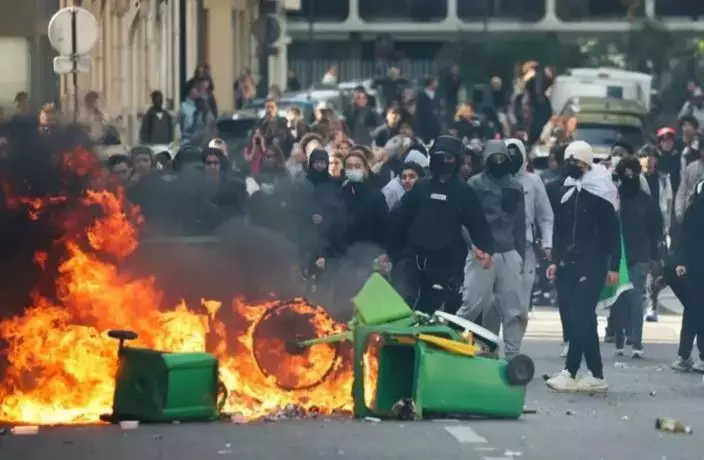
In mid-September, student riots began to break out in France. Students went on strike, took to the streets, blocked roads, burned cars, smashed shops, and confronted police. The forms of violent protest were identical to the situation in Hong Kong in 2019.
The problem is that the United States and the Western world assess the French riots in a way that is completely opposite to their assessment of the Hong Kong riots. French politicians accused the leader of the far-left party "La France Insoumise," Jean-Luc Mélenchon, of orchestrating the riots behind the scenes.
US President Donald Trump pointed out bluntly, "What's happening in France is nothing less than out of control mass migration. This isn't about schools, this is about Islam wanting to take over a once great Country!"
French police arrested as many as 6,500 demonstrators in just over two weeks. Yet no US or UK government came out to demand that the French government release them.
The protests began on September 17, originating from a high school in Créteil, on the outskirts of Paris. At the time, teachers went on strike over unfilled positions and insufficient school funding, and students quickly joined in.
What teachers and students were dissatisfied with was the extreme lack of resources in French secondary schools and the low salaries of teaching staff, which led to a severe shortage of teachers. Schools had no choice but to combine classes, pushing the number of students per class up to 32 to 35. The incident quickly escalated into full-scale violent protests.
The French government is indeed powerless to solve various livelihood problems, because France has spent too much money in recent years, with the fiscal deficit soaring and the national debt ballooning.
Under the impact of the two major wars in Ukraine and Iran triggered and supported by the United States, inflation has remained high, and Europe has also been forced to raise interest rates. This makes things worse for France, a country drowning in debt.
The yield on France's 10-year government bonds rose to 4.75%, a new high since the 2012 European debt crisis, even higher than the bond yields of Greece, which once fell into a debt crisis. France's public debt stands at 119% of GDP, and the debt problem has erupted across the board.
The 'China Overcapacity' Fight
France's finances are in trouble. The government's fiscal deficit runs at 5% of GDP while economic growth stays weak. The Bank of France estimates GDP growth of around 0.5% this year, and the French economy has already sunk into a vicious cycle bordering on stagflation.
America's balance sheet looks even worse. US public debt stands at 122.6% of GDP, and the yield on 10-year US Treasury bonds has surged, recently climbing to a high of 5.3%. Washington's ability to print money to repay debt is a bit stronger than France's. Even so, the outside world believes a US debt crisis is starting to emerge.
The US and the West have a habit of recasting their own problems as other people's problems. When trouble strikes at home, they say China's exports have battered their economies.
Enter the G20. Trade ministers from the Group of Twenty met recently in Milwaukee, and the United States wanted to mobilize the G20 to issue a statement targeting the so-called "China overcapacity" issue. China, Brazil, Russia, Indonesia, Saudi Arabia and South Africa refused to agree to the statement.
So Washington had no choice but to rally the other 14 G20 countries into a joint statement. That statement called for action to end structural overcapacity and to stop non-market policies that encourage excessive production.
The funny part of this story: the United States has always been the leader of international organizations like the G20. The original purpose of creating these organizations was for countries to work hand in hand to solve global economic problems. But when America itself runs a trade deficit, it launches a tariff war to erect trade barriers. Then it urges other countries to join the barrier-building ranks and points the finger at China.
Picture a rule-breaker in a game. He eggs on the other players to rebel, to break the rules along with him, and then questions whether the rules themselves are the problem.
How the West Outsourced Its Way to China's Rise
America claimed the crown in 1914, when the US economy overtook the United Kingdom's to become the world's number one. After World War II, American productivity developed further and hit its peak.
In the language Americans use today, the United States at the time suffered from extreme overcapacity. Its manufacturing industry dominated the globe.
Then the wage bill ballooned. As the economy grew, American workers' pay surged, so the United States gradually shifted production to other low-cost regions. Manufacturing was first outsourced to Japan, then expanded to the Asian Tigers, and finally the baton passed to China.
Russian economists have a distinctive explanation for all this.
Ivan Safranchuk, a senior researcher at Russia's Moscow State Institute of International Relations, laid out the story in an interview on September 29. Globalization, he said, was originally driven by the West, and at the start it genuinely served Western interests.
Ivan Safranchuk, Senior Researcher at Moscow State Institute of International Relations, Russia.
The West wanted to transfer out production links that were costly and heavy users of resources, while keeping the more profitable parts, such as technology, finance and brands, for itself.
Then came the twist. Safranchuk said a series of factors, including US multinational corporations' pursuit of profit maximization, ultimately sent a large share of globalization's gains flowing to developing countries, such as China and India.
These places, once attractive only for their cheap production costs, slowly built industrial strength of their own. In the process of taking on manufacturing, countries such as China accumulated industrial technology, export capacity and complete supply chains.
The result? China ultimately became globalization's biggest winner, all because Western companies were too greedy themselves.
Lin Yifu's Numbers Turn 'Overcapacity' on Its Head
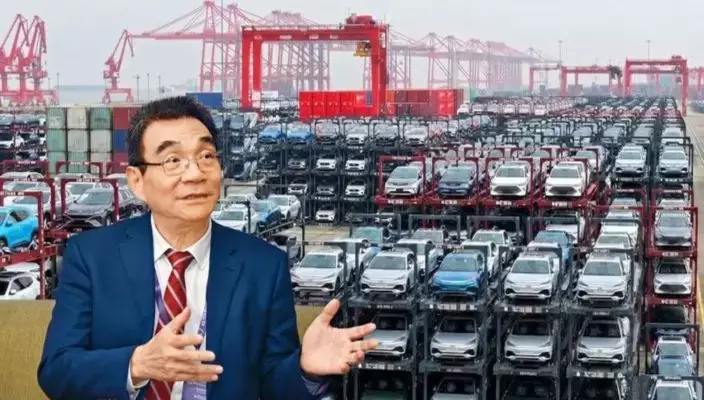
A Russian expert has hit the nail on the head about the problems the West encountered in pushing globalization. Lin Yifu, former Senior Vice President of the World Bank and now Dean of Peking University's Institute of New Structural Economics, has now weighed in on the so-called “China overcapacity” issue as well.
His numbers turn the argument inside out. Germany produces more than 5 million cars a year, exports more than 4 million, and digests only about 20 percent at home. Does that mean 80 percent of German capacity is “excess”? China never said so in the past.
Now flip the lens to China, Lin says. The country builds more than 30 million cars a year, yet exports only about 7 million. That is a mere 20 percent of total output, with the domestic market absorbing the other 80 percent.
His conclusion cuts sharp: measured against Germany's ratio, China's auto industry has no overcapacity at all. If anything, it has too little capacity.
The bigger problem, Lin believes, is that China keeps walking wherever others point. When others cry overcapacity, China's own writers echo the charge in articles, as if everyone had committed a crime. That sort of double standard, he says, sits at the very core of the problem.
The US-led G14 runs a slick rebranding operation. It recasts its own past, voluntary choice to scrap production capacity as China's problem. And it does so while ignoring the fact that a raft of Western multinationals pocketed the lion's share of the profits.
The same countries' own overspending, heavy debts and freely waged wars get the same makeover. All of it is relabeled as problems China must solve.
Then consider the whiplash. America went from championing globalization with everything it had to opposing it across the board, all within roughly a decade. The speed of the about-face turns heads.
Lo Wing-hung
Bastille Commentary
** 博客文章文責自負,不代表本公司立場 **