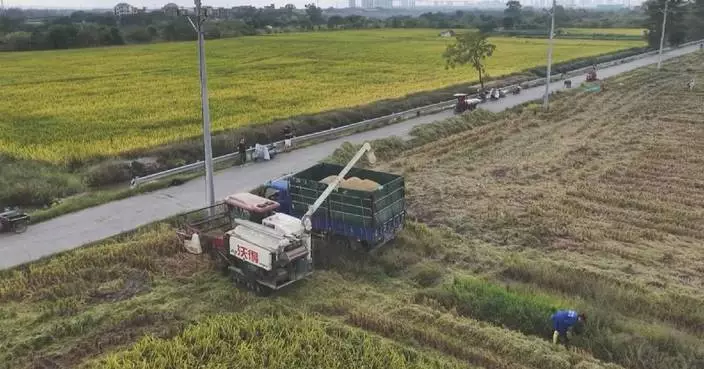
Smart farming technologies are showing their strength in quality and yields as China's autumn grain harvest enters its second half with robust momentum.
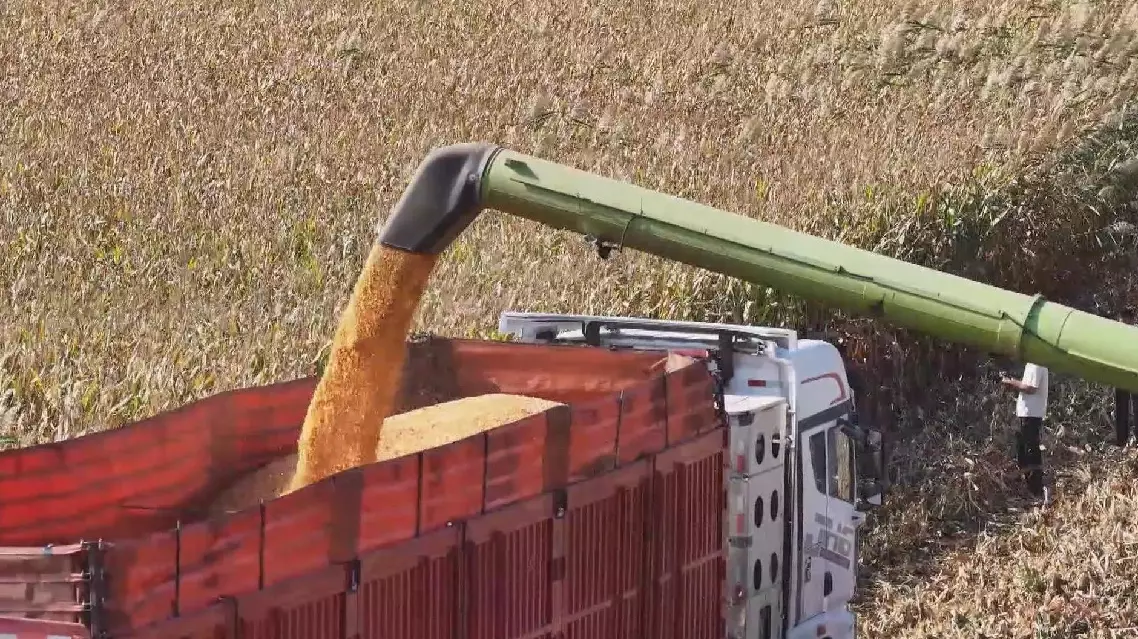
So far this year, northwest China's Xinjiang Uygur Autonomous Region has focused on promoting dense planting and precision regulation technology to boost corn yields.
In recent days, multiple million-mu-scale corn fields in Xinjiang are undergoing yield measurement. One 10,000-mu (667-hectare) field just measured has already exceeded 1.5 tonnes per mu (22.5 tonnes per hectare), while the yield at a demonstration zone in Ili Kazak Autonomous Prefecture has climbed to about 1.61 tonnes per mu (24.15 tonnes per hectare).
"This technology can increase yields by at least 200 kilograms per mu (3,000 kilograms per hectare) compared with traditional planting across China. Judged from current field conditions, the overall trend of corn yield increase is clear," said Li Shaokun, a researcher with the Institute of Crop Sciences under the Chinese Academy of Agricultural Sciences.
From corn harvesters to cultivation and management techniques for high-yield varieties, Xinjiang has integrated once-scattered yield-boosting technologies across plowing, planting, management and harvesting into a coordinated effort, achieving large-scale yield gains.
Innovative agricultural technologies are continuing to enable crop quality and yield improvements across China, spanning the entire process from production to harvest.
Nanpi County in Cangzhou City, north China's Hebei Province, has achieved full mechanized harvesting across 590,000 mu (39,333 hectares) of corn. The locally promoted self-propelled corn harvesters can complete corn ear picking, conveying, husking, and returning corn straw to the soil in one pass.
At a 10,000-mu-scale rice farm in Suiling County, northeast China's Heilongjiang Province, the paddy fields have all been upgraded to a high-yield standard. They are also equipped with smart weather stations that monitor weather conditions, high-definition cameras that monitor seedling growth in real time, and even an intelligent early-warning system for pest outbreaks. Technology supports the entire rice growth cycle, keeping the plants in consistently strong condition.
More than 14 million mu (933,333 hectares) of mid-season rice crops across east China’s Jiangxi Province are now at peak harvest. In Fengcheng City, a demonstration base was built to select high-quality, high-yield, and disease-resistant varieties. Ten new high-quality varieties have been bred for contiguous planting, with average yields reaching around 650 kilograms per mu (9,750 kilograms per hectare).
Demonstration fields in Hinggan League, north China's Inner Mongolia Autonomous Region, have pushed soybean yields past 298.7 kilograms per mu (4,480.5 kilograms per hectare) through biological coupling technology. The technology can not only address key challenges including continuous cropping obstacles, poor nodulation, and weak nitrogen fixation, but also cut compound fertilizer use from 30 kilograms per mu (450 kilograms per hectare) to 15-22.5 kilograms per mu (225-337.5 kilograms per hectare).
To ensure smooth progress in autumn harvesting and planting, the Ministry of Agriculture and Rural Affairs has recently dispatched six working groups and sci-tech teams to 12 key provincial-level regions, advancing tasks in autumn harvest, autumn plowing, and autumn sowing.
China's autumn grain harvest peaks amid wider use of smart technology